Code gets slower one pull request at a time. Nobody means it. A small change here, a convenient library there, and each one passes review because nobody measured it. Months later the product is noticeably slower and there's no single change to blame. jvq measures every one. It's a performance budget gate for CI: it runs your benchmarks on the base branch and on the change, … [Read more...] about jvq Fails the Pull Request That Makes Your Code Slower and Its Sister Tool Queries JSON Lines 19 to 31 Times Faster Than jq
LQO Finds the PostgreSQL Queries the Planner Gets Wrong and Proves Which Setting Makes Them Faster
Some PostgreSQL queries are slow without being big. The planner picks plans from estimated row counts, and those estimates can be off by a factor of a thousand, often because two related columns are invisible to the statistics. A query that should take 40 milliseconds takes four seconds. A good DBA knows the fix routine: run EXPLAIN ANALYZE, find the bad join, try … [Read more...] about LQO Finds the PostgreSQL Queries the Planner Gets Wrong and Proves Which Setting Makes Them Faster
HyperCrux Market Analysis: Agent Memory and Local AI Drive Demand for a One-File Multi-Model Database
HyperCrux, an open-source database that reached version 0.1 in October 2026, keeps records, the links between them and their vector embeddings in a single SQLite file. An application can reach any record four ways: by its key, by SQL, by following its links, or by asking which records sit closest to a question in vector space. There's no server. It ships as a Go library and as … [Read more...] about HyperCrux Market Analysis: Agent Memory and Local AI Drive Demand for a One-File Multi-Model Database
Small Infrastructure Primitives Run the $700 Billion AI Buildout, and Open Source Is How They Get Adopted
Microsoft, Alphabet, Amazon and Meta have guided to something like $700 billion of capital spending for 2026. Microsoft alone put its calendar-year figure at about $190 billion, and said roughly $25 billion of that is plain component inflation. The money goes into GPUs, memory, power contracts and buildings. That's where the analyst coverage goes too, because that's where the … [Read more...] about Small Infrastructure Primitives Run the $700 Billion AI Buildout, and Open Source Is How They Get Adopted
FlowChassis Runs Multi-Step Jobs in Go That Resume After a Crash and Undo Themselves on Failure
Plenty of jobs come in steps that have to finish together or not at all. An order reserves stock, charges a card and books a courier. A sign-up creates an account, sets up billing and sends a welcome email. A device update downloads, verifies and installs. The risk is always the same: the process dies halfway, and you're left with a charged card and no courier. There are two … [Read more...] about FlowChassis Runs Multi-Step Jobs in Go That Resume After a Crash and Undo Themselves on Failure
Screening Startup and Product Ideas After a Brainstorm: Four Questions, Money First
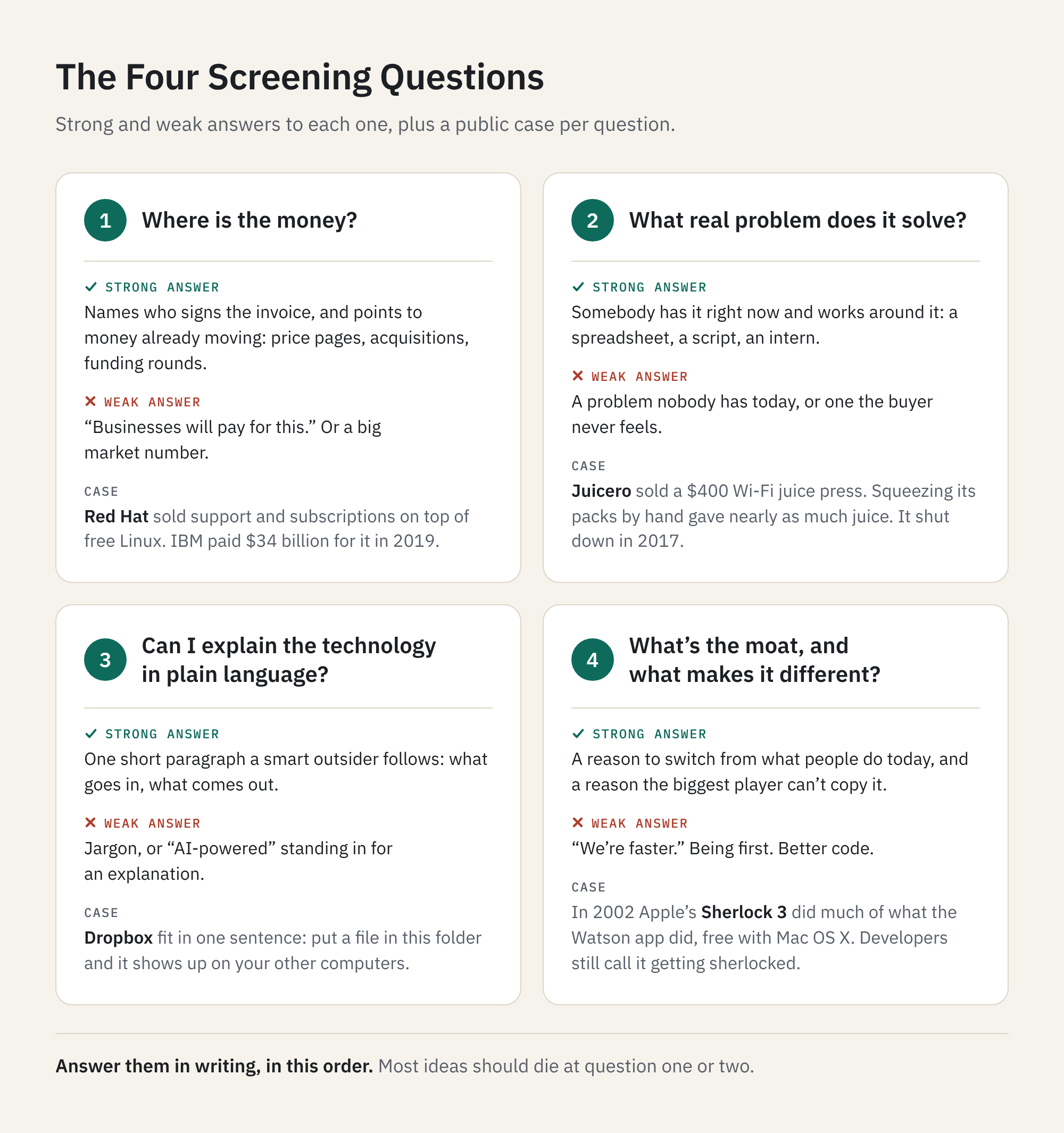
A brainstorm is the cheap part. An hour gives me a page of ideas (products, tools, the odd technology bet, now and then a whole company). On the page they all look good. Building any one of them takes weeks, often months. So nothing gets built until it answers four questions in writing. Where is the money? What real problem does it solve? Can I explain the technology in … [Read more...] about Screening Startup and Product Ideas After a Brainstorm: Four Questions, Money First
Multivergence Gives AI Agents Forkable State to Try Several Plans Before Committing to One
Good agents, like good planners, keep options open. A coding agent tries three fixes for a bug. A travel agent holds four venue bookings until the client decides. An on-call agent weighs competing explanations for an outage while the evidence trickles in. The trouble is where those alternatives live. Usually in the prompt, which isn't state at all, or in full copies like git … [Read more...] about Multivergence Gives AI Agents Forkable State to Try Several Plans Before Committing to One
Inorderly Puts Late, Duplicated and Out of Order Events Into One Sequence That Replays Byte for Byte
Events rarely arrive in the order they happened. Webhooks get retried, so the same event shows up twice. Device clocks drift, so a payment looks older than the order it paid for. A market feed handler sees tick 88 before tick 87. Most teams patch it with a dedupe table, a sort buffer and a timeout, and the patch mostly works. The trouble shows up on the second run. A backfill, … [Read more...] about Inorderly Puts Late, Duplicated and Out of Order Events Into One Sequence That Replays Byte for Byte
CodeInstances Keeps a Program Run as a File You Can Replay Offline, Compare and Shrink
Code is versioned, reviewed and kept for years. Its runs are thrown away. When a run fails, it leaves a log line and a guess. A CI test fails at 3 a.m. and the run is stuck on one machine. An API answered oddly once and never again. A maintainer gets an issue saying "sync breaks against our account" and has no way into the reporter's account. CodeInstances keeps the run. It … [Read more...] about CodeInstances Keeps a Program Run as a File You Can Replay Offline, Compare and Shrink
TaskFused Runs Duplicate Requests Once and Shares the Result With Every Caller
Work gets asked for more than once all the time. A user double-clicks Export. A client times out and retries while the first request is still running. Ten dashboards ask for the same monthly report at nine in the morning. Each copy burns the same CPU, the same API calls and the same database load, and sometimes the copies get in each other's way. With paid AI model calls or … [Read more...] about TaskFused Runs Duplicate Requests Once and Shares the Result With Every Caller
