When Stephen M. Carmel addressed industry leaders at the CMA Shipping Conference, his message was interpreted in many summaries as a call to rebuild American shipbuilding. But that reading misses the deeper substance of what he was actually describing. Carmel was outlining a structural diagnosis of the American maritime decline — and more importantly, explaining why traditional industrial responses have repeatedly failed.
The central insight of Carmel’s remarks is not about ships at all. It is about systems. Maritime power, in Carmel’s formulation, is not a shipyard problem but a network problem. The United States does not simply lack ships. It lacks the interlocking commercial architecture that produces ships as a natural consequence of trade activity.
Shipyards do not exist in isolation. They are the industrial byproduct of cargo flows, logistics networks, port ecosystems, maritime finance, trained labor, and commercial fleets that generate continuous demand for vessel construction. In countries that dominate maritime industries today, those components reinforce each other in a self-sustaining cycle.
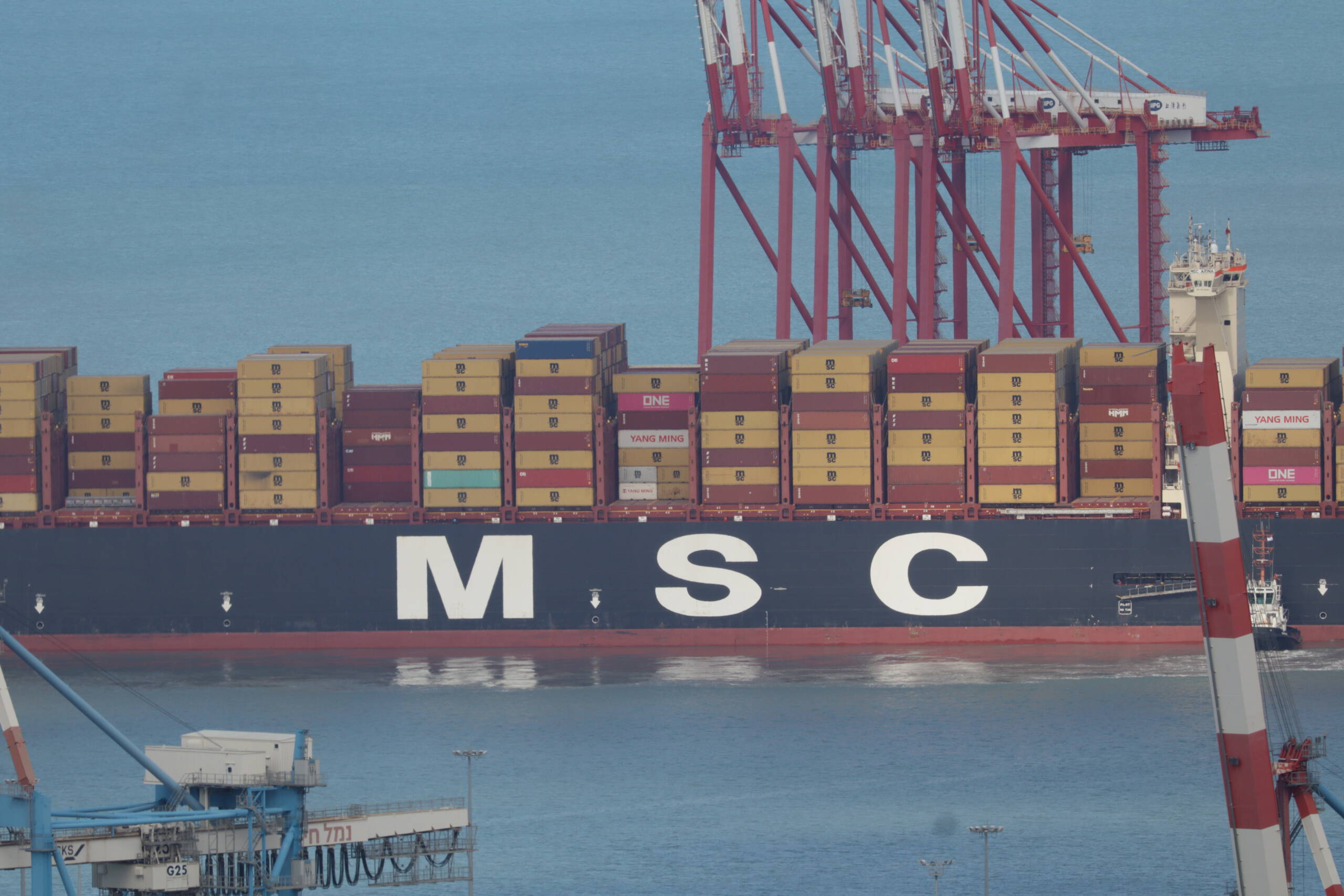
The United States once had such a system. It no longer does.
Understanding the implications of that observation requires stepping back from shipyards and examining the entire maritime stack.
At the base lies trade architecture — the pattern of global commerce that determines where goods move and which countries become maritime hubs. Above that sits port infrastructure and logistics integration. These create the physical and digital gateways through which cargo flows. On top of those layers sit shipping companies and merchant fleets that transport the cargo. Only after those elements exist does a shipbuilding industry emerge to supply vessels.
American maritime policy over the past half century has largely attempted to revive the top layer — shipbuilding — without rebuilding the layers underneath.
The result is predictable: shipyards struggle because they lack a sustained commercial order book. Without merchant fleets expanding or renewing vessels, shipyards rely heavily on naval contracts and protected domestic trades governed by the Merchant Marine Act of 1920.
Carmel’s speech implicitly acknowledges that this model cannot produce maritime scale. It preserves a narrow domestic sector but does not rebuild global competitiveness.
To grasp how maritime systems actually evolve, Carmel pointed to two historical turning points that reshaped global shipping — both of which were systemic innovations rather than technological breakthroughs.
The first occurred in the early nineteenth century when the Black Ball Line introduced scheduled transatlantic shipping between New York and Liverpool. Before that moment, merchant ships sailed whenever cargo was assembled. The Black Ball Line reversed the logic. Ships sailed on fixed dates regardless of cargo loads.
Predictability created trust. Trust generated cargo commitments. Cargo volume justified larger fleets. Fleet expansion stimulated shipbuilding.
The revolutionary idea was not a vessel design. It was a logistics concept.
The second transformation came with containerization, pioneered by Malcom McLean. McLean did not invent containers, cranes, or cargo ships individually. His innovation was to integrate them into a unified system that linked ships, ports, trucks, and rail networks.
The container system did more than accelerate shipping. It reorganized global manufacturing, reshaped port geography, and enabled supply chains to operate on planetary scale.
Once again, the decisive factor was the system rather than the hardware.
Carmel’s remarks suggest that the United States must rediscover this systems mindset if it hopes to rebuild maritime capacity in the twenty-first century.
But doing so will require confronting uncomfortable realities about the current structure of global shipping.
Today the overwhelming majority of commercial vessels are built in East Asia. China, South Korea, and Japan dominate global shipbuilding not merely because of cost advantages but because they possess fully integrated maritime ecosystems. Their ports rank among the busiest in the world. Their shipping companies control large portions of global cargo flows. Their financial institutions specialize in maritime lending. Their governments coordinate industrial policy with export trade.
Shipyards in those countries operate at the center of maritime clusters that encompass technology firms, classification societies, maritime universities, and logistics conglomerates.
By contrast, the American maritime landscape is fragmented.
Ports are often governed by local authorities pursuing regional priorities rather than national strategy. Most international cargo arriving in the United States travels on foreign-flag vessels. Ship financing largely occurs through foreign lenders. American shipyards rarely participate in global commercial markets.
The United States therefore faces a paradox: it remains one of the largest trading economies in the world but has only a marginal presence in the industries that physically move that trade across oceans.
This disconnect has strategic consequences that extend beyond economics.
Commercial shipping forms the logistical backbone of military power. In times of conflict, the ability to move equipment, fuel, and supplies across oceans becomes essential. The United States has historically relied on its merchant marine to provide surge capacity for military logistics.
However, the size of the U.S.-flag merchant fleet has declined dramatically since the mid-twentieth century. Many policymakers now worry that sealift capacity could become a constraint in large-scale conflicts requiring sustained overseas deployment.
Carmel’s argument therefore intersects with broader concerns within defense and industrial policy circles: maritime capability cannot be regenerated quickly during crises. It must exist continuously as part of the national economic infrastructure.
Yet rebuilding that infrastructure presents formidable obstacles.
The first challenge is cargo control. Modern shipping is dominated by global carriers whose networks span continents. American cargo owners frequently rely on foreign carriers because those carriers operate the most extensive and efficient logistics systems.
Without cargo commitments, new American merchant fleets would struggle to compete economically.
The second challenge is port integration. Many American ports remain operationally successful but structurally fragmented. Global maritime hubs increasingly function as integrated logistics platforms linking container terminals, rail corridors, distribution centers, and digital supply-chain management systems.
Ports that cannot operate within these integrated systems risk becoming endpoints rather than nodes in global logistics networks.
The third challenge is maritime finance. Building commercial vessels requires long-term financing frameworks that combine government support, private capital, and maritime insurance structures. Countries that dominate shipbuilding possess sophisticated maritime banking sectors capable of funding fleets and shipyards simultaneously.
The United States lacks comparable depth in maritime finance.
Workforce development is another constraint. Shipbuilding and maritime engineering require highly specialized skills. Many countries that lead in shipbuilding maintain dedicated maritime universities and training systems that continuously supply skilled labor.
American maritime education institutions exist but operate at far smaller scale relative to global competitors.
Finally, technological transition adds complexity. The next generation of shipping will likely incorporate alternative fuels, autonomous navigation, digital logistics platforms, and advanced port automation. Countries investing heavily in maritime technology may gain advantages that extend far beyond ship construction.
Against this backdrop, Carmel’s call for rebuilding the maritime system reads less like a policy recommendation and more like a strategic framework for understanding the problem.
The critical question then becomes whether the United States can realistically reverse decades of maritime decline.
From an industry perspective, the answer depends on whether policymakers are willing to pursue systemic maritime strategy rather than incremental policy adjustments.
The likelihood of a full maritime revival in the near term is modest. Maritime ecosystems take decades to develop. East Asian dominance emerged through sustained investment over half a century, aligned with export-driven economic strategies.
However, several factors could create conditions for partial reversal.
First, geopolitical competition is reshaping supply chains. Companies are reconsidering dependence on single-country manufacturing networks. If supply chains diversify geographically, new cargo patterns may emerge that could support expanded American maritime participation.
Second, national security concerns are increasingly influencing industrial policy. Governments may view maritime capacity as strategic infrastructure rather than purely commercial activity.
Third, technological shifts could reduce some structural disadvantages. Automation and digital logistics platforms may allow new maritime clusters to emerge without replicating every feature of traditional shipbuilding ecosystems.
Even under optimistic scenarios, though, rebuilding maritime capacity will require sustained political commitment over decades.
Shipyards alone cannot generate maritime power. Ships follow cargo. Cargo follows trade networks. Trade networks follow economic strategy.
Carmel’s remarks effectively remind policymakers that maritime strength is not an industrial sector but a living system. Systems grow slowly, accumulate capability over time, and decline gradually when neglected.
Reversing that decline is possible — but only if the United States decides to rebuild the entire oceanic architecture that once made it a maritime nation.
