The industrial robot market is now a two-speed story. China keeps adding robots at a pace nobody else comes close to, and the rest of the world is roughly treading water. The International Federation of Robotics counted 603,307 new industrial robots installed worldwide in 2025, up 11% on the year. China alone took 354,000 of them. That is 59% of every new robot bolted to a factory floor anywhere.
When this page first ran, on 2022 numbers, the headline was Japan’s surge and China’s 52% share. Three years on, Japan has slipped to third, the United States has moved into second place, and China’s share has grown again. Here is how the map has changed.
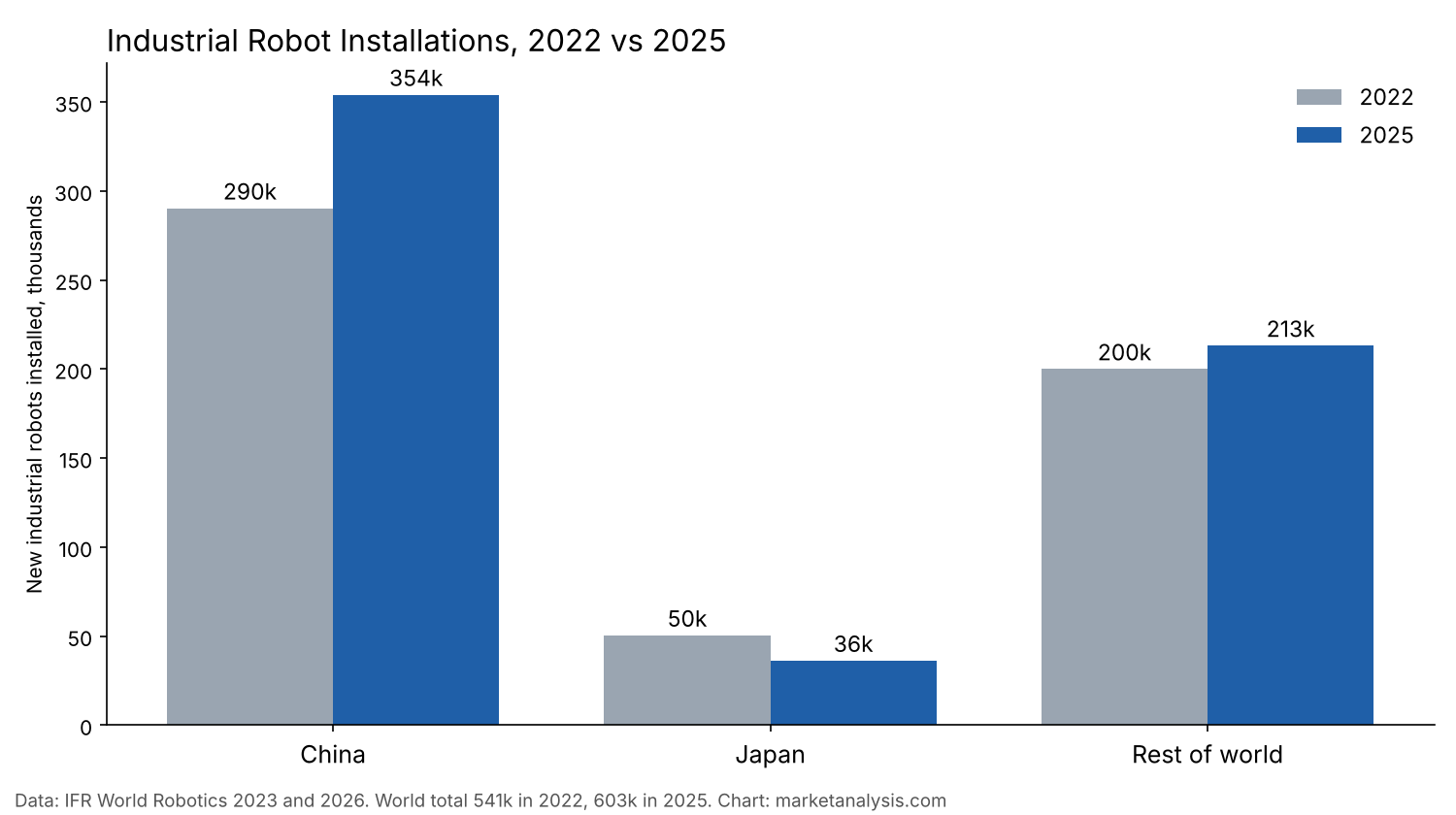
Industrial Robot Installations by Country, 2022 and 2025
| Market | 2022 installs | 2025 installs | Change in 2025 |
|---|---|---|---|
| World | 540,625 | 603,307 | +11% |
| China | 290,258 | 354,000 | +20% |
| United States | about 40,000 | 38,400 | +12% |
| Japan | 50,413 | 36,219 | −19% |
The installed base passed 5 million robots in 2025, up 9%. The IFR expects 655,000 new installations in 2026 and about 806,000 a year by 2029.
China Is Now Most of the Market
A 20% jump on a base that was already more than half the world is hard to read as anything other than policy plus price. Chinese robot makers have cut prices hard, local buyers get subsidies and cheap credit, and electronics, batteries and EV plants keep expanding. Foreign brands still hold the high end, but domestic suppliers now take a growing share of the volume.
For anyone selling robots, servo motors, reducers or vision systems, China is no longer one big market among several. It is the market, and it is increasingly served by Chinese vendors. That squeezes margins at Fanuc, Yaskawa, ABB and KUKA even when global unit numbers look healthy.
The US Overtakes Japan
US installations rose 12% to 38,400. The interesting part is where they came from. Car plants, the traditional robot buyer, were flat to down, with automotive installs at about 13,500 (−1%). Growth came from food, warehousing and logistics, and medical and lab work. That is a broader and probably more durable base than one industry’s model cycle. Reshoring, tariffs and a tight labour market all push the same way.
Japan and Europe Lose Ground
Japan installed 36,219 robots, down 19%, and a long way below the 50,413 of 2022. Japanese manufacturers are still huge robot makers. As buyers, though, they are investing less at home. The EU fell 11%, with German auto and machinery plants cutting spend as energy costs and weak demand bite.
Worldwide, automotive installations were still up about 10%, mostly thanks to Chinese EV capacity. Car makers are still automating. They are just doing more of it in China.
What It Means for Investors
- Volume is not profit. More robots in China does not mean fatter margins for the incumbents. Watch pricing and mix in the Japanese and European suppliers’ results.
- The US story is about new users. Logistics, food and healthcare automation favour mobile robots, cobots and software-heavy systems over classic welding arms.
- Humanoids sit on top of this. The same supply chain of actuators, reducers and sensors feeds the humanoid push, where China is also moving fastest. Our pieces on Skild AI’s funding round and Project Prometheus cover the AI side of that shift.
More robotics coverage is in our Robotics and Industry section, and on the technology side at technologies.org.
