Walking into Van Gogh Alive feels less like entering a museum and more like stepping inside a calibrated machine for attention, emotion, and throughput. The image captures this perfectly: a darkened hall punctuated by towering rectangular columns, each wrapped in high-resolution projections of Van Gogh’s brushwork. Thick greens and turbulent blues ripple vertically, the paint strokes enlarged far beyond their original canvas scale, turning texture into architecture. Visitors move slowly between these luminous pillars, their silhouettes cutting across cypress trees, wheat fields, and night skies, briefly becoming part of the composition themselves. Overhead, the ceiling disappears into black, rigged with lighting trusses and projectors, a quiet reminder that this “world” is powered less by oil paint and more by synchronized hardware, software, and logistics. Some people pause to photograph the spectacle, others simply stand still, absorbed, while the images cycle with mechanical precision. It’s beautiful, undeniably so—but it’s also extremely engineered.
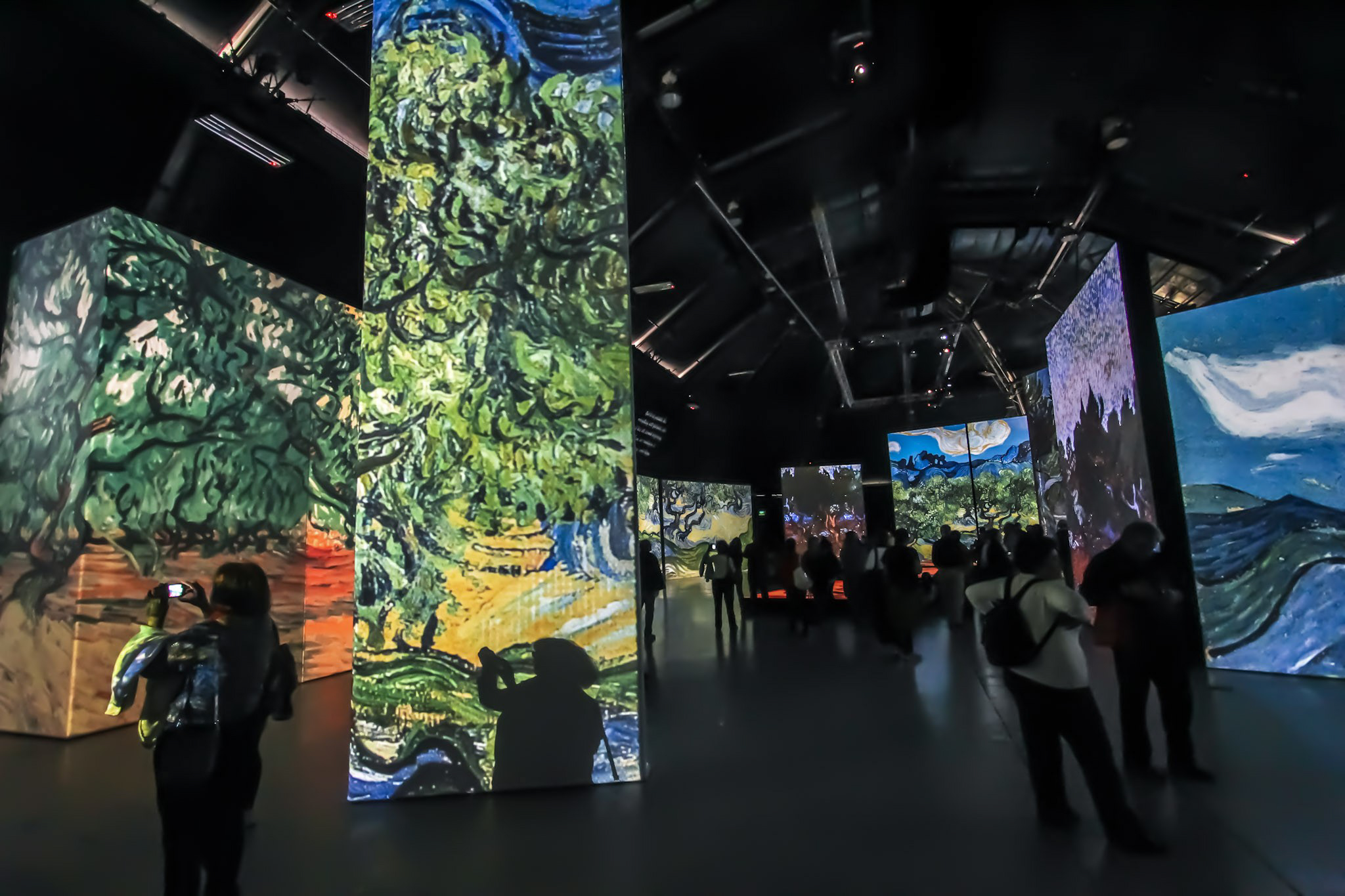
From a market analyst’s perspective, Van Gogh Alive represents a mature, almost frictionless business model for cultural consumption. Unlike traditional museums, it carries no permanent collection, no conservation costs, no long-term curatorial obligations. The intellectual property—Van Gogh’s work—is in the public domain, eliminating licensing friction while retaining instant global brand recognition. What remains is execution: projection systems, sound design, venue rental, ticketing, merchandising, and marketing. This is culture as a touring product, optimized for scalability. Once the core audiovisual package is built, it can be redeployed city after city with marginal costs far lower than those of conventional exhibitions. The exhibition’s success is not measured in scholarly contribution or collection depth, but in visitor numbers, dwell time, Instagram reach, and revenue per square meter.
The image underscores another crucial element: immersive exhibitions monetize space differently. Instead of walls displaying discrete works, space itself becomes the exhibit. Vertical columns multiply usable projection surfaces without expanding floor area, increasing visual density and perceived value. The visitor flow is loose but controlled; people circulate rather than queue, which psychologically reduces friction and increases satisfaction while still allowing high attendance volumes. This design supports a broad demographic—from art-curious tourists to families and first-time museumgoers—lowering the intimidation barrier often associated with “high art.” In doing so, the exhibition captures audiences that traditional museums sometimes struggle to reach, converting cultural curiosity into ticket sales with impressive efficiency.
Yet this efficiency comes with trade-offs. Immersive shows like Van Gogh Alive decouple art from material authenticity. There is no original canvas here, no aura of proximity to the artist’s hand. Instead, value is generated through spectacle, narrative pacing, and sensory saturation. For operators, this is a feature, not a flaw. The experience is standardized, predictable, and brand-safe. For museums watching from the sidelines, however, it poses a strategic dilemma. These exhibitions compete for leisure time and discretionary spending while operating outside the traditional museum economy. They do not need donors, long-term memberships, or academic credibility to succeed. They need foot traffic, strong visuals, and a recognizable name.
Seen in this light, Van Gogh Alive is less an exhibition and more a case study in how technology reshapes cultural markets. It demonstrates how art history can be repackaged as an experiential product, how public-domain masters can anchor global touring franchises, and how immersive technology converts emotional impact into repeatable revenue. The glowing columns in the image are not just screens; they are balance-sheet assets, projecting both brushstrokes and a future where museums must decide whether to compete, collaborate, or consciously differentiate themselves from this new, highly profitable species of cultural experience.
Immersive Media Is More Accommodating: A Crowd at MoMA, New York
The photograph gains a sharper edge once you name what everyone is pressing toward. This is not just any painting drawing the crowd into a tight knot of bodies and raised phones—it is Vincent van Gogh’s The Starry Night. A canvas so culturally overdetermined that its physical size feels almost like a contradiction: small, quiet, fragile, hanging on a white wall while dozens of people negotiate for a few seconds of unobstructed vision. In the image, the painting itself is barely visible, swallowed by human density, its swirling blues and yellows reduced to a distant rectangle glimpsed between shoulders. What dominates the scene instead is the choreography of access: people leaning forward, holding phones aloft as prosthetic eyes, documenting proof that they were close enough, briefly, to one of the most famous images in Western art.
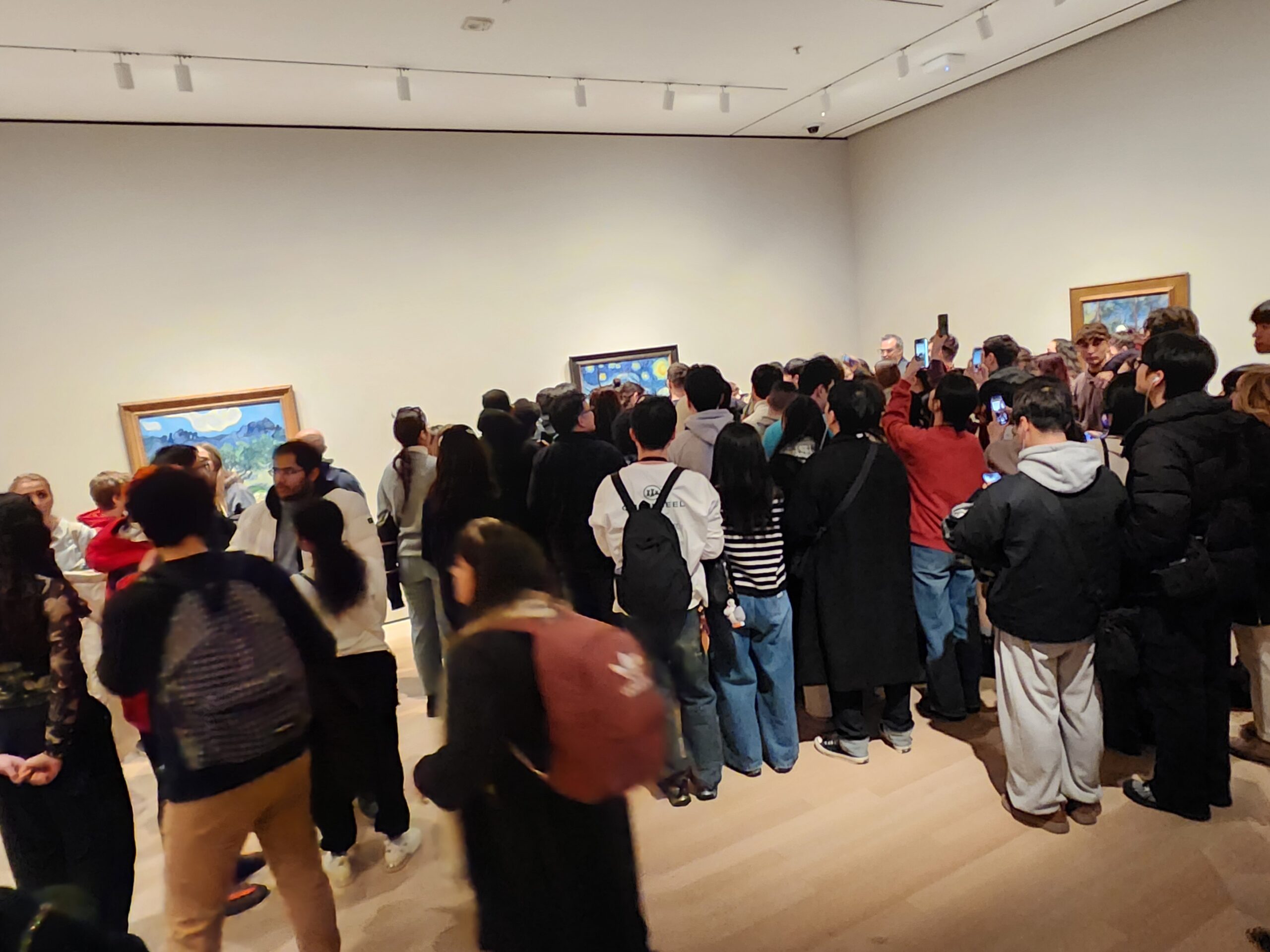
From a market and systems perspective, this is the purest demonstration of the limits of object-based display. The Starry Night is singular by definition—one original, one location, one optimal viewing zone. Its aura depends on that singularity, yet that same condition produces congestion, frustration, and unequal experience. Only a few visitors can truly “see” the painting at a time; the rest experience it socially, indirectly, or through screens. The museum absorbs this friction as part of its prestige economy, but it also pays for it in crowd stress, reduced dwell quality, and a visitor experience that often feels more competitive than contemplative.
Immersive media approaches Van Gogh from the opposite direction. Instead of concentrating value into a single object, it diffuses it across space, scale, and time. In immersive Van Gogh exhibitions, The Starry Night is no longer a bottleneck—it becomes an environment. The sky expands to fill walls, the brushstrokes grow architectural, and hundreds of visitors can occupy the same moment without blocking one another. No one needs to fight for the front row because there is no front row. From an operational standpoint, this is profoundly accommodating: higher throughput, smoother circulation, fewer stress points. From the visitor’s perspective, it feels oddly democratic, even generous, as if the artwork has adapted to modern crowds rather than demanding that crowds adapt to it.
This is not a claim that immersive versions replace the original The Starry Night. The painting at MoMA retains its historical gravity and symbolic power precisely because it is the object. But the image of that crowded gallery makes the trade-off unmistakable. Traditional museums preserve authenticity by accepting physical scarcity; immersive media preserves emotional impact by engineering abundance. In an era of mass cultural tourism and attention saturation, immersive formats align more naturally with how people move, look, and gather. The crowd around Van Gogh’s original shows us the problem we’ve learned to tolerate. Immersive media, especially when built around artists like Van Gogh, quietly proposes a different equation—one where access scales, space relaxes, and wonder doesn’t require elbowing your way to the wall.
