The five largest cloud providers are on track to spend roughly $600 billion on infrastructure this year, and the broader hyperscaler group closer to $710 billion. Every dollar of that lands somewhere physical: a building, a transformer yard, a battery room, a rack of GPUs worth more than the concrete around them. Someone has to insure it. Increasingly, nobody can.
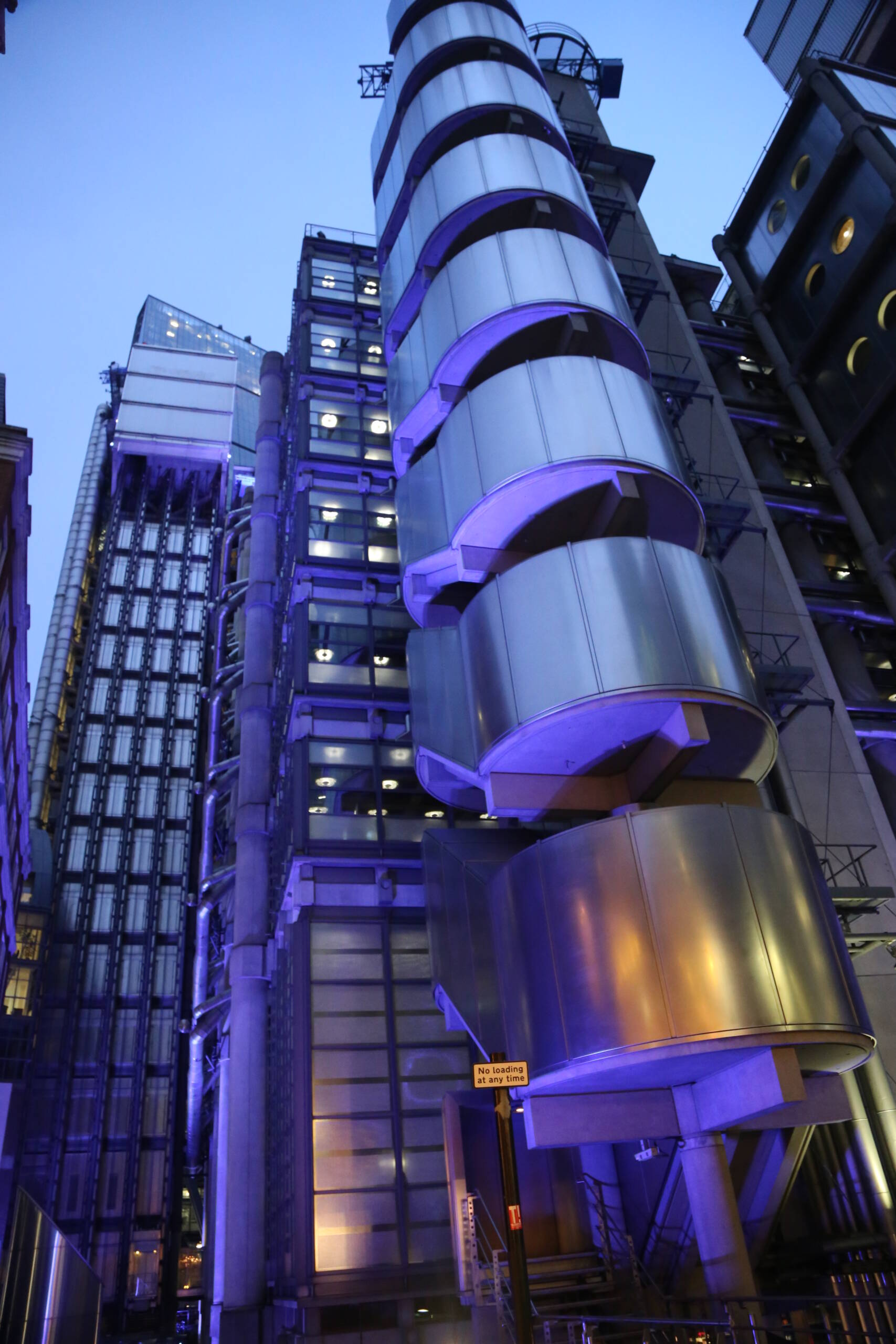
Lloyd's Building, London
The gap is not subtle. S&P Global Ratings puts the insurable value of the largest individual data center projects at as much as $30 billion. Swiss Re Corporate Solutions says a single hyperscale campus can now demand $20 billion in limits for the buildings alone. The largest dedicated facility in the market, Aon’s Data Center Lifecycle Program, tops out at $3.5 billion after two increases this year. Marsh’s Nimbus facility offers up to $2.7 billion. Munich Re, one of the largest reinsurers on earth, writes something in the region of $250 million net on a single data center construction project.
Do that arithmetic and the structure of the problem is obvious. Getting to $10 billion of cover on one site means stacking a tower across forty or more carriers. Getting to $30 billion is not a placement problem. It is an arithmetic impossibility at anything resembling competitive terms.
The Class Grew Faster Than the Capital Behind It
Zurich North America puts the average insured data center project value at around $3 billion today, up from roughly $150 million five years ago. That is a twentyfold increase in single-risk severity inside one underwriting cycle, in a class that most property carriers were treating as ordinary commercial real estate with better fire suppression.
The premium pool has followed, but nowhere near as fast. Roughly 11,000 data centers are in operation globally, representing an insurable asset base above $2 trillion. Swiss Re expects data center premium to grow from about $10.6 billion now to $24.2 billion by 2030. S&P estimates $10 billion in new premium generated in 2026 alone, which would be about twice the annual premium of the entire global aviation insurance market.
Twice aviation, in one year, from a class that did not meaningfully exist as a specialty line a decade ago. That is why every broker has launched a facility and every reinsurer has a data center team. It is also why capacity is rationed rather than priced: carriers are managing aggregate exposure, not chasing rate.
Where the Uninsured Layer Actually Sits
Value that no carrier will write does not vanish. It flows back to the sponsor, and this is the part that matters for anyone holding the paper.
Hyperscalers absorb it. Microsoft, Amazon, Alphabet and Meta run captives, hold enormous liquidity, and operate genuine redundancy across sites. A total loss at one campus is an earnings footnote for them, in the same way oil majors have self-insured deepwater projects for decades once commercial capacity ran out. For that cohort, the capacity ceiling is an inconvenience.
The problem sits one tier down. A growing share of construction is financed through special purpose vehicles backed by private equity, leveraged anywhere from 50% to 80% with debt. Those projects have no balance sheet to retain risk against. The uninsured layer shows up directly in the credit: lenders accept narrower protection on projects worth up to $10 billion, deductibles rise, and the residual exposure is reflected in the ratings of the debt the project issues. Data center asset-backed securitisations and private credit funds have absorbed a great deal of this paper on the assumption that the physical asset is fully covered. Often it is not.
Business Interruption Is the Coverage That Does Not Work
Property damage is rarely the loss at a data center. Downtime is. And the standard property policy requires physical damage before it responds at all.
Power supply causes about 45% of data center outages. A grid event, an ERCOT curtailment, a utility fault, or a cyberattack that disables cooling can shut a facility down for days without a single dollar of damaged property. Service level agreement penalties trigger. Training runs are lost. Nothing in a conventional property form pays for any of it. Non-damage business interruption exists in the market, but as a bought-back extension with sublimits that bear no relationship to the revenue at risk.
Valuation is the second problem. Revenue per square foot at a hyperscale AI facility resembles nothing else in the property book, and downtime is tied to compute capacity, power draw and campus interdependency rather than to floor area. Underwriters modelling it against conventional commercial benchmarks will get the number wrong in both directions.
Then there is contingent business interruption, which is where the loss actually propagates. A data center depends on third party power, water, fibre and cooling. A failure entirely off premises closes it as effectively as a fire. CBI cover is routinely sublimited and hedged with restrictive triggering conditions, and tenants running mission-critical workloads on someone else’s infrastructure are often carrying that exposure without knowing it.
New Physics, Repriced
The hardware changed and the loss profile changed with it, faster than wordings did.
- Direct liquid cooling now accounts for close to a quarter of total data center loss costs, per Swiss Re. Coolant leaks, manifold installation errors and pressurised line failures interacting with high-voltage equipment are failure modes that air-cooled policies were never priced for. Facilities converting mid-lifecycle and not resubmitting are exposed to a coverage argument they will lose.
- Lithium-ion batteries sit inside racks now. FM Global raised its 2026 loss prevention standard to require two-hour fire-resistance wall ratings, up from one, specifically because of thermal runaway in a room that previously contained no comparable ignition source.
- GPU replacement assumes market availability. Lead times on top-end accelerators run six to eighteen months depending on allocation. A replacement cost provision that presumes you can buy the part is a fiction in an allocation-constrained market, and the indemnity period runs regardless.
- Around 64% of capacity under construction this year sits outside traditional hubs like Northern Virginia, pushing into interior markets where severe convective storms are routine. Tornado at a construction site was among the leading causes of loss in Zurich’s US builders risk book last year.
- Clustering compounds all of it. Abilene, Texas and the Virginia corridor concentrate correlated exposure such that one storm or one grid event can hit multiple insured sites at once.
The Fab Version of the Same Problem
Semiconductor manufacturing has been running this experiment for years, and the results should worry anyone underwriting compute.
At a fab, business interruption is the loss. Property damage is trivial by comparison. Work in progress is scrapped, tools fall out of calibration, cleanrooms need requalification. TSMC’s April 2024 Taiwan earthquake produced structural damage that was largely cosmetic and a reported hit of about $92.4 million net of insurance, almost all of it wafer loss and downtime rather than buildings.
The July 2026 magnitude 7.1 quake in Kumamoto was the cleaner illustration. Attention went to TSMC’s JASM fab, which inspected its structures and resumed. The commercially significant disruption came from Tokyo Electron Kyushu, which suspended its Koshi and Ozu plants for precautionary inspection. Tokyo Electron held roughly 91% of the coater/developer market in 2025, and coater/developer systems touch every wafer made anywhere on earth.
Now read a typical contingent business interruption wording. It requires physical damage at a named supplier’s premises. Tokyo Electron reported no major damage and stopped voluntarily to inspect. Under most forms, that combination triggers nothing at all. Worse, CBI schedules name direct suppliers, not the supplier’s supplier, and the chokepoint in this industry is almost always two or three tiers up from where the schedule stops.
Verisk put insured property losses from Kumamoto at between roughly $1.4 billion and $2.1 billion. The economic disruption running through the chip supply chain is not in that number and largely will not be recovered.
What the Market Is Building, and Why It Is Not Enough Yet
The response so far is structural rather than additive. Aon’s lifecycle program went from $1.5 billion at launch to $2.5 billion in January to $3.5 billion in April, and extended into operational property and business interruption to close the gap where builders risk terminates at completion and the equipment-loaded campus sits briefly under nothing. Willis has a comparable facility above $3 billion. Advanced Technology Assurance has launched a consortium program backed by Arch, Munich Re, SCOR and Lloyd’s syndicates that folds property, hardware, cargo, cyber, technology E&O, environmental and terrorism into a single contract.
Parametric cover is filling the non-damage hole, paying on a measured trigger rather than an adjusted loss: tornado during construction in West Texas, flood in Northern Virginia, grid-mandated shutdown during a deep freeze. It is fast money and it does not argue about physical damage, which is exactly what an outage loss needs.
And the capital markets have started, barely. Hannover Re moved cloud outage exposure to investors this year through Cumulus Re, a catastrophe bond of $35 million. Thirty-five million against a $2 trillion asset base is a pilot, not a solution, but it is the right direction. Property catastrophe risk only became insurable at scale once it was securitised.
The Trade
Three things follow for anyone with exposure to this buildout.
First, the brokers are the clean way to own the growth. Aon, Marsh McLennan and WTW collect fees on placements whose limits are rising twentyfold without taking the underwriting risk. Data center is one of the few genuinely new specialty lines with a decade of visible premium growth ahead.
Second, the pricing has never been tested. There has been no mega-loss in this class. No $5 billion single-site event, no correlated regional outage, no litigated non-damage BI claim of consequence. Rates and terms today reflect competition for a growth line, not experience. The first serious loss will reprice the class and, more importantly, will reprice the debt of every levered developer whose lender accepted narrow protection.
Third, watch the credit rather than the equity. Hyperscaler self-insurance is rational and their balance sheets can carry it. The SPV-financed, 70% levered projects funding a large share of this construction cannot. The insurance ceiling is a hidden leverage constraint on the marginal builder, and the marginal builder is the one setting compute prices two years from now.
