In July 2025 this page argued that AMD, then trading near $146, could reach $250 as its Instinct AI accelerators caught on. It did, and then some. The stock went through $250 before the end of 2025 and spent most of November 2026 swinging around $500. So the old question is settled. The new one is whether the data center ramp can carry the next leg, now that analysts are writing $600 targets.
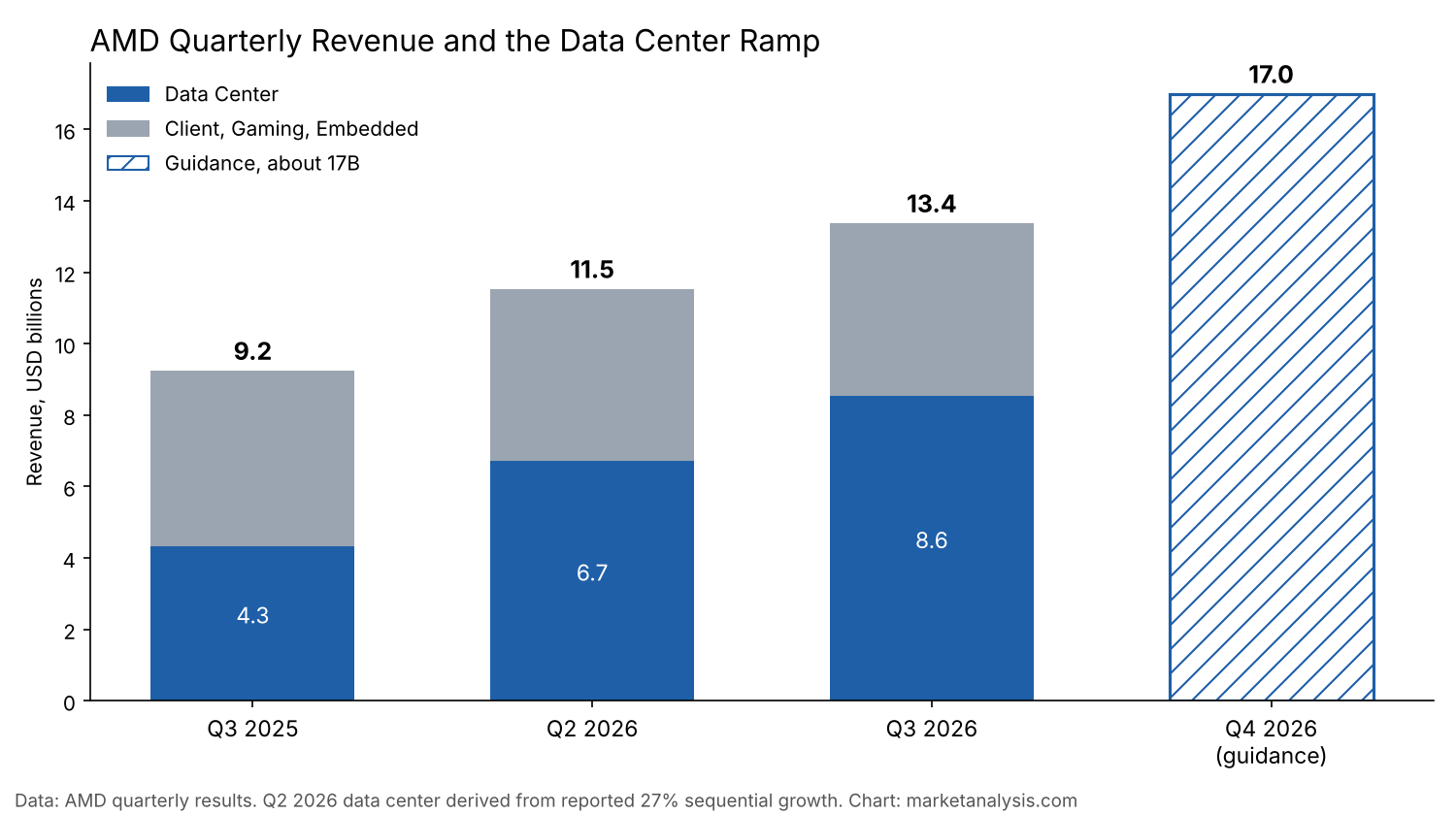
The Q3 2026 numbers, reported on November 3, say the ramp is real. Revenue hit a record $13.4 billion, up 45% on the year. Data Center revenue nearly doubled to $8.5 billion, up 97%, and now makes up about 64% of the company. Management guided Q4 to roughly $17 billion.
AMD Q3 2026 Results at a Glance
| Metric | Q3 2026 | Year earlier |
|---|---|---|
| Revenue | $13.4B | $9.2B (+45%) |
| Data Center revenue | $8.5B | $4.3B (+97%) |
| Data Center operating margin | 34% | 25% |
| Client and Gaming revenue | $3.7B | −8% |
| Gross margin (non-GAAP) | 56% | |
| EPS (non-GAAP) | $2.09 | +74%, vs $1.94 expected |
| Q4 2026 revenue guidance | about $17B |
What Drove the Quarter
Two products did the work. The Instinct MI450 series started shipping in volume, and 5th Gen EPYC server CPUs kept selling hard, partly because agentic AI workloads need a lot of general-purpose compute next to the GPUs. Data Center revenue grew by about $4.2 billion on the year, which is more than the whole company grew. Everything else, taken together, shrank.
The customer list matters as much as the dollars. AMD named Anthropic and Meta among the buyers, and in November said its EPYC chips host Google Cloud’s TPU 8tx systems. Being the CPU next to someone else’s accelerator is a quiet but sticky business.
What Could Go Wrong
- Cash flow. AMD built a lot of inventory ahead of the Helios rack and MI450 ramp. If shipments slip, that stock sits on the balance sheet.
- The rest of the company is weak. Client and Gaming fell 8%. Memory costs are rising fast, which hurts PC and console margins. Our piece on why memory prices won’t come down explains the squeeze.
- Valuation and rates. At around 60 times this year’s adjusted earnings, AMD trades on next year’s numbers. When ten-year yields pushed above 5% in mid-November, chip stocks with rich multiples fell first.
- Politics and power. The stock dropped 17% on November 5 after the midterm results raised fears of limits on new data center construction. Any capex pause at the hyperscalers hits AMD’s newest and most profitable revenue.
- Nvidia. AMD is gaining share from a small base. Nvidia still sets the pace in software, networking and rack-scale systems. See our Nvidia earnings analysis for the other side.
The Bull Case for 600 Dollars
Oppenheimer upgraded the stock on November 9 with a $600 target, and others have gone higher. The logic is simple. If Q4 lands near $17 billion and Data Center keeps compounding through the Helios rollout in 2027, earnings per share could roughly double again, and the multiple can come down while the price still rises. That is what happened between July 2025 and now.
The bear case is just as simple. AMD is priced for the ramp to go right, and the ramp depends on hyperscaler budgets that are already huge. Watch our AI Capex Tracker for the spending side and the AI Market Analyzer for how stretched sentiment is across the sector.
This is analysis, not investment advice.
