Two pieces of news landed within days of each other, and they point in opposite directions. American factories want more robots. Washington wants fewer of them to come from China.
The Association for Advancing Automation (A3) says North American companies ordered 10,989 robots worth $723.5 million in the third quarter of 2026. That is 24.8% more units and 26.1% more value than a year earlier, and the strongest quarter of the year so far. Labor shortages in manufacturing are the main reason buyers give. Meanwhile technical staff at several Chinese humanoid robot makers, Xpeng among them, have been refused US visas ahead of CES in Las Vegas in January. Their companies planned to show hardware there. Now they may be showing it with nobody from engineering at the booth.
Put the two together and you get the shape of the robot market for 2027. Demand in the US is real and accelerating. The cheapest and fastest-growing supply base in the world is being walled off.
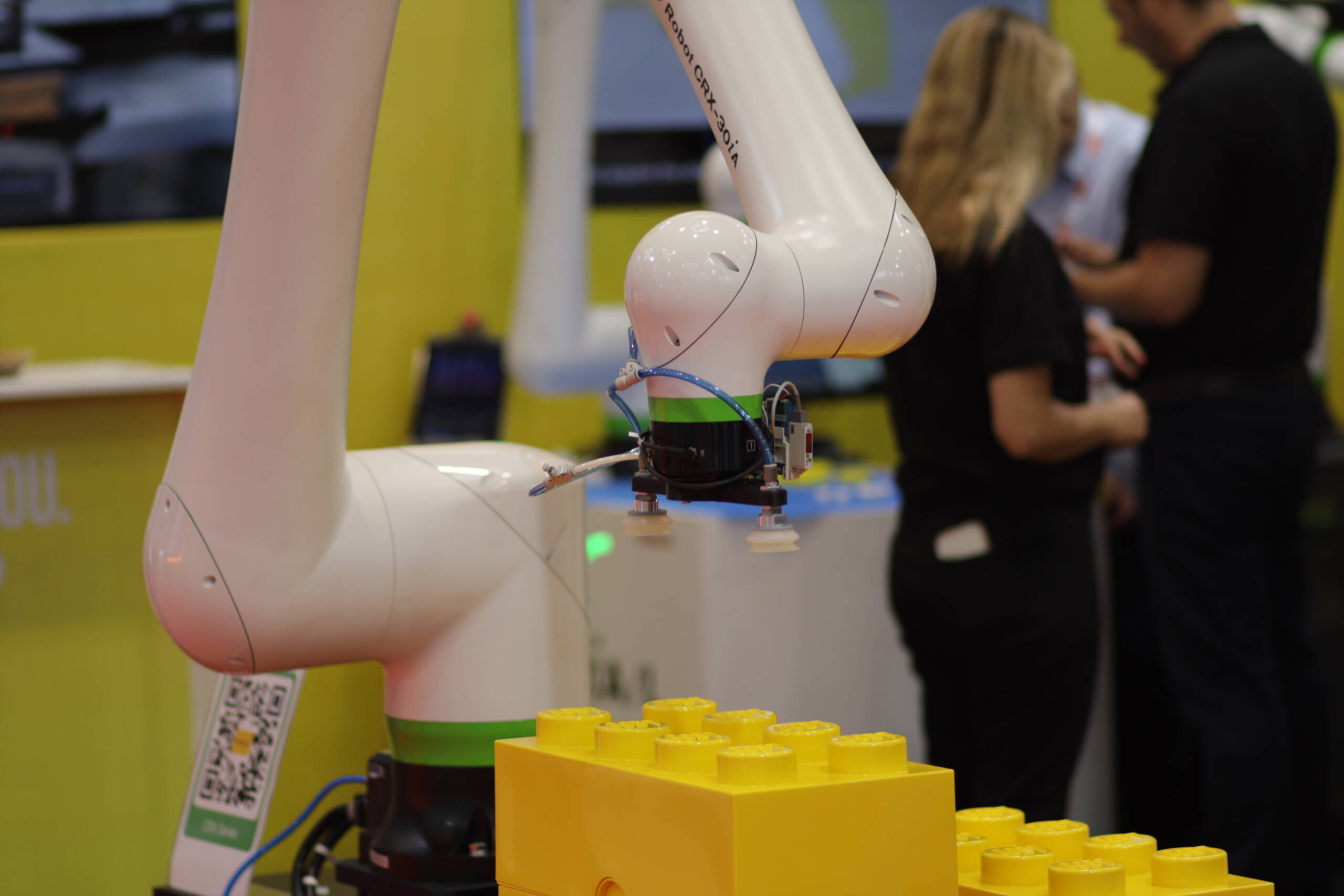
The Q3 Order Numbers
The first half of 2026 was flat-ish. Orders for January to June came to 17,995 robots, up just 2% in units. Q3 changed the pace. Nine-month totals now stand at 28,984 robots worth about $1.89 billion, up 9.6% in units and 13.3% in value.
Where the growth came from matters more than the headline:
- Automotive components: orders up 90.4%. Suppliers are automating harder than the carmakers they sell to.
- Automotive OEMs: back to growth in Q3 at +7.5%, after falling in the first half. Through nine months they are still 17% below last year.
- Semiconductors, electronics and photonics: +97.6% in units. This is the reshoring money (fabs, packaging lines, electronics assembly) turning into equipment orders.
- Plastics and rubber: +67.7%.
- Life sciences, pharma and biomed: +38.7%, helped by domestic drug manufacturing investment.
Collaborative robots, the small arms that work next to people, did well too. 1,831 cobots worth $63.8 million were ordered in Q3, up about 56% in units. In life sciences cobots made up 43.8% of all robot orders over nine months, and 36.9% in semiconductors and electronics. Small batches, clean rooms, frequent changeovers. That’s cobot territory.
A3 still flags higher input costs, trade uncertainty and the timing of big factory projects as things to watch. Fair. A single strong quarter driven by a few large projects can reverse. But the breadth this time (eight sectors, not just autos) is what makes it look like a trend rather than a blip.
The Other Front, Keeping Chinese Robots Out
The visa refusals are the latest step in a policy line that has been hardening all year. On July 28, 2026 the administration banned imports of new humanoid and quadruped robot models from foreign manufacturers, calling them an unacceptable national security risk. Models already sold in the US were exempted. China wasn’t named, but nobody was confused about the target. Chinese companies shipped around 90% of the world’s humanoids last year, and the US was their biggest overseas market.
CES agents warned Chinese exhibitors over the summer: if you already sell a robot in the US you can bring it to the show; if this is your first time, your machine may not clear customs. Now the people who were supposed to run the demos can’t get in either. For a humanoid maker CES is not a marketing extra. It is where investors, distributors and developers see whether the robot actually walks.
Xpeng is a good example of what is at stake. Its robotics unit raised more than $900 million at a $6.3 billion valuation in August. Its humanoid, IRON, is supposed to reach mass production by the end of 2026, with customer deliveries in 2027 and overseas sales part of the plan. The US part of that plan now looks closed for the foreseeable future. Unitree, which is preparing an IPO, faces the same wall.
We’ve seen visa trouble at CES before. Ahead of CES 2025 many Chinese exhibitors reported refusals despite holding invitations. The difference now is that it sits next to an import ban, so it reads less like friction and more like a policy package.
Who Gains From a Split Market
Short term, the winners are fairly obvious. Japanese and European industrial robot makers (Fanuc, Yaskawa, ABB, and others) sell into exactly the sectors that drove Q3. They don’t face the humanoid ban, and US buyers worried about Chinese hardware have fewer alternatives. KUKA is a complicated case, German-made but owned by China’s Midea since 2017. Watch how US customers treat it.
In humanoids, the ban hands the US market to a small group of American players (Figure, Agility, Apptronik, Tesla with Optimus) that ship tiny volumes today. In 2025 Unitree and AgiBot each shipped over 5,000 humanoids. Figure and Agility were at roughly 150 each. Protection buys the US firms time. It does not buy them scale, and scale is what pushes cost per working hour down. We covered that gap in detail in Humanoid Robots in 2026, Who Ships the Most, China vs US Leaders and the Price That Unlocks Scale.
Longer term the picture is murkier. China installed 59% of all new industrial robots in the world in 2025, and the US only just passed Japan for second place (see Industrial Robot Market 2026, China Installs 59% of New Robots as the US Overtakes Japan). Chinese makers learn on a home market far bigger than anyone else’s. Many of them are already turning to Europe as their main export destination. If European factories end up running cheaper Chinese humanoids while American ones pay more for local models, the ban protects suppliers at the expense of US manufacturers’ costs. That trade-off hasn’t been argued out in public yet.
What to Watch Into 2027
- CES in January. Which Chinese robot companies still show up, and with what staff and hardware.
- A3’s Q4 data. Whether automotive OEM orders keep recovering, and whether semiconductor orders hold up as fab projects move from construction to tool install.
- Any widening of the ban. So far it covers humanoids and quadrupeds. Industrial arms and their components are a much bigger and much more tangled market.
- US humanoid pricing. If domestic makers can’t cut costs without Chinese competition pushing them, adoption in US plants will lag.
The fight for the robot market used to be about who builds the best machine. Right now it’s also about who is allowed to sell one, and who gets a visa to plug it in.
