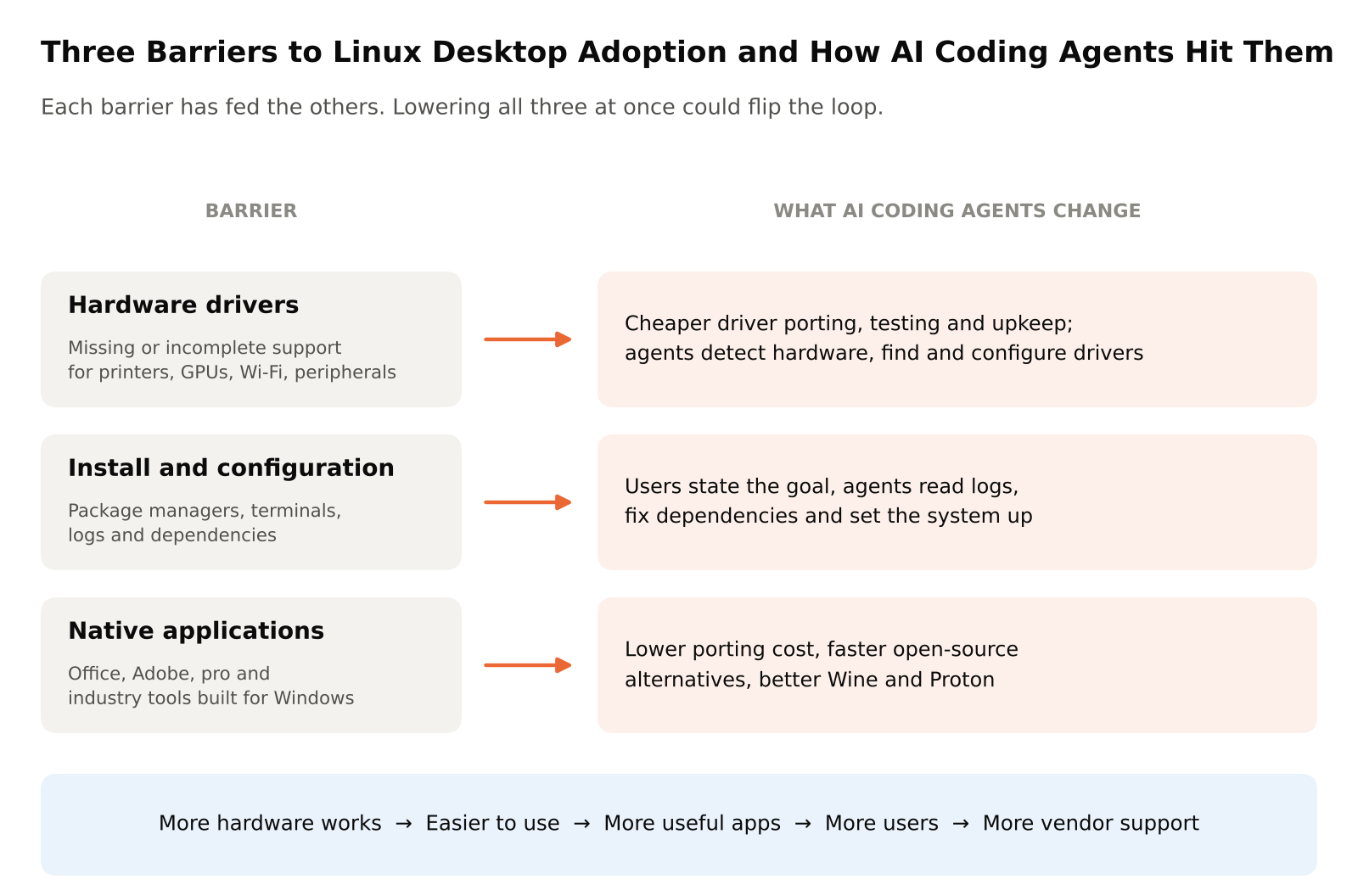
For decades, Microsoft’s dominance of personal computing has rested on an enormous structural advantage: the Windows software and hardware ecosystem. Linux has offered a technically capable, flexible and largely free alternative, yet its adoption has repeatedly stalled against three persistent obstacles: inadequate driver support for certain hardware, complicated installation and system configuration, and the absence of native versions of popular commercial applications. Artificial intelligence may now be changing all three simultaneously. As AI-powered coding agents become capable of writing, modifying, testing and maintaining increasingly complex software, the economic barriers protecting Windows could weaken substantially. What previously required large development teams and years of engineering effort may increasingly become feasible for small organizations, independent developers and technically inexperienced users assisted by AI.
This argument builds on the ideas explored in AppCoding’s November 21, 2026 article, DHH Says AI Lets Small Teams Compete With Software Ecosystems Built by Thousands. David Heinemeier Hansson, creator of Ruby on Rails and the Omarchy Linux project, suggests that AI-powered software development is making it possible for relatively small teams to challenge software environments built and maintained by thousands of engineers. His experience developing Omarchy illustrates a potentially transformative change in software economics. The implications extend far beyond one Linux distribution. If AI reduces the engineering effort required to maintain a competitive operating system environment, Linux could emerge as a principal beneficiary, capturing market share primarily from Windows.
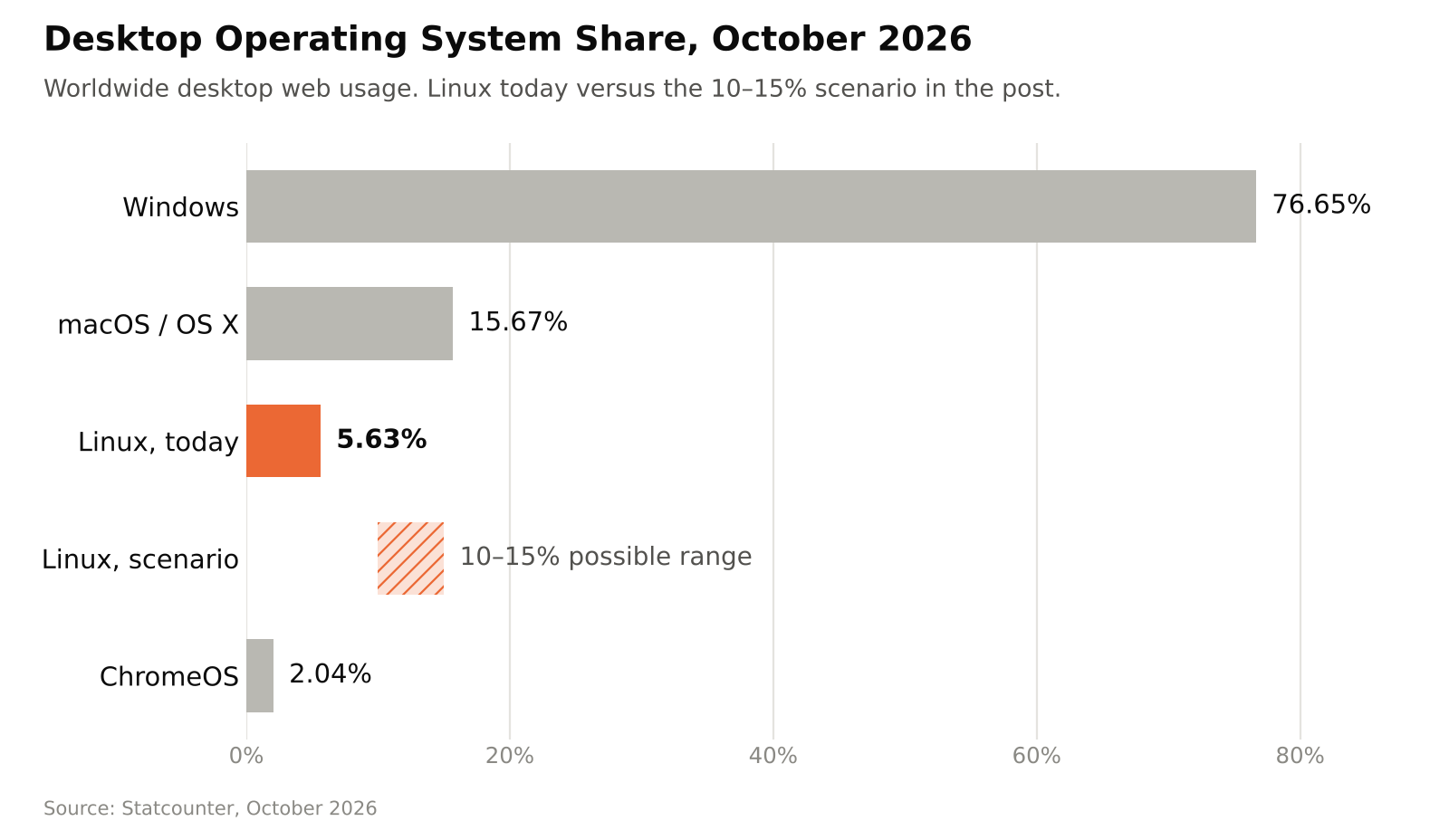
The current market structure illustrates the size of the opportunity. According to Statcounter’s October 2026 worldwide desktop operating system figures, Windows accounts for approximately 76.65% of desktop web usage, compared with 5.63% for Linux, around 15.67% for macOS and OS X combined, and 2.04% for ChromeOS. These statistics measure web activity rather than the precise installed base of operating systems, but they demonstrate the overwhelming scale of Microsoft’s position. Linux remains a relatively small desktop player despite decades of development and its established role in server and cloud environments. The question is whether AI can accomplish what conventional open-source development, compatibility projects and years of desktop usability improvements have not: make Linux convenient and capable enough to become a mainstream alternative to Windows.
One of the most persistent barriers has been hardware driver availability. Windows benefits from an extensive network of manufacturers developing, certifying and maintaining drivers for graphics cards, printers, scanners, wireless adapters, sound interfaces, specialized peripherals and industrial equipment. Linux users have frequently encountered devices with incomplete support, undocumented functionality or no usable drivers at all. Manufacturers often have little commercial incentive to develop Linux drivers for relatively small desktop markets, reinforcing the cycle in which limited adoption leads to limited support, which discourages adoption.
AI-powered development could change those economics. Coding agents can assist developers in analyzing device behavior, understanding existing driver implementations, adapting open-source drivers to additional hardware, generating test cases, investigating kernel compatibility problems and maintaining drivers across operating system updates. Tasks that formerly demanded substantial manual engineering may become less expensive and faster to perform. Small Linux development teams could potentially maintain support for a broader range of devices without proportionally increasing staffing. AI will not magically solve every hardware compatibility problem: undocumented proprietary interfaces, inaccessible firmware, legal constraints and devices requiring manufacturer cooperation remain substantial barriers. Nevertheless, reducing the cost of driver development and maintenance could expand the range of computers and peripherals that work reliably with Linux.
A particularly interesting possibility is automated hardware adaptation. Instead of expecting users to search discussion forums for the correct driver or experiment with kernel modules, an AI agent could inspect hardware identifiers, determine which components are supported, locate compatible drivers, verify their provenance, configure the system and test whether the device works. Where an existing driver requires a configuration change or a modest compatibility update, the agent could potentially perform that work. This would not replace secure, properly reviewed kernel-level code, but it could transform hardware configuration from an intimidating technical exercise into an increasingly automated service. For consumers, the difference between spending hours troubleshooting a device and having an assistant resolve the problem safely could be decisive.
The second obstacle, Linux’s reputation for difficult installation and configuration, may be even more directly vulnerable to AI. Modern distributions have made considerable progress in usability, but their diversity introduces complexity. Different package managers, desktop environments, system services, repositories and configuration conventions can confuse users familiar with Windows. Installing specialized software sometimes involves dependencies, terminal commands, permissions or environment settings that ordinary consumers have no interest in understanding. A malfunctioning desktop environment or failed application installation can quickly become a frustrating exercise in system administration.
AI agents are especially well positioned to reduce this friction because Linux exposes so much of its functionality through accessible configuration files, command-line utilities and documented system interfaces. An agent can inspect logs, identify dependencies, interpret error messages, recommend corrective actions and automate configuration procedures. Instead of following a ten-step installation guide, a user could request a working graphics environment, a development toolkit, a printer setup or a specialized workstation configuration. The agent could carry out the necessary operations, subject to appropriate permissions, verification and recovery safeguards.
There is a subtle reversal here. The command-line orientation and transparency that historically made Linux appear complicated may become advantages in an AI-operated environment. Windows interfaces were optimized largely for humans navigating graphical menus. Linux’s extensive automation facilities are particularly well suited to software agents executing structured tasks. Linux may no longer need to imitate Windows to overcome its usability disadvantage. It may benefit from a new interaction model in which users explain what they want and agents manage the underlying system.
The third obstacle, the shortage of Linux applications, has arguably been the most powerful factor protecting Windows. Consumers and businesses do not typically choose an operating system because of its technical architecture. They choose it because it runs the software they need. Microsoft Office, Adobe’s creative applications, specialized business programs, professional engineering tools and countless industry-specific applications have contributed to Windows’ entrenched position. Historically, recreating or porting this software required substantial engineering investment, while the limited Linux user base provided insufficient commercial justification.
AI-assisted coding could alter that calculation. Application developers may find it increasingly economical to support multiple operating systems when agents can help modify platform-dependent code, generate interface components, identify portability problems and automate testing. Small independent teams could create Linux-native alternatives to applications that previously required major commercial development budgets. Existing open-source programs could improve more rapidly as contributors use AI to implement features, resolve bugs and modernize interfaces. Compatibility layers such as Wine and Proton could benefit from faster testing, debugging and implementation work.
This does not imply that AI can automatically recreate proprietary applications or guarantee feature-for-feature compatibility. Intellectual property restrictions, proprietary file formats, specialized integrations and complex professional workflows impose real limits. But the market consequences do not require complete duplication of every Windows application. They require sufficient alternatives for a growing number of users to accomplish their work without Windows. If AI reduces the cost of filling those gaps, Microsoft’s application ecosystem could become a less formidable competitive barrier.
Even more disruptive is the possibility that AI agents will reduce the importance of conventional desktop applications themselves. Many people use specialized software primarily to produce documents, transform files, analyze data, generate reports, edit images or automate repetitive operations. Increasingly capable AI agents can perform some of these tasks by combining open-source utilities, web services, local models and custom-generated software. The user may no longer need a particular Windows application if an agent can accomplish the same objective through a different workflow. Competition could shift from application catalogs toward environments capable of executing user intentions.
These changes reinforce one another. Better hardware support makes Linux installation feasible on more computers. AI-assisted configuration makes those computers easier to use. Cheaper application development makes the environment more useful. A larger user population then increases incentives for manufacturers, software vendors and enterprise customers to support Linux. The historical negative feedback loop could gradually become positive. This is why AI-powered coding may represent something more consequential than another incremental improvement in Linux usability.
The economics of Linux distribution development could also change dramatically. Traditionally, building a polished distribution required substantial expertise across package management, desktop integration, installation, updates, security and application compatibility. AI-assisted engineering could allow smaller teams to create distributions optimized for particular professional and consumer markets. A photography-oriented Linux environment could emphasize image processing, color management, camera connectivity and media workflows. A small-business distribution could integrate accounting, document processing, backup and administrative automation. A developer-oriented desktop could combine AI agents, containers, development environments and advanced diagnostic tools. Educational systems could be tailored to institutional requirements without the overhead of maintaining a large internal engineering department.
Such specialization has historically contributed to Linux fragmentation, but AI may change the consequences. If configuration, migration, compatibility and maintenance can increasingly be managed by agents, differences between distributions become less burdensome. The ecosystem could support more specialized products without requiring consumers to master their technical details.
Windows appears more exposed to this transition than macOS. Apple’s operating system is tied to an integrated hardware and software ecosystem, and many customers choose Macs for the complete product experience. Windows, by contrast, runs across an enormous installed base of commodity computers manufactured by competing companies. Many of those machines can already operate Linux with suitable hardware support. A Windows customer considering Linux may not need to purchase a new computer. The operating system can potentially change while the hardware stays the same.
This creates an opportunity during hardware replacement and operating system migration cycles. Microsoft’s October 2025 end of mainstream Windows 10 support forced many consumers and organizations to reconsider their computing arrangements. AI-assisted Linux migration tools could help evaluate hardware, identify application alternatives, preserve documents, transfer settings and configure replacement workflows. The easier these processes become, the less convincing the argument that remaining with Windows is simply the most practical choice.
Gaming provides a useful example of how technical barriers can weaken. SteamOS, Proton and other compatibility technologies have made Linux gaming more viable than it was a decade ago. Valve’s October 2026 Steam Hardware and Software Survey reported Linux at approximately 3.95% of participating systems, compared with Windows at 93.70%. Linux remains a minority gaming platform, but improvements in compatibility show that access to Windows-oriented software does not always require running Windows itself. AI-assisted development could accelerate compatibility testing, performance optimization, driver work and game-specific fixes, although proprietary anti-cheat systems and unsupported components may remain significant constraints.
For Microsoft, the financial implications would extend beyond Windows licensing. A larger Linux desktop market could weaken customer lock-in, increase hardware manufacturers’ negotiating leverage and encourage software vendors to prioritize cross-platform development. Enterprises might gain greater freedom to choose operating systems without abandoning familiar workflows. Microsoft could continue selling cloud services, productivity subscriptions, security products and AI applications to customers using Linux, but Windows itself might become less central to its ecosystem strategy.
There are counterarguments. Microsoft is incorporating AI capabilities into Windows and possesses enormous resources to improve development productivity, system management and application compatibility. Large organizations depend on established identity systems, security controls, certified applications, vendor support and predictable maintenance. AI-generated code introduces risks, particularly where system-level privileges and kernel drivers are involved. Linux distributions that become easier to develop will not automatically become more reliable, secure or commercially sustainable. Technical fragmentation and inconsistent support could remain persistent problems.
Nevertheless, the competitive asymmetry is significant. Microsoft already possesses an exceptionally mature ecosystem. Making software development less expensive benefits the company, but it may benefit smaller competitors proportionally more by reducing the cost of overcoming disadvantages that previously appeared insurmountable. When the cost of building a credible alternative falls faster than the cost of maintaining an incumbent platform, market concentration can begin to weaken even if the dominant company continues to innovate.
A Linux desktop market share of 10% to 15% over the coming years should be considered a plausible scenario under favorable conditions rather than a reliable forecast. Such an expansion would require substantial progress in agent reliability, application portability, hardware compatibility and consumer confidence. Yet even a move into that range would be commercially meaningful. Software vendors would find Linux increasingly difficult to ignore, manufacturers would have stronger incentives to offer preinstalled Linux systems, and enterprise technology buyers could gain a more credible alternative to Windows.
The broader transformation may ultimately concern the meaning of an operating system itself. In conventional personal computing, the user selects an application, navigates its interface and manually performs operations. In an AI-oriented environment, the user increasingly specifies an objective while software agents select tools, manage files, configure services and execute workflows. The operating system becomes less a visible collection of menus and applications and more an execution platform for intelligent automation. Linux’s open architecture, flexible tooling, mature networking and established automation capabilities could prove especially valuable in that environment.
The original AppCoding analysis of David Heinemeier Hansson’s vision points toward a shift in the economics of software competition. Small teams are acquiring capabilities once associated with much larger engineering organizations. Applied to Linux, that development directly addresses the three weaknesses that have repeatedly limited desktop adoption: insufficient drivers, difficult configuration and inadequate application availability.
Linux does not need to defeat Windows in every category to reshape the market. It needs to become a practical alternative for a growing share of users whose dependence on Windows has historically been dictated by software availability and technical convenience rather than genuine preference. AI-powered coding and system administration could make that possible. For thirty years, Windows benefited from the cost of constructing a competing ecosystem. AI may be making that cost dramatically smaller.
