• Skip to main content
  • Skip to secondary menu
  • Skip to footer

Market Analysis

Connecting the Dots, Quantifying Technology Trends & Measuring Disruption

  • Custom Market Report
  • Sponsored Post
  • Domain Marketplace
  • Technology News
  • About
  • Contact

Screening Startup and Product Ideas After a Brainstorm: Four Questions, Money First

October 4, 2026

A brainstorm is the cheap part. An hour gives me a page of ideas (products, tools, the odd technology bet, now and then a whole company). On the page they all look good. Building any one of them takes weeks, often months.

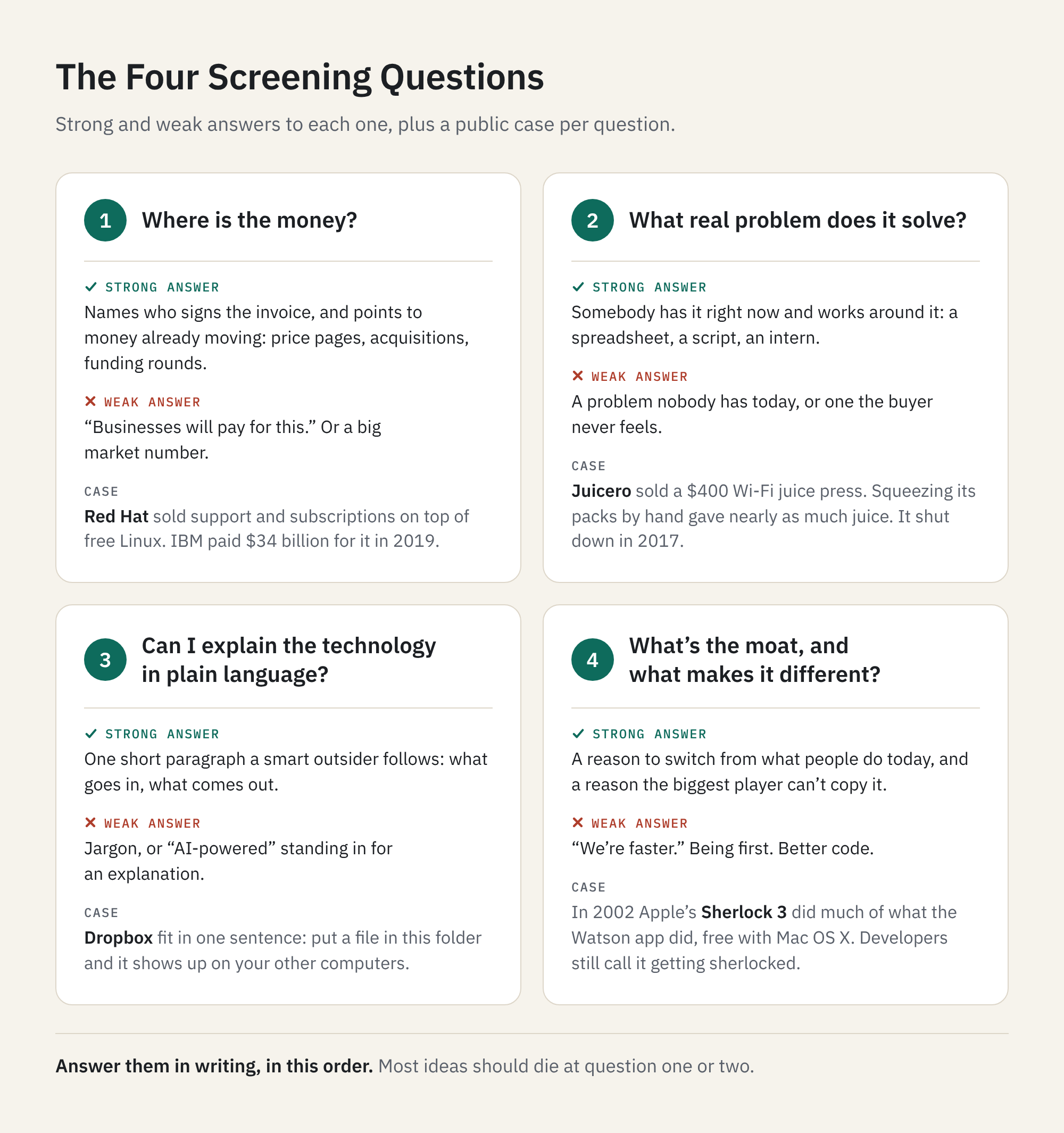
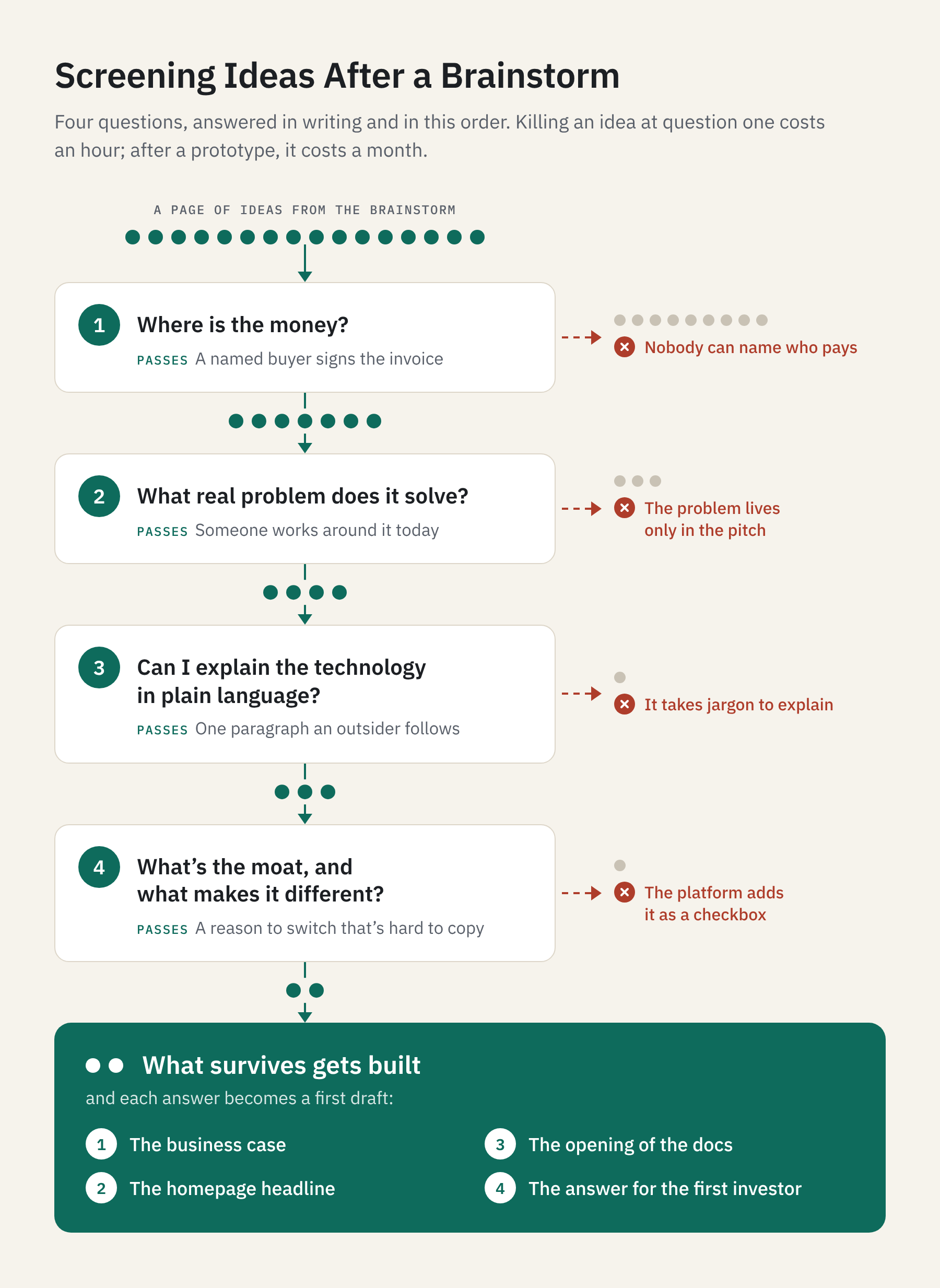
So nothing gets built until it answers four questions in writing. Where is the money? What real problem does it solve? Can I explain the technology in plain language? What’s the moat, and what makes it different? It’s the screen an investor runs on a startup pitch, except the founder across the table is me.
Screening Startup and Product Ideas After a Brainstorm: Four Questions

The order is on purpose. Technical people tend to start with the technology, since that’s the fun part; an idea can live for months on fun alone. Asking about money first kills the weak ones while killing them still costs an hour.
Screening Startup and Product Ideas After a Brainstorm: Four Questions

Where Is the Money?
Every idea shows up with a big number attached. A $40 billion market, one percent of it, done. That number tells me nothing about whether anyone will pay me. So I skip it and look for a name: who pays for what, out of whose budget.

A weak answer says businesses will pay for this. A strong one names the job title that signs the invoice.

The best evidence is money that’s already moving. Competitors with public price pages. Acquisitions in the space. Funding rounds. A line item in somebody’s budget that the new thing would replace. When none of that exists, either I’ve found something new or I’ve found a market that doesn’t pay. The second happens far more often.

Software has a trap here. In many categories the core product is free, so nobody pays for the thing itself. They pay for what it takes to run a lot of it safely: support, management, compliance, someone to call at 3 a.m. Linux is free. Red Hat built a business selling subscriptions and support on top of it; IBM paid $34 billion for the company in 2019. When the core is free, my money answer has to point at whatever sits around it.

Prices at this stage are guesses. I write them down anyway, as guesses to test with real buyers, because a guess I can test beats a market size I can’t.

What Real Problem Does It Solve?
A real problem is one somebody has right now. It costs them something they can count, hours or money. The surest sign is a workaround. A spreadsheet someone updates every Friday. A script nobody admits to owning. A chat channel where the same question comes up every week. An intern. Half of somebody’s job. People who work around a problem have it; people who don’t, mostly don’t.

The cautionary case is Juicero. It sold a $400 Wi-Fi juice press that checked a code on each pack of chopped fruit and vegetables before pressing it. Then reporters tried squeezing the packs by hand. They got nearly as much juice. The machine worked. Nobody needed it. Juicero had raised about $120 million; it shut down in 2017.

The question has a second half that’s easy to miss. The person with the problem and the person who pays are often different people. Developers feel the pain; a security team or the finance department signs. If my money answer and my problem answer name different people, with nothing connecting them, I’m describing two products. Maybe neither one sells.

Can I Explain the Technology in Plain Language?
This one is a writing test. One short paragraph, for a smart reader outside the field, saying what goes in and what comes out. No jargon. No “AI-powered” standing in for an explanation.

If I can’t write that paragraph, I don’t understand the idea yet, or it’s vaguer than the pitch makes it sound. Either is worth knowing before any code exists.

The plain version also shows what’s new. Written out, it often describes a product that already exists. That’s useful. Now I know who the competitor is, and the last question just got harder.

Sometimes the plain version is the product. When Dropbox was first shown on Hacker News in 2007, a commenter pointed out that a Linux user could already build the same thing with an FTP account and version control software. He was right about the parts. Dropbox fit in a sentence anyone could repeat: put a file in this folder and it shows up on your other computers. People bought the sentence.

What’s the Moat, and What Makes It Different?
Two questions share this slot. The difference is why someone would switch from what they do today, which usually means a free tool or nothing at all. The moat is why the biggest player in the space can’t copy me once it’s obvious the thing works. Difference wins the first customer. The moat keeps the hundredth.

The real threat to a small product is the platform adding it as a checkbox. Mac developers have a word for this. In 2002 Apple shipped Sherlock 3, which did much of what Karelia’s Watson app already did, free with the operating system. Getting sherlocked has meant the same thing ever since. It still happens most years.

Real moats are dull. Switching costs. Data that piles up as people use the product. Being the format other tools read. Deep integrations. Years of trust with one kind of buyer. Being first doesn’t count, and neither does better code; code gets rewritten.

“None yet” is an honest answer this early, as long as I can say what the moat would be once there are users. “We’re faster” isn’t an answer at all. The incumbent can be faster by next quarter.

Keep the Answers
I keep the answers. If the idea survives, they’re the first draft of everything after it. The money answer grows into the business case. The problem becomes the headline on the homepage. The plain-language paragraph opens the documentation, and the moat answer is ready for the first investor who asks.

Most ideas should die at question one or two. Killing an idea there costs an hour; killing it after a prototype costs a month.

I’d rather spend the hour.

Filed Under: Reports Tagged With: brainstorming, business models, idea screening, product development, startups

Footer

Recent Posts

  • Screening Startup and Product Ideas After a Brainstorm: Four Questions, Money First
  • An AI Lab Is Paying Up Front for Atlas Energy’s (AESI) Generators as Agentic AI Multiplies Token Demand
  • Oracle’s Force Majeure Notice on Project Jupiter Shows Where AI Data Center Risk Is Landing
  • AI Infrastructure Credit Costs Rise as CoreWeave-Tied Bonds Price at 9.25% and China Chipmaker Profits Jump 620%
  • OpenAI and Anthropic Cut AI Model Prices as $1.75B in Funding Flows to Data, Security and Infrastructure
  • Semiconductor Revenue Hits Record $425B in Q2 2026, but Omdia’s $500B Q3 Forecast Implies Growth Halves
  • AI Extinction Warnings Went Global in Six Days. Nothing in the Technology Changed.
  • Anthropic Walks Away From $6 Billion Decart Acquisition: The Deal Was About Inference Cost, Not World Models
  • VR Status Report 2026: Quest Sales Keep Falling While Smart Glasses Take the Money
  • The Case That the US Can Grow Out of $40 Trillion in Debt: Three Conditions the Clinton Surpluses Actually Met

RSS feed: Market Research Media Market Research Media

  • Infrastructure Software Market Watch: Five Early-Stage Tools Test Edge Data, Agent Security, Metering, Agent Setup and Proxies
  • The Economist Is Right About a Million AI Jobs. It’s a Construction Boom, Not a Tech Boom.
  • AI Slop Earns Higher CPMs Than Clean Inventory: Why the Ad Market Cannot Fix the Web It Funds
  • Weekly Network Analytics, July 19 to July 25, 2026: Visits Up 14%
  • Adobe (ADBE) and Figma (FIG) Have Each Lost Roughly Half Their Value to a Competitor Set Worth $34 Million
  • Getty Images Kills the $3.7 Billion Shutterstock Merger Rather Than Sell the Editorial Business the UK Demanded
  • Fox’s $22B Roku Deal: 4.6x Sales, Paid in 1.5x Stock
  • Tuesday Open: AI Earnings Engine Holds the Line as Iran Overhang Fades to Noise
  • China’s U.S. Treasury Holdings: The Great Repositioning (2021–2025)
  • Infographic: Why the 2025 CIPA Data Proves the APS-C Renaissance is Real

Media Partners

  • Analysis
  • Technology Conferences
  • OSINT
  • Defense Market
  • Cybersecurity Market
  • Event Calendar
  • Calendarial
  • Opinion
  • 3V
  • Media Presser
  • Exclusive Domains

Copyright © 2026 MarketAnalysis.com | Terms of Service | Privacy Policy | Supplier Disclaimer |

Media Partners: Technologies | Photography | Referently

We use cookies on our website to give you the most relevant experience by remembering your preferences and repeat visits. By clicking “Accept”, you consent to the use of ALL the cookies.
Do not sell my personal information.
Cookie SettingsAccept
Manage consent

Privacy Overview

This website uses cookies to improve your experience while you navigate through the website. Out of these, the cookies that are categorized as necessary are stored on your browser as they are essential for the working of basic functionalities of the website. We also use third-party cookies that help us analyze and understand how you use this website. These cookies will be stored in your browser only with your consent. You also have the option to opt-out of these cookies. But opting out of some of these cookies may affect your browsing experience.
Necessary
Always Enabled
Necessary cookies are absolutely essential for the website to function properly. These cookies ensure basic functionalities and security features of the website, anonymously.
CookieDurationDescription
cookielawinfo-checkbox-analytics11 monthsThis cookie is set by GDPR Cookie Consent plugin. The cookie is used to store the user consent for the cookies in the category "Analytics".
cookielawinfo-checkbox-functional11 monthsThe cookie is set by GDPR cookie consent to record the user consent for the cookies in the category "Functional".
cookielawinfo-checkbox-necessary11 monthsThis cookie is set by GDPR Cookie Consent plugin. The cookies is used to store the user consent for the cookies in the category "Necessary".
cookielawinfo-checkbox-others11 monthsThis cookie is set by GDPR Cookie Consent plugin. The cookie is used to store the user consent for the cookies in the category "Other.
cookielawinfo-checkbox-performance11 monthsThis cookie is set by GDPR Cookie Consent plugin. The cookie is used to store the user consent for the cookies in the category "Performance".
viewed_cookie_policy11 monthsThe cookie is set by the GDPR Cookie Consent plugin and is used to store whether or not user has consented to the use of cookies. It does not store any personal data.
Functional
Functional cookies help to perform certain functionalities like sharing the content of the website on social media platforms, collect feedbacks, and other third-party features.
Performance
Performance cookies are used to understand and analyze the key performance indexes of the website which helps in delivering a better user experience for the visitors.
Analytics
Analytical cookies are used to understand how visitors interact with the website. These cookies help provide information on metrics the number of visitors, bounce rate, traffic source, etc.
Advertisement
Advertisement cookies are used to provide visitors with relevant ads and marketing campaigns. These cookies track visitors across websites and collect information to provide customized ads.
Others
Other uncategorized cookies are those that are being analyzed and have not been classified into a category as yet.
SAVE & ACCEPT