Blackstone’s agreement to invest in Futronic, the Busan-based actuator maker, at a reported valuation near 675 million dollars is a small deal by the standards of the AI infrastructure trade, but the logic behind it is the same logic that has driven every AI-adjacent bottleneck trade of the past three years. If AI-driven robotics demand actually compounds the way its backers assume, the physical actuator, not the AI model running on top of it, becomes the constraint on how fast that demand can turn into deployed machines. Futronic has spent three decades supplying electromechanical actuators to automotive and industrial customers, exactly the drivetrain and motion-control hardware that robotics manufacturers need for joints and grippers. That overlap, not a pivot into humanoid demos, is what Blackstone is actually underwriting.
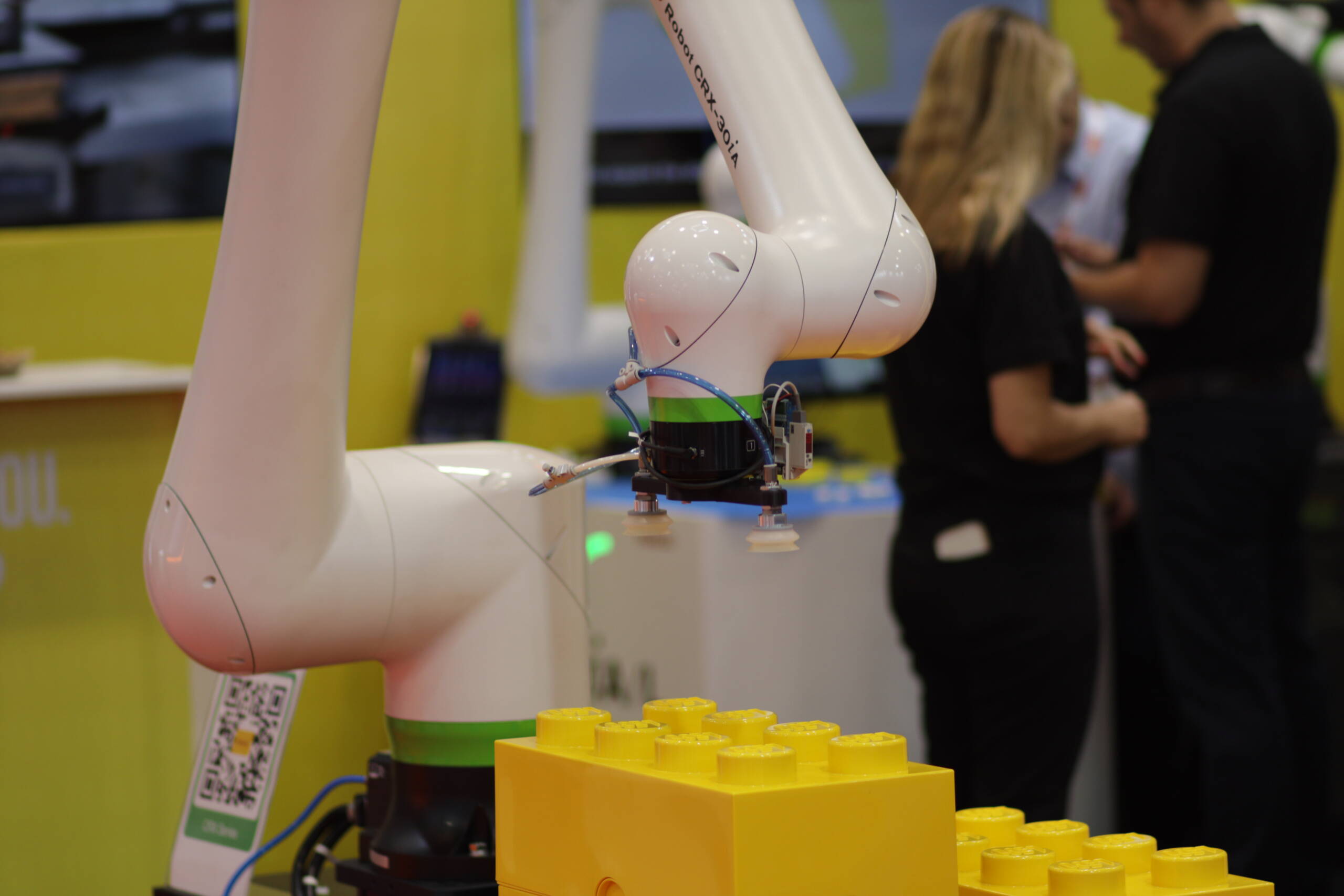
A collaborative robot arm with a vacuum-suction end effector picks up an oversized yellow block at an automation trade show demo. A collaborative robot arm demonstrates a vacuum-suction end effector at an automation trade show. The joint motors and grippers behind demonstrations like this one are exactly the actuator layer the Futronic deal is pricing.
Why the bottleneck sits here and not upstream
Software and even silicon can scale on a cost curve that compounds quickly once a design is proven. Actuators cannot. They require precision manufacturing tolerances, magnet and bearing supply chains, and multi-year qualification cycles with each customer before a part is trusted inside a production robot. None of that compresses at the pace a language model or a chip design shrinks on a new process node. That mismatch is exactly what turned memory into the binding constraint on AI compute buildouts even as GPU output scaled, and it is the same mechanism now being underwritten in robotics: if the demand assumption is exponential, the actuator supply chain is the layer least able to keep pace with it, which is what makes it investable years before the robots themselves are profitable.
Why capital is targeting this specific layer
Actuators, end-effectors, and tactile sensors have emerged as the specific sub-segments drawing private equity attention inside Korea’s robotics buildout, precisely because they are the physical inputs every robotics platform needs regardless of who wins the systems-integration layer above them. Faraday Dynamics, a Korean actuator developer founded in 2020, took a 25 billion won investment from Premier Partners and HB Investment earlier this year on the same logic. The Korean government has folded robotics into its National Growth Fund alongside AI, semiconductors, and future mobility, and investment bankers covering the sector have been explicit that outright buyouts remain difficult because most of these companies are not yet profitable, which is exactly why minority stakes in component suppliers like Futronic are the entry point being used instead of acquiring the businesses outright.
The rotation is already visible at the index level
This is not an isolated venture bet. Korean robotics stocks pulled in 590 million dollars in foreign buying in a single week in May as capital rotated out of chip names and into automation plays. Hyundai Motor Group has committed 86.7 billion dollars domestically through 2030 to build what it calls a global robotics hub, built around Boston Dynamics for the finished humanoid platform and Hyundai Mobis for the actuators and head modules underneath it, the same component category Futronic sits in. Nvidia has separately signaled it sees Korea as a testbed for physical AI. The Futronic deal is a small, specific instance of a capital flow that is already running at a national-index scale, all of it priced off the same exponential-demand assumption.
What the bottleneck framing is actually resting on
The gap between narrative and revenue is still wide, and it matters more here than in most bottleneck trades because the entire premium being paid for actuator suppliers depends on the exponential assumption holding, not on what these companies currently earn. The 35 listed Korean robotics companies combined for only about 2.265 trillion won in 2025 sales, a fraction of what the capital rotation into the sector implies about future demand. If AI-driven robot deployment scales the way memory demand scaled for AI compute, actuator suppliers holding qualified, scarce manufacturing capacity look underpriced today. If deployment timelines slip the way humanoid pilots have slipped before, the bottleneck evaporates along with the premium, and Futronic becomes a mid-sized auto-parts supplier valued like something else entirely. The deal is a wager on which of those two futures is correct, not a confirmation of either one.
