A review of more than 300 Chinese documents shows that AI model distillation has moved from academic experiments into mainstream industrial use in China, and that Beijing is encouraging it. Distillation means taking the outputs of a large, capable model and using them as training data for a smaller one. The student model learns selected skills from the teacher without the teacher’s training bill, and it can run on far less hardware.
This builds on an earlier review in July of more than 80 Chinese papers and patents, which found researchers linked to the People’s Liberation Army using outputs from OpenAI and Anthropic models to train specialized systems. One example used Anthropic’s Claude 3 Haiku to generate training data for a classifier that monitors social media. Central and local governments have been steering subsidies toward “model lightweighting” and edge computing so that models can run on drones, satellites and other devices with little processing power. Chinese companies deny that their progress depends on foreign models, and Moonshot rejected US claims that its Kimi K3 model was built by distillation. Beijing accuses Washington of AI hegemonism.
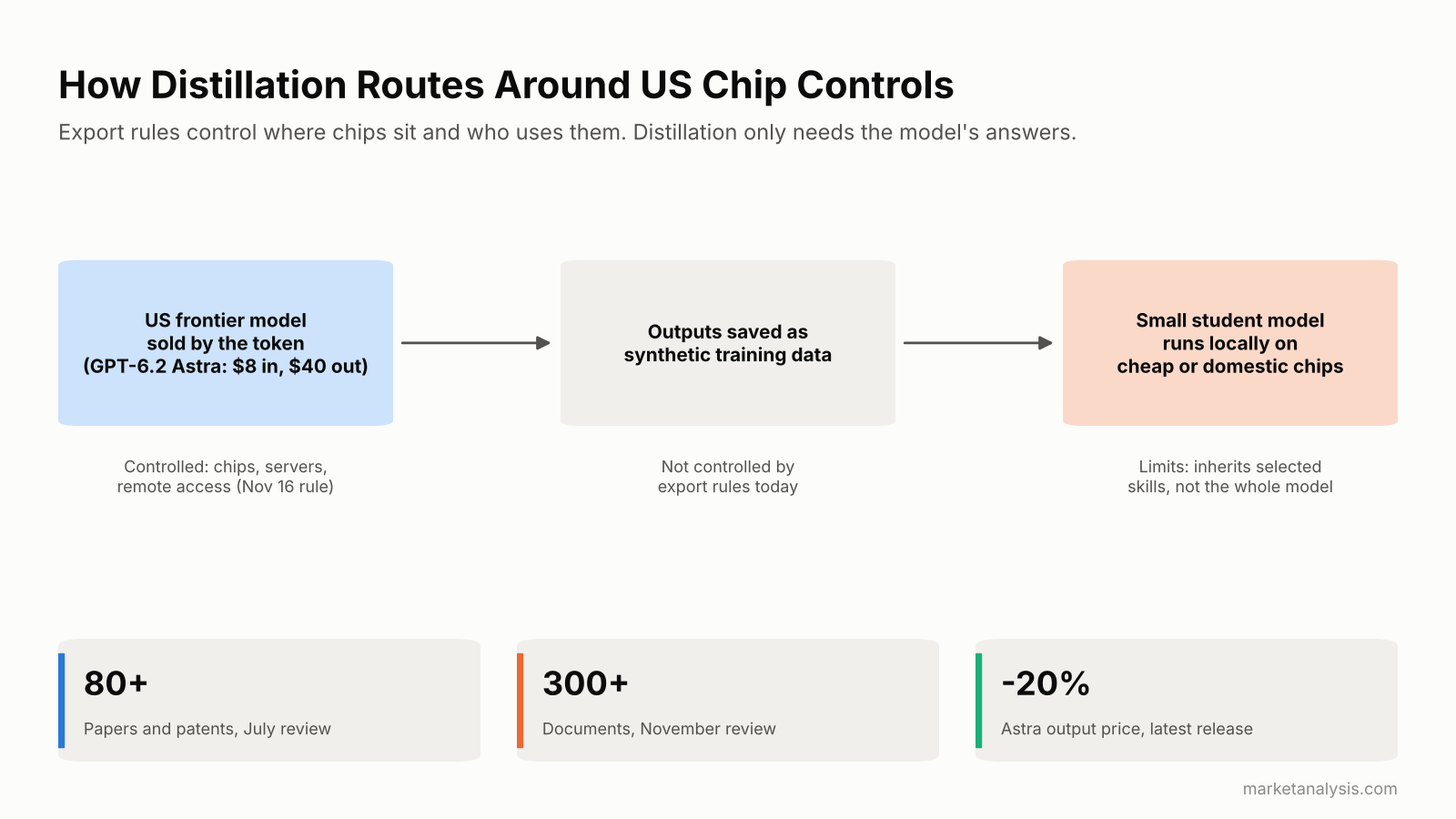
The timing is what makes this a market story. On Monday the Commerce Department closed the remote-access route, so Chinese companies can no longer rent advanced US chips in data centers in Southeast Asia (see our post on the new controls). Nvidia has stopped shipping H200s to China. Every hardware path to frontier-scale training is now narrower than it was a week ago. Distillation needs none of it. It needs access to a model’s answers, which US labs sell by the token to anyone with an API key.
And those answers keep getting cheaper. OpenAI just cut GPT-6.2 Astra’s price by 20% to $8 per million input tokens and $40 per million output tokens (see our post on AI model prices). Each price cut that helps a US enterprise buyer also lowers the cost of extracting capability from US models. Distilled models have real limits, and they inherit selected skills rather than the whole model. For most commercial work, selected skills are what a business pays for anyway.
Two things follow for markets. First, the moat of the US frontier labs leaks partly through their own API, which pushes them toward tighter terms, identity checks on API customers and rate limits that are harder to game. Expect those to show up as product changes before they show up as law. Second, Chinese AI products get cheaper to run. That helps the economics of companies such as Tencent, which is losing about RMB15 billion a quarter on new AI products (see our Tencent post), and it makes domestic accelerators good enough for more of the work.
The question to watch is whether Washington extends the logic of Monday’s rule from compute to outputs. Export controls have followed the chip into foreign data centers. If they follow the model’s answers next, through know-your-customer rules for API access or limits on bulk output, the US labs’ fastest-growing overseas revenue becomes regulated revenue, and the price war they are running gets a floor set in Washington.
