Restrictions Ohio voters approved on November 3 affect three of Amazon’s proposed data center projects, accounting for about $17 billion of its planned spending in the state, excluding chips and equipment. Amazon has said its Ohio data center investment will pass $23 billion by 2030, so the measures sit on top of roughly 74% of that pipeline. The three projects add up to about 1.8 GW of power demand.
The measures are blunt. In Sunbury, north of Columbus, a citizen-initiated charter amendment caps data centers at 25 MW and passed with 78.6% of the vote. Trenton passed a similar ban on facilities above 25 MW with about 80%. Prologis, which is developing the Trenton site for Amazon, has filed a lawsuit challenging the measures. Ohio had 21 data center measures on its ballots, more than any other state, and every one of the five central Ohio communities that voted rejected data centers.
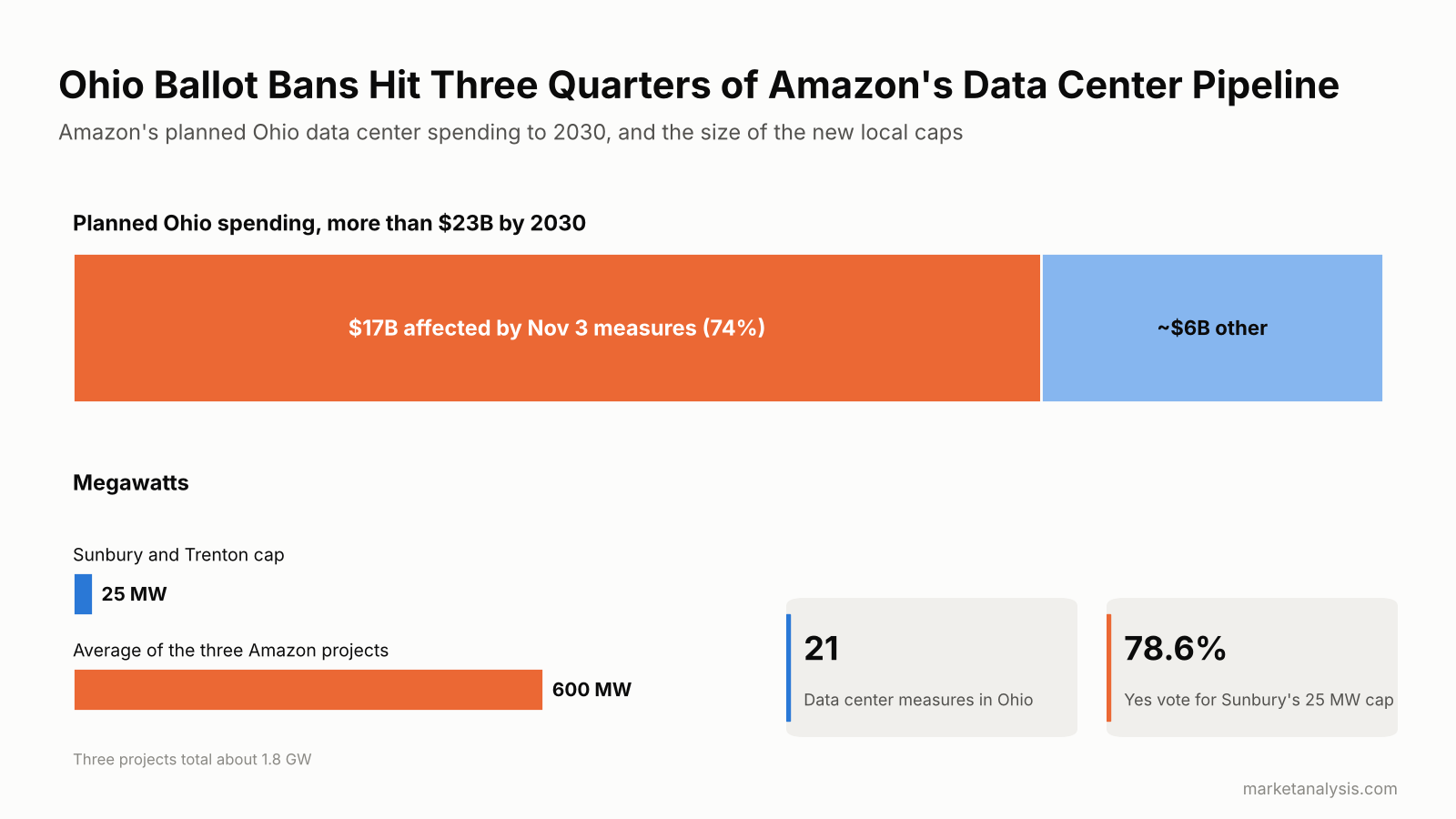
The 25 MW figure is the part that matters for AI. An enterprise colocation hall can live under that cap. A hyperscale AI campus can’t. Amazon’s three affected projects average about 600 MW each, so the cap is roughly one twenty-fourth of what they need. A ban written as a size limit lets towns say they still welcome data centers while ruling out the only kind the AI buildout is building.
Ohio is not alone. Across the country dozens of measures passed or led on election night, nearly all of them against data centers, and estimates put the proposed capacity now restricted at 10 GW or more, affecting Amazon, Meta and Microsoft among others. This week Sam Altman said that data centers will get built, but that the current way of building them and engaging with communities is not working for people. Coming from the CEO whose company depends on that buildout most, that reads as an admission that the industry lost the argument locally.
The market effect runs in two directions. Projects that already have local approval, power and land become scarcer, and their owners gain pricing power. Developers with sites in places like Ohio carry a new kind of risk that does not show up in power purchase agreements: a town vote. The labs are already choosing where to build. Anthropic’s flagship River Bend campus is going up in Louisiana, with about 1,300 workers on site (see our Anthropic IPO post). Capacity is moving toward places that want it, and the map of AI infrastructure is being redrawn by referendum as much as by grid capacity.
Washington adds a layer on top. Democrats won both chambers in the same election, and earlier this month the market sold off on fears that a Democratic Congress would slow the buildout, as we described in our trust-crisis post. Federal policy is still a worry. The binding constraints so far are local.
The test case is the Prologis lawsuit. If courts uphold municipal charter caps on data center size, the Sunbury template will spread to every town with a contested site before the next ballot cycle. If the caps are struck down, the industry keeps its sites but not its welcome, and the cost shows up in community payments and ratepayer guarantees instead.
