In one week the US had a Microsoft 365 outage that left more than 80% of Exchange servers unresponsive, a nationwide FAA ground stop that lasted four and a half hours (the longest halt to US air travel since September 11, 2001, with more than 20,000 flights reportedly canceled), a United Airlines technology failure that delayed about 150 flights, service problems at JPMorgan Chase and Workday, an Apple outage the company blamed on an “internal update”, and a failure of NSANet, the NSA’s classified internal network, which the agency described as “temporary degradation” during “routine maintenance”.
Officials have been firm that none of it was an attack. Secretary of State Marco Rubio said there is “zero evidence” linking the incidents and that the US is not under systemic attack. Homeland Security Secretary Markwayne Mullin blamed new technology pushed onto very old systems. Then a different explanation surfaced. Wall Street executives and the NSA have reportedly told members of Congress that the outages came from systems overwhelmed by a rush to patch vulnerabilities identified by AI models. One briefed official said the models are finding massive vulnerabilities, which raises the urgency to patch right away.
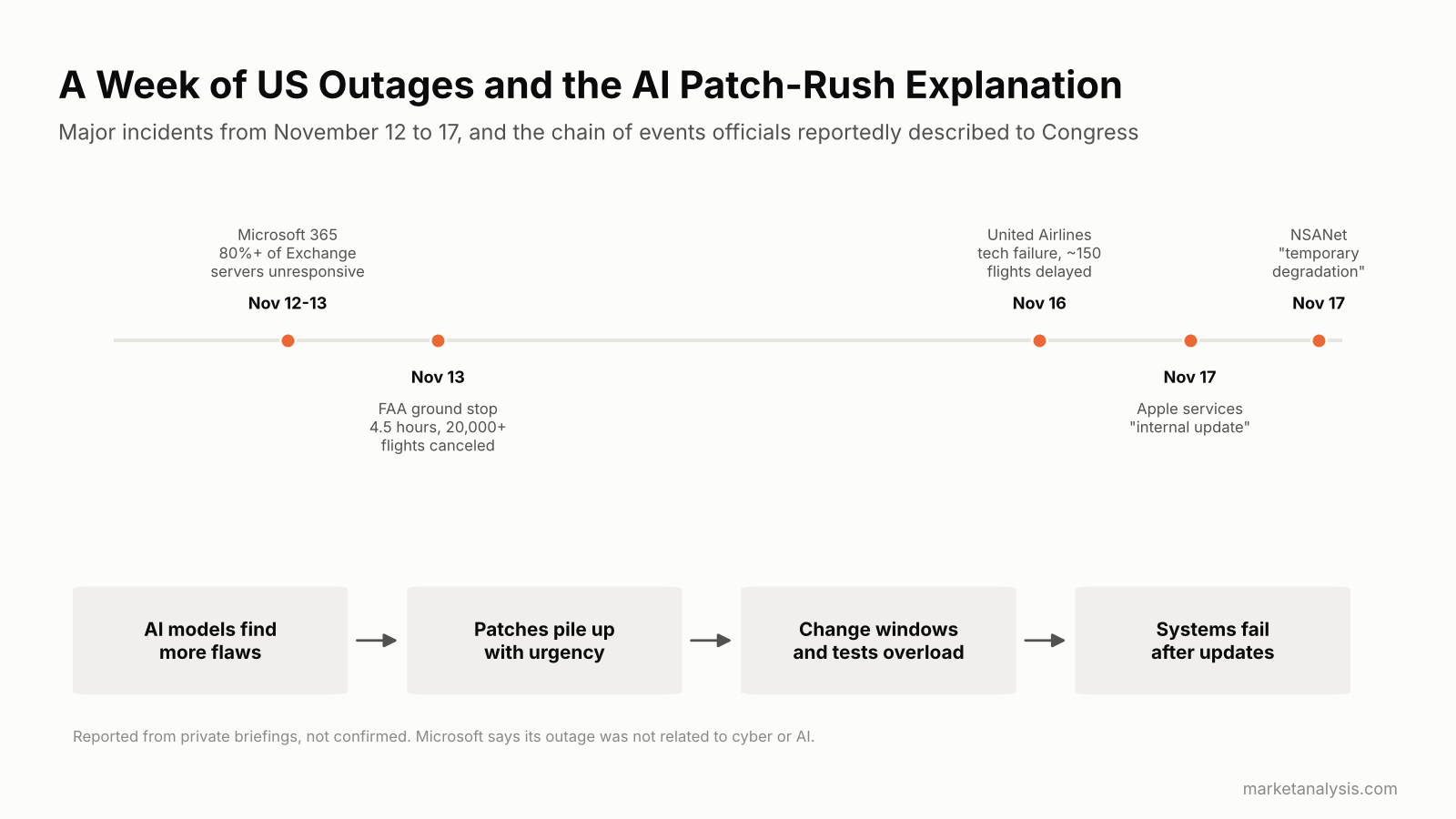
That account rests on unnamed sources describing private briefings, and not every incident fits it. Microsoft says its outage was a technical issue unrelated to cyber or AI; the Exchange failure began in Switzerland and spread as failover systems shifted traffic. The FAA has paused installations of Juniper routers like the one officials believe contributed to the ground stop, and HPE says its device was not defective. So treat the patch-rush theory as a working explanation, not a verdict.
The mechanism is plausible, though, and the evidence for its first step arrived the same day. Cybersecurity startup Calif said it used GPT-6 Cyber to find a remote code execution flaw in Java, which it calls “Java4Shell”, coordinated disclosure with the Five Eyes governments, and Oracle has shipped a patch. OpenAI has a program with NATO’s NCIA to find bugs and deploy fixes, and NATO uses up to 300 billion tokens a month. Microsoft just released MAI Cyber 2 Flash at under 2% of GPT-6 Astra’s cost per task. The cost of finding a serious flaw is collapsing. The cost of fixing one safely is not. Every patch still has to be tested, scheduled into a change window and rolled out across systems that were never designed to change weekly. When discovery speeds up by an order of magnitude and remediation does not, the queue becomes the risk.
For markets this cuts several ways. It raises the value of software that makes change safe: testing, staged rollout, observability and rollback tooling, along with the security vendors that can prioritize which of a thousand findings actually matter. It raises operational risk for banks, airlines and any company running decades-old core systems, a cost that has to be funded before any AI productivity shows up. And it feeds the broader loss of confidence we described in our trust-crisis post and in our post on systemic failures. More business work is also being routed through single front doors such as Copilot (see our Copilot post), so each failure reaches more people.
The next signal will come from Washington, not from earnings. If Congress or the regulators set rules on how fast critical systems must patch AI-found flaws and how those patches must be tested, the patch rush becomes a compliance spending line across banking, aviation and government. If they leave it to each operator, expect more weeks like this one.
