The neoclouds lost their loudest champion last week. Jensen Huang resigned as Nvidia’s CEO on November 12, days after admitting to an extramarital affair, with reports linking one relationship to the head of Megaspeed, who is alleged to be a Chinese intelligence asset. The board has hired Wachtell Lipton to look at whether his conduct put national security or company secrets at risk. CFO Colette Kress is interim CEO. As of Monday the board was not considering bringing him back, petition and presidential sympathy notwithstanding.
For CoreWeave, Nebius, IREN and the rest, this lands on top of a month that was already ugly. Between October 6 and November 6 CoreWeave fell about 50% and Nebius about 48%. Power limits, local data center moratoriums and the debt pile were the worry then. Huang’s exit added a new one. Who at Nvidia will keep saying the neoclouds matter?
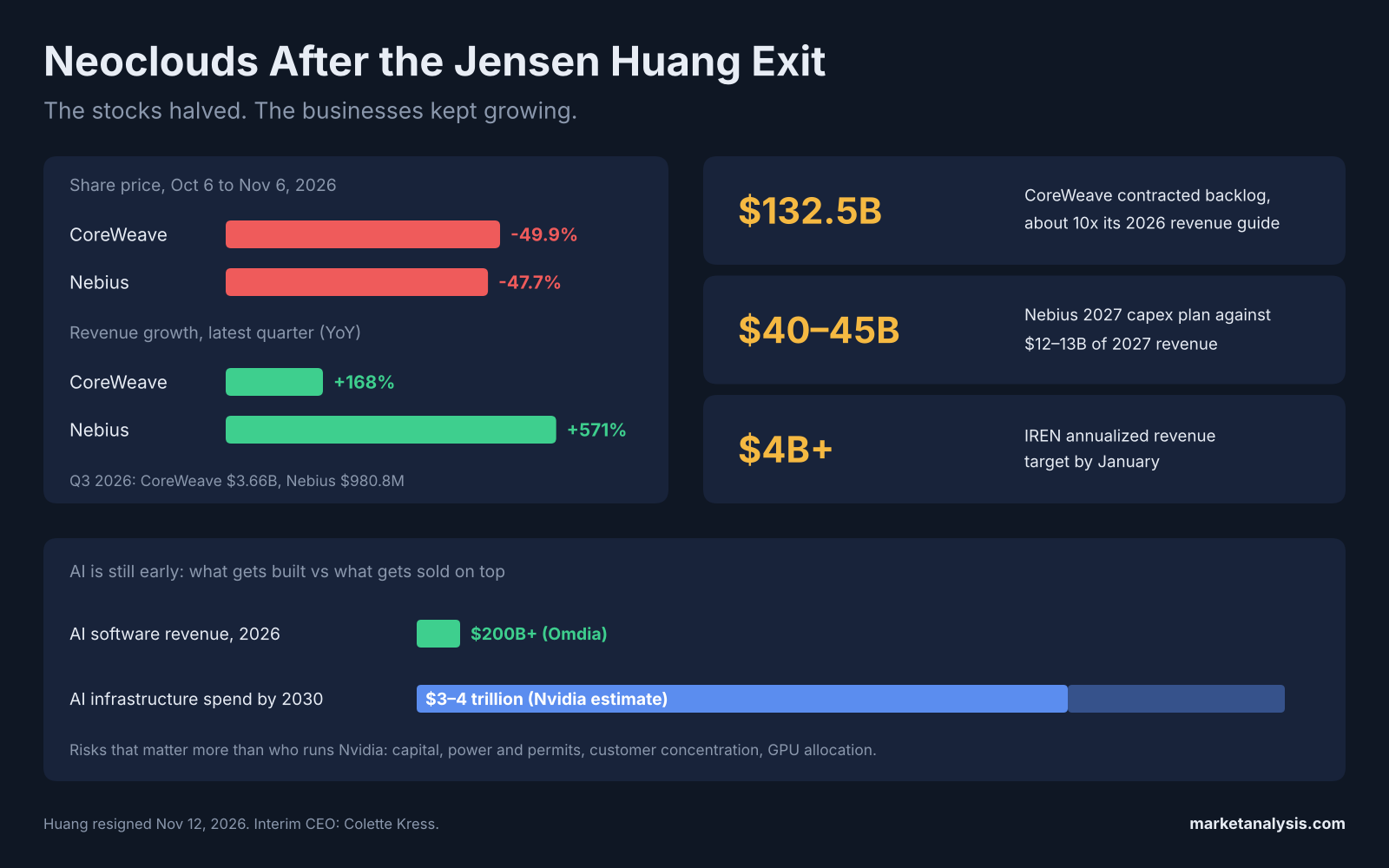
I think the market is pricing a bust. The numbers say something else.
What the companies actually reported
CoreWeave reported on November 10. Revenue was $3.66 billion for the quarter, up 168%. It raised its 2026 outlook to $13 billion to $13.3 billion and said its backlog is about $132.5 billion. That is ten years of this year’s revenue already contracted. Bloomberg then reported it wants to raise at least $4 billion through an investment-grade loan. Investment grade. A year ago nobody would have used that phrase near this company.
Nebius followed on November 12 with $980.8 million in revenue, up 571%, and well ahead of consensus. The stock fell 14% anyway. Why? Management guided 2026 revenue to the low end of its range and lifted capex to $27 billion. For 2027 it wants to spend $40 billion to $45 billion against revenue of $12 billion to $13 billion. That is a lot of money going out the door before it comes back. It is also what a company does when it believes the orders are there.
IREN says it is aiming for more than $4 billion of annualized operating revenue by January. None of this reads like a sector running out of customers.
Huang was the cheerleader, not the customer
Here is the mix-up. The neocloud trade has two legs. One is demand from the people who rent the GPUs: OpenAI, Microsoft, Meta, the model labs, a growing list of enterprises. The other is supply and sponsorship from Nvidia, which sells them chips first, invests in some of them (it held roughly $329 million of Nebius stock at the end of June) and, under Huang, talked them up at every chance.
Only the second leg is touched by last week. And even there, the logic that made Nvidia back neoclouds does not depend on one man. Huang’s own pitch was that hyperscalers plan too slowly, that the neoclouds find land, power and shells the big clouds have already used up, and that more GPU buyers means less dependence on four giant customers. That logic belongs to Nvidia’s shareholders. A new CEO who wanted to hand all the pricing power back to Microsoft, Amazon and Google would be doing something odd.
Harvey Jones, now board chair, said operations, customer commitments and the product roadmap should continue without interruption. Nvidia reports its fiscal third quarter tonight. That call is the first real test of whether the post-Huang company sounds any different about this channel. My guess: it won’t, much.
AI is still early
The bigger reason I don’t buy the doom is where we are on the adoption curve. Omdia just put global AI software revenue above $200 billion for 2026, with generative AI growing 139%. Nvidia talks about $3 trillion to $4 trillion of AI infrastructure spending by 2030. Huang said in October that Nvidia expects around 70% revenue growth next year while unconstrained demand grows faster than 100%. The gap is chips, power and capital. Not buyers.
Most companies are still in pilots. Agents that actually run workflows are barely deployed. Inference, the part of AI that grows with every user and every query, is only starting to outweigh training. Each step pushes compute demand up, and a lot of that compute will be rented, because most firms will never build a 200 MW site of their own. Neoclouds are the landlords for that.
Railways, fiber and the early cloud all had brutal stock drawdowns during the build-out. The traffic came anyway.
What could actually go wrong
Being bullish on the decade doesn’t mean every neocloud makes it. The risks are real and mostly predate Huang:
- Capital. Huang himself said in October that demand was “off the charts” but money was scarce. These companies spend years of revenue in capex up front. If credit tightens, the weakest ones break first.
- Power and permits. Fitch flagged moratoriums and grid limits in early November. A delayed site is a delayed revenue line with the interest still running. Nscale’s troubles in Europe show how that looks.
- Customer concentration. A handful of model labs fill most of the backlogs. If one of them stumbles, contracts get renegotiated.
- Allocation. If a post-Huang Nvidia quietly shifts priority toward hyperscalers, the smaller players feel it in GPU delivery dates long before it shows in any press release.
Elon Musk has been saying some neoclouds will fail. He is probably right about some of them. That is how build-outs work. It’s a long way from saying the model is broken.
How I read it
The Huang affair is a governance story and a key-person shock for Nvidia. For the neoclouds it removes a megaphone. It does not remove a single GPU hour of demand. The stocks have been cut roughly in half in six weeks while backlogs grew and revenue guidance went up. That gap between price and business is the opportunity, provided you pick the operators with funded pipelines, real power contracts and the balance sheet to ride out a bad year. Those are CoreWeave and Nebius at the top of the list, with the smaller names a much riskier bet.
Watch tonight’s Nvidia numbers and, more than the numbers, the tone on data center customers outside the big four. Our AI Market Analyzer was sitting in Cooling going into the week. Readings like that have tended to come before the next leg of the cycle, not after it.
This is market commentary, not investment advice.
