Read the economic data on its own and you would never guess the S&P 500 just had its worst day since the April 2025 tariff panic. Third-quarter GDP grew 3.4% annualised. Both ISM surveys sit above 50. Nvidia guided its quarter to $108 billion and the Street expects about $109 billion, growth of roughly 91%. AppLovin beat and jumped about 30% on the worst day of the month. Constellation Energy beat by more than a dollar a share. Companies are delivering.
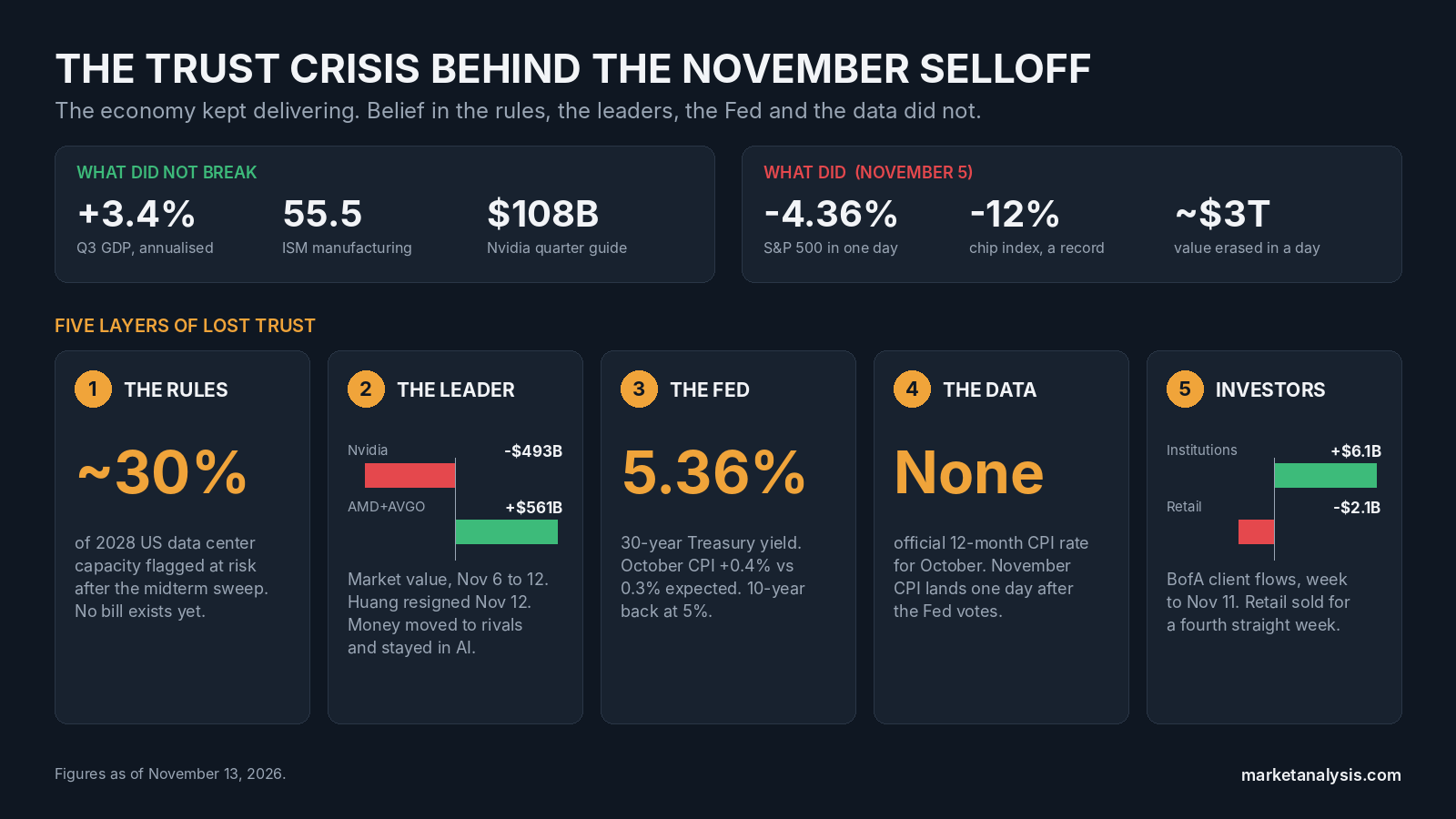
Then look at the tape. On November 5 the S&P 500 fell 4.36% to 7,353.73. The Nasdaq lost 5.5% and slid into correction. The Philadelphia chip index dropped 12%, a record one-day fall for that index. About $3 trillion went away in a single session, and the equal-weight index was as weak as the headline one. A week later the S&P closed out its worst week since April 2025.
Nothing in the fundamentals changed between Wednesday and Thursday. What changed was how much investors were willing to believe what they were being told. This market is in a trust crisis. And it is running on several floors of the building at the same time.
Trust in the rules
The trigger was political. Democrats took both houses in the midterms. The market rallied on Wednesday (the Dow added 1,569 points, its best post-midterm session in 44 years) and then reversed on Thursday. The fear was that a Democratic Congress would slow the data center buildout. Nobody could point to an actual bill. UBS put a figure on the worry, roughly 30% of 2028 US data center capacity potentially at risk under Democratic oversight. Within days Morgan Stanley and UBS were calling the rout overdone.
That is the tell. When investors dump a sector over a law that does not exist yet, they are pricing doubt about whether the rules will hold. Truist’s Keith Lerner called it a buyers’ strike in tech. A strike is a refusal. It says nothing about the earnings.
Trust in the man at the top
Then the most important company in the market lost its founder. On November 8 Jensen Huang told Nvidia staff he had been unfaithful to his wife, and the board opened an independent investigation into his relationship with a former Megaspeed executive whom US intelligence reportedly suspects of working for Beijing. Reports of a second relationship, with an executive who reported to him, followed. On November 12 he resigned as CEO, president and director. Colette Kress is interim CEO while keeping the CFO job, and Harvey Jones became the company’s first-ever board chair. Megaspeed denies any illegal chip transfers, Beijing calls the spy claim baseless, and Nvidia has said it found no sign that secrets were compromised. The market did not wait for any of that to be settled.
Here is the number that matters. From the November 6 close through November 12, Nvidia lost about $493 billion in market value. Over the same stretch AMD and Broadcom together added about $561 billion. The money did not leave AI. It left one company whose governance it stopped trusting, and walked across the street to its competitors. Bernstein halved its Nvidia target to $200, the third broker in two days to step back. The order book did not move. The discount is for key-person risk and a national security question mark hanging over the man who spent years negotiating Nvidia’s China business with Washington.
Trust in the Fed and in money
Inflation has been above the Fed’s 2% target for more than five years. October CPI rose 0.4% against a 0.3% forecast, core rose 0.3% against 0.2%. The Fed already hiked in September to 3.75%-4.00% under Kevin Warsh, and after the print Goldman Sachs moved to two more hikes with the first cut pushed out to December 2027. The 10-year Treasury yield went back to 5% and the 30-year rose to 5.36%.
A central bank hiking into 3.4% growth is doing its job. The trouble is that the market has stopped believing inflation will fade by itself, and it is no longer buying the Warsh argument that AI productivity will do the work for him. A 30-year yield at these levels is a trust price. Lenders want more to hold government paper for three decades because they are less sure what a dollar will be worth at the end.
Trust in the numbers themselves
This one is small but telling. The BLS could not publish a 12-month inflation rate for October, because last year’s government shutdown meant no October 2025 survey was collected. Bloomberg Economics backs out roughly 3.9%. November CPI lands on December 10, one day after the Fed votes. So the Fed will decide partly blind, and investors are pricing an annual inflation figure nobody has officially published. When the scoreboard has holes, people trust the score less.
Trust between investors
The most revealing data point of the month came from BofA’s client flows for the week to November 11. Institutions bought a net $6.1 billion of US stocks. Hedge funds were net buyers for the first time in four weeks. Retail sold $2.1 billion, its fourth straight week of net selling. Since the pandemic, retail has been the most reliable dip buyer in the market. It bought aggressively in April 2025. This time it went the other way.
Look at what retail sold and what it kept. It dumped close to $3.5 billion of individual stocks and added about $1.4 billion of ETFs. Small investors stopped trusting single companies and the people who run them, and kept trusting the market as a whole. After watching a founder-CEO fall in four days, that is a rational response. Investors Intelligence now shows bulls at 37% and bears at 24%, the most bearish reading since April.
Why a beat will not fix it
A trust problem does not get solved by a better quarter. It closes when the doubt is answered, or when prices fall far enough to pay people for carrying it. That is why stock-specific good news still works (AppLovin, Constellation) while the index keeps stalling. The market will reward a company it believes in. It just believes in fewer of them this month.
The test comes tonight. Nvidia reports after the close with Kress on the call for the first time in the company’s 27 years as a public company without Huang in charge. Anthropic prices its IPO on Wednesday, with 825 million shares marketed at $70 to $78, and is expected to start trading on Thursday as ANT. Reports put the book at about six times covered, so the money is there. What the market is short of is confidence in who is running things, and in the rules they run under.
Watch one thing. If Nvidia beats and the stock still falls, the thesis is confirmed: investors are grading the board, the succession and the China question, and the quarter is beside the point. The next real catalyst for Nvidia is the name of a permanent CEO, not a revenue line. For a running read on sentiment across the sector, see the AI Market Analyzer and its November 12 reading.
