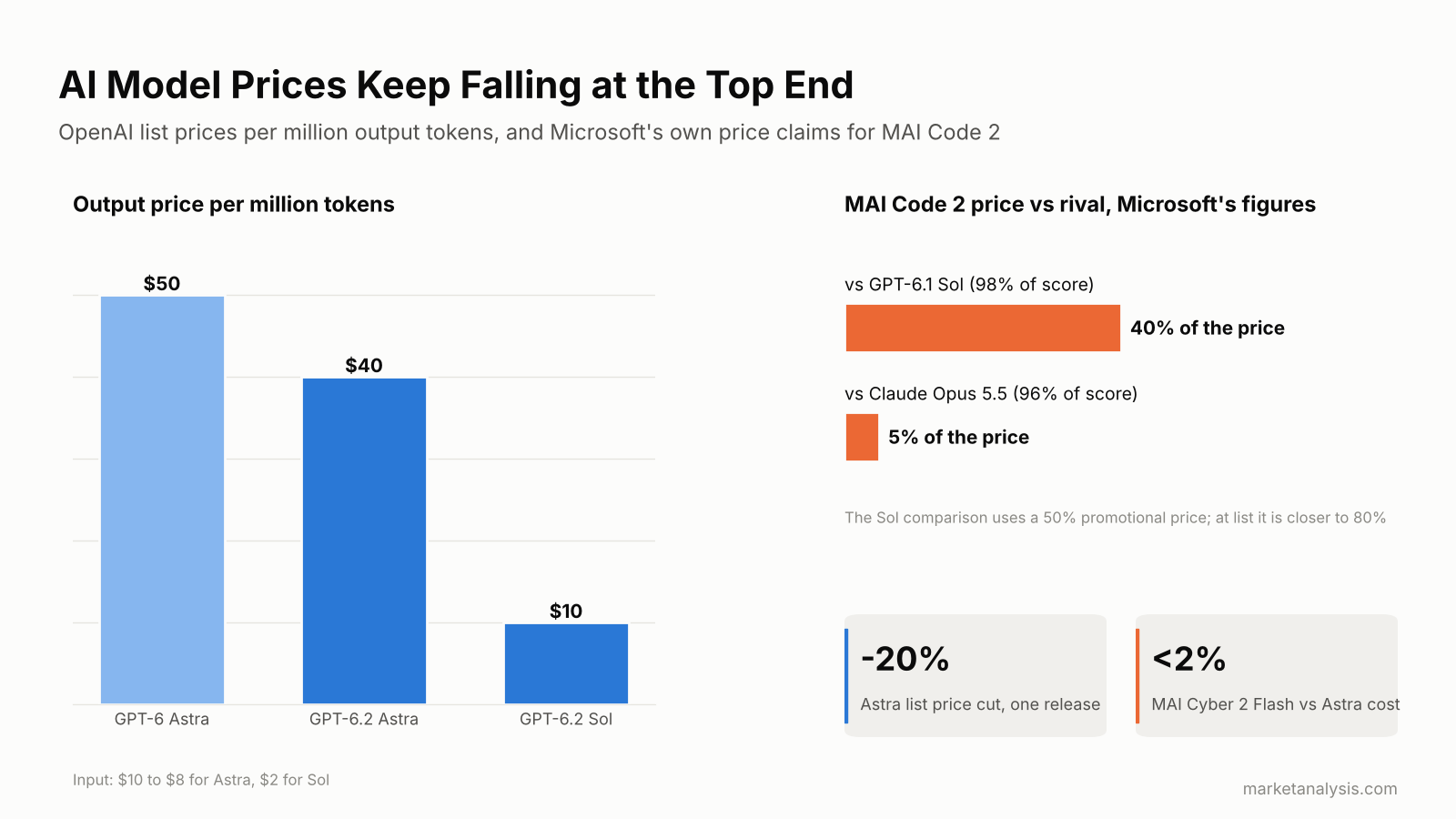
OpenAI released GPT-6.2 Astra and GPT-6.2 Sol on Tuesday in ChatGPT Work, Codex and the API. Astra now costs $8 per million input tokens and $40 per million output tokens, down 20% from GPT-6 Astra’s $10 and $50 at its September launch. Sol stays at $2 and $10. OpenAI says the new Astra sets records on its work and science evaluations at under a third of GPT-6 Astra’s cost per task. Artificial Analysis ranks it second only to Claude Fable 5.2 on its main index, flat against GPT-6 Astra in coding, and Epoch AI has it tied with Fable 5.2. Early hands-on reviews were rougher, with complaints that the model loses its way on long tasks.
Microsoft went further the same day. At Ignite it released a family of MAI models and said MAI Code 2 delivers 98% of GPT-6.1 Sol’s performance at 40% of the price, and 96% of Claude Opus 5.5’s at 5% of the price, averaged over four coding benchmarks. MAI Cyber 2 Flash, it says, matches GPT-6 Astra on a security benchmark at under 2% of the cost per task. These are Microsoft’s own tests, and the Sol comparison uses a 50% promotional price; at list, MAI Code 2 would be closer to 80% of Sol’s cost. Even so, the direction is plain.
Put this next to Nvidia’s quarter. The supplier of the compute grew revenue 103% and still earns close to 75% gross margins. The sellers of the output are cutting their prices by a fifth per release, with GPT-6 Sol in September already priced 50% below the GPT-5.6 Sol promotional rate. Memory, power and data center leases are all getting more expensive at the same time. Somebody absorbs that squeeze, and right now it is the model labs’ gross margin. They are betting that volume grows faster than price falls. So far it has: Anthropic’s run rate went from about $9 billion to $10 billion at the end of 2025 to $81 billion in October, as we noted in our Anthropic IPO post.
The Microsoft move matters more than the OpenAI cut. Microsoft is OpenAI’s biggest distributor and owns a large stake in it. MAI Code 2 ships inside GitHub Copilot, which means the channel now has its own product on the same shelf at a lower price. Every coding seat that routes to MAI instead of Sol is margin Microsoft keeps rather than pays out. It also gives Microsoft a credible answer to the cost of Copilot, which it is turning into the front door for Office work (see our Copilot post).
OpenAI’s president Greg Brockman argued at the Astra launch that pricing per token makes no sense and buyers should look at price per completed task. That is the right unit, and it is the one where specialized models like MAI Code 2 win, because most coding work does not need a frontier generalist. It also means frontier pricing power now rests on the hardest tasks only, a smaller slice of total volume each quarter.
There is a side effect worth naming. Cheaper frontier output is also cheaper training data for anyone distilling it into smaller models, and that is now mainstream practice in China (see our post on distillation). The number to watch is the next disclosed gross margin from a frontier lab. Anthropic’s first public quarter will show whether a 20% price cut per release is a choice or a necessity.
