Tencent reported third-quarter revenue of RMB207.34 billion, about $31.1 billion, up 8% from a year ago and below the roughly RMB210.5 billion analysts expected. Operating profit fell 7% to RMB59.15 billion against estimates near RMB66.6 billion. Non-IFRS operating profit fell 6% to RMB68.1 billion. Profit attributable to shareholders still edged up 0.8% to RMB63.6 billion, but that came from below the operating line. For a company whose profit has outgrown its revenue quarter after quarter for years, this is the first real decline in a long time.
The number that explains it sits in the filing’s own breakdown. Excluding what Tencent calls its new AI products (Hy, Yuanbao, CodeBuddy, WorkBuddy and Xiaowei), non-IFRS operating profit rose 8% to RMB83.3 billion. With them, it fell to RMB68.1 billion. The difference is about RMB15.2 billion in a single quarter, roughly $2.1 billion. That is what Tencent is paying to run AI products to consumers and businesses before they earn their keep, and it is the cleanest measure any Chinese platform has given of what the AI push costs.
Capex is the other half of the story. Tencent spent RMB81.4 billion in the quarter, about $11.4 billion, against expectations of RMB55.4 billion and roughly RMB13 billion a year earlier. Capex reached about 39% of revenue, up from 6.7% in the same quarter of 2025, 16.3% in Q1 and 25.8% in Q2. Cash paid for capex jumped 225% to RMB65.1 billion. Free cash flow was negative RMB69.1 billion, including large prepayments for compute. Tencent has swung to net debt. General and administrative expenses rose 29% to RMB44.08 billion, which is where much of the AI research cost lands.
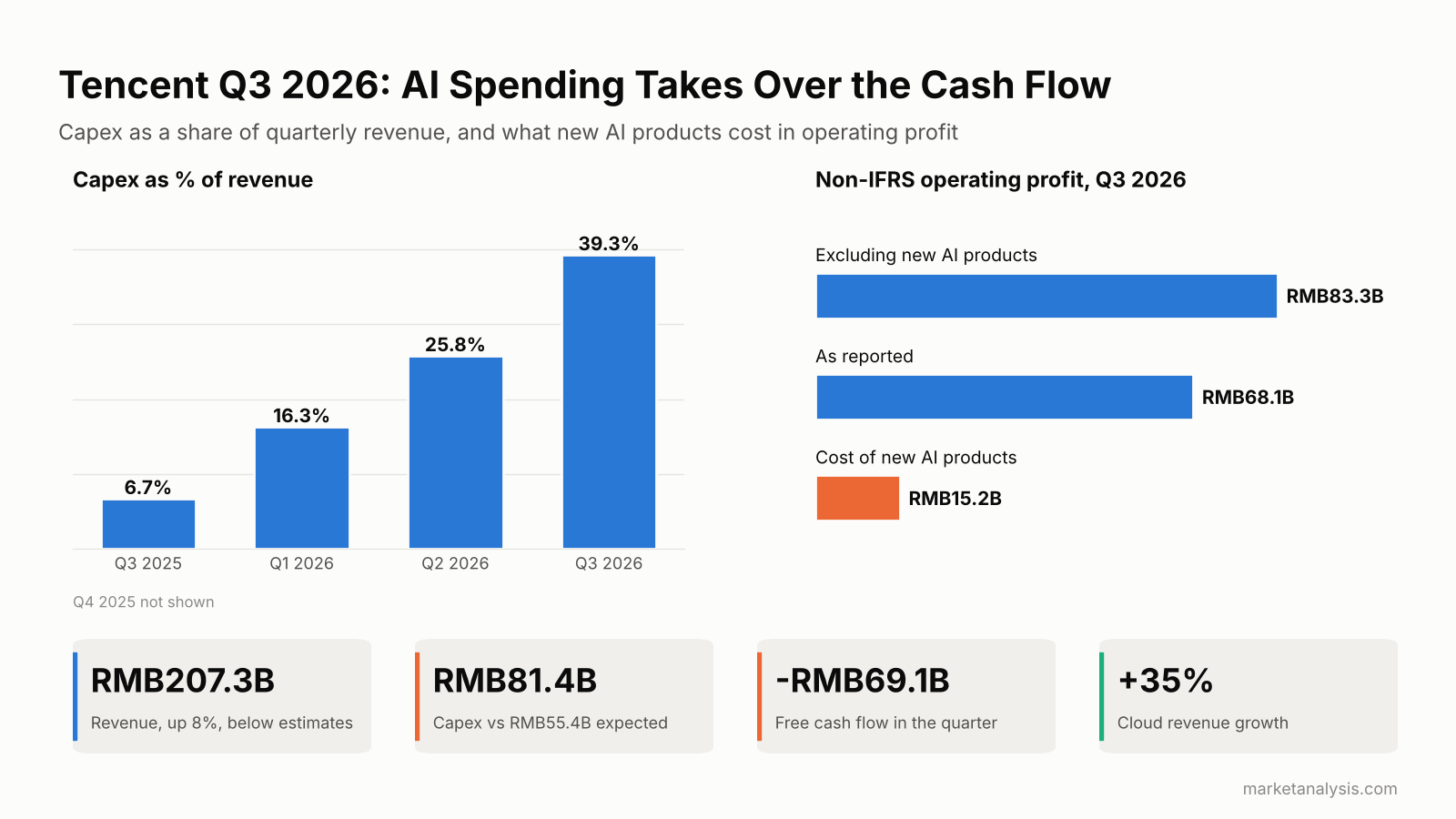
A year ago Tencent was the cautious one. It cut capex in Q3 2025 and blamed limited access to AI chips, and the market treated its restraint as discipline. That stance is gone. Tencent is now spending at a share of revenue above what the US hyperscalers spend, and the timing is awkward. Nvidia has just stopped shipping H200s to China, and a new US rule blocks Chinese companies from renting advanced chips in data centers in Malaysia, Singapore and other third countries (see our post on the new export controls). The compute Tencent prepaid for has fewer places to come from than it did a year ago, and domestic accelerators are the obvious beneficiaries.
The moat argument still holds, at least on the revenue side. Marketing services grew 19% as AI-driven ad ranking improved conversion, and cloud revenue rose 35%. WorkBuddy, its agent product for work, has more than 10 million daily active users consuming over 100 trillion tokens a day. WeChat gives Tencent distribution that no stand-alone Chinese AI app can buy, which is why it can afford to run these products at a loss for a while. The weak spot is games, where growth slowed, and games are what pays for the rest.
Read the quarter as a choice, and the stock reaction as a vote on it. Tencent has decided that AI products are worth about RMB15 billion of operating profit a quarter now, against a payoff later in ads, cloud and agents. The decision-relevant figure for Q4 is that gap. If it narrows while token volumes keep rising, Tencent is learning to charge for AI. If it widens again with capex still near 40% of revenue, the market will start valuing Tencent less like a cash machine and more like a capital-intensive cloud company, and those trade on very different multiples.
