Microsoft opened Ignite on Tuesday by making Word, Excel and PowerPoint generally available inside Copilot. Users can now create and edit documents, workbooks and decks directly in the Copilot app, with the files still editable in the standalone apps. Satya Nadella called Copilot “the new OS for work”. Copilot Home, which puts Chat and Cowork in one place, is also generally available, as is Copilot Managed Runtime for hosting what people build. Copilot Code reaches general availability in December. Autopilot, an always-on agent that handles routine work such as scheduling and drafting replies, starts rolling out through Microsoft’s Frontier program with usage-based Copilot Credits pricing that Microsoft has not disclosed yet.
The change sounds cosmetic. It is not. For thirty years the Office user started in an app and called up help when needed. Now the user starts in an agent and the app is called up when needed. The document becomes an output of a conversation, and Word, Excel and PowerPoint become rendering engines behind it. Whoever owns the place where work starts owns the relationship with the user, and Microsoft has just moved that place from its applications to its AI layer.
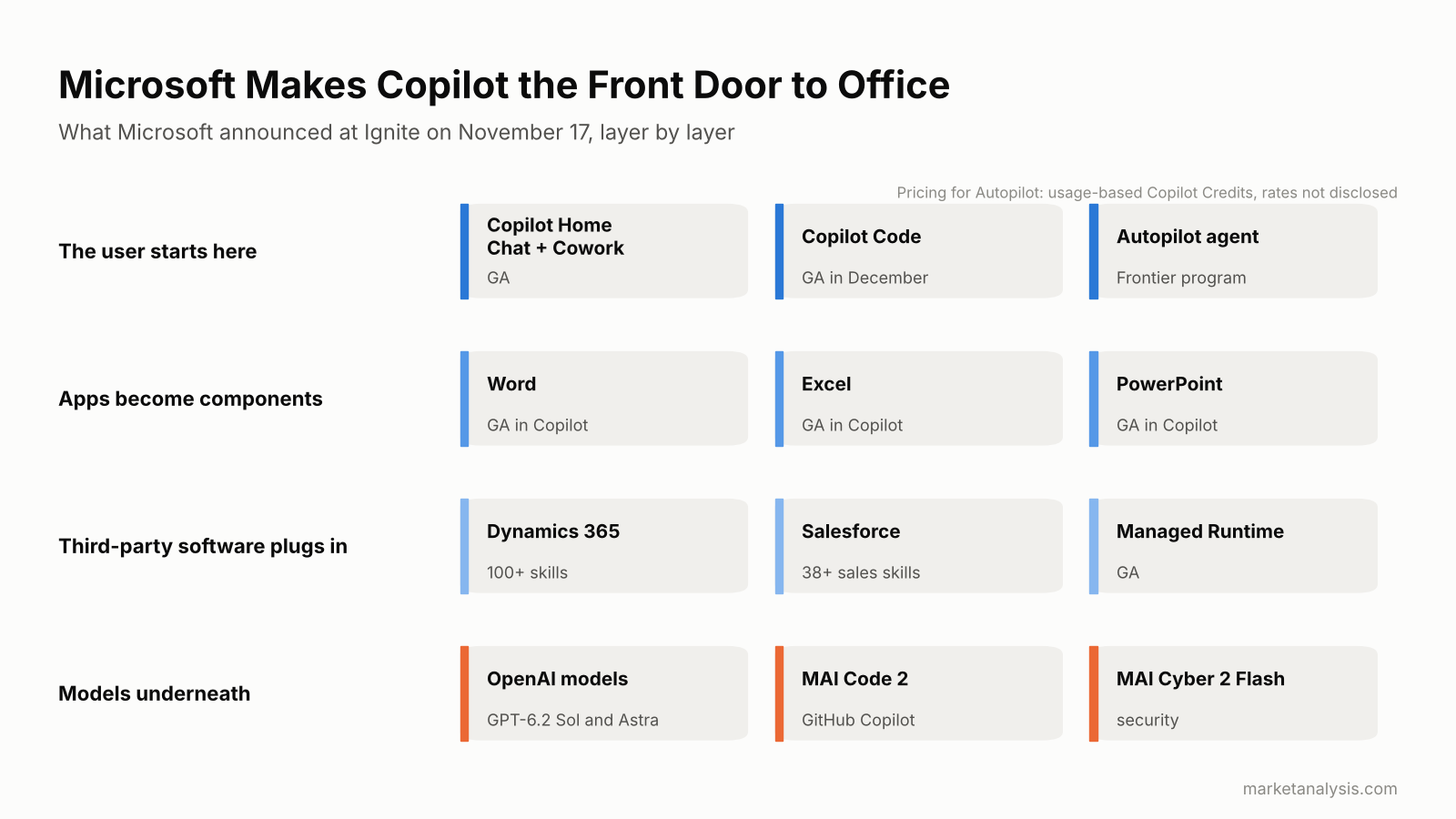
Look at what plugs in underneath. Microsoft announced Copilot plugins for Dynamics 365 with more than 100 skills and for Salesforce with more than 38 sales skills. Salesforce is the telling one. A CRM vendor whose product is reached through Microsoft’s agent is a supplier of skills to someone else’s front door. That is the risk every per-seat software company faces in this shift: the seat stops being where the work happens, and the value of a seat drops with it. This is the most concrete version of the AI threat to enterprise software so far.
The pricing matters as much as the product. Usage-based Copilot Credits would tie Microsoft’s revenue to how much work its agents do, not to how many people hold a license. That is closer to a cloud meter than a software subscription. It also makes model cost a direct input to Microsoft’s margin, which is why the same keynote introduced Microsoft’s own MAI models, including MAI Code 2 at a fraction of the price of OpenAI’s equivalent (see our post on AI model prices). Owning cheaper models is how a metered agent business keeps its margin as usage grows.
There is a concentration question the keynote did not dwell on. Last week a Microsoft 365 outage began in Switzerland and spread as failover systems shifted traffic, leaving more than 80% of Exchange servers unresponsive. Putting more of the working day behind one front door raises the cost of the next outage for every customer at once. We look at the wider wave of failures in our post on the patch rush.
For investors the number to watch is the Copilot Credits rate card, when Microsoft publishes it. A price per action set high enough to cover model costs with room to spare means the agent layer adds margin on top of Microsoft 365. A low rate set to win adoption means Microsoft is willing to compress margin to own the front door before Google and the AI labs can.
