The Commerce Department’s Bureau of Industry and Security issued a rule on Monday that blocks Chinese companies from remotely using advanced US chips housed in data centers in third countries. It took effect immediately. The 132-page rule also adds case-by-case license requirements for advanced chips sold to companies headquartered in Malaysia, Singapore, Thailand, Indonesia and Brazil, which it says carry a higher than normal risk of diversion. The House has separately passed the Remote Access Security Act, which would give Washington standing authority to police cloud access to controlled technology.
Until now US export controls governed where a chip physically went. Once a GB300 sat legally in a data center in Johor, a Chinese AI lab could rent its compute and train on it, and nothing in the rules followed the chip that far. Monday’s rule closes that gap. It regulates who uses the chip, not just who owns it, and it puts the burden on the operator of the data center.
Southeast Asia took it hard. Governments across the region spent Tuesday working through the document while President Trump headed to the ASEAN summit in Manila and then to Shenzhen to meet Xi Jinping. The region’s data center boom has been fed in large part by Chinese tenants using it to reach compute they could not import. A rule that removes those tenants removes the marginal buyer for a lot of capacity that is built or under construction, and the license requirement slows the arrival of new chips for everyone else.
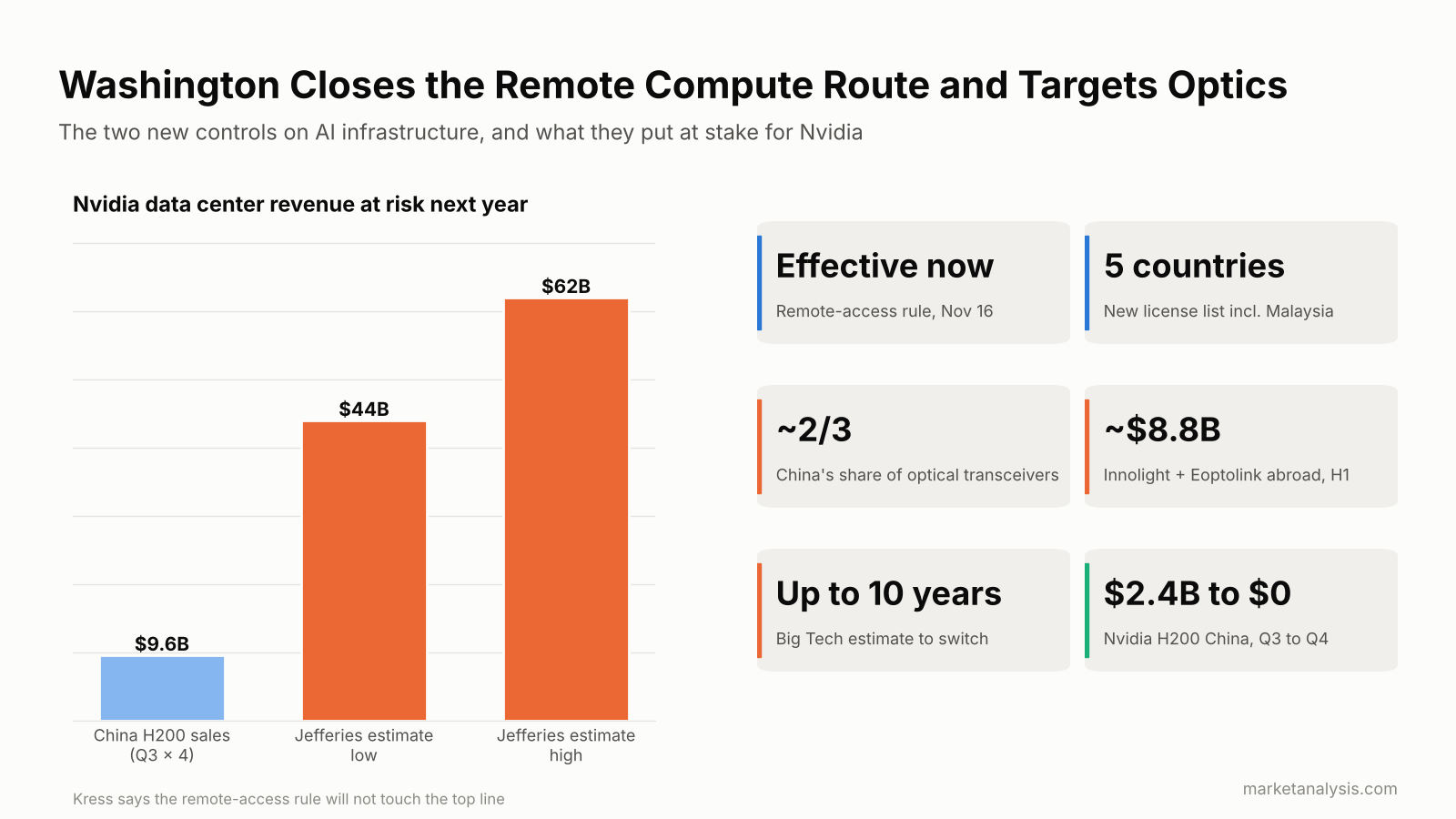
Nvidia sits in the middle of it. Interim CEO Colette Kress said on Tuesday’s call that Nvidia is no longer shipping licensed Hopper data center products to China, ending the H200 arrangement that let Washington collect a 25% tariff. Those sales were $2.4 billion last quarter, about $9.6 billion annualized. The remote-access rule is a much larger exposure. Jefferies estimates it could cut $44 billion to $62 billion from Nvidia’s data center revenue next year. Kress says the rule will not touch Nvidia’s top line, presumably because demand elsewhere absorbs the capacity. Nvidia has also warned customers that the Remote Access Security Act could expose them to US legal action if Chinese companies reach their chips remotely, and its board has set up a National Security and Export Control Oversight Committee. Documents reported this week show Nvidia’s Singapore unit accounted for close to half of its revenue in 2025, which is why this region matters so much to the company (more in our Nvidia earnings post).
The second control hits the optics. The administration is pressing ahead with an FCC effort to ban US imports of new models of Chinese optical transceivers, the modules that move data over fiber between servers, despite lobbying from Amazon, Google, Meta, Microsoft, CoreWeave and Cisco. China supplies about two-thirds of the world’s optical transceivers, and the two leaders, Innolight and Eoptolink, sold roughly $8.8 billion of product abroad in the first half of 2026. Big Tech has told Washington that replacing them could take up to a decade. The FCC’s September rule left both companies off its restricted list, so the market had treated the threat as shelved. It is back.
The obvious winners are the Western optics makers such as Lumentum and Coherent, which would gain pricing power on every 800G and 1.6T module the hyperscalers can no longer source from China. The catch is upstream. They depend on indium phosphide, a material Beijing put under export controls in 2025. A US ban on Chinese modules hands Beijing a lever on the substitutes.
Taken together, the two moves raise the cost of building AI capacity outside the US and China at the same moment that Ohio voters are making it harder inside the US (see our Ohio post). The figure to watch is the license approval rate for Malaysia over the next sixty days. Fast approvals mean the rule targets tenants. Slow ones mean it targets the region.
