Anthropic is set to price its IPO tonight and start trading on Nasdaq on Thursday as ANT. Bankers have been telling investors to expect a price at or above the top of the $70 to $78 range, and the book is reportedly about six times covered. The offering is 825 million Class A shares, 801.4 million of them new. At $78 it raises about $64.35 billion before any over-allotment, valuing the company at roughly $1.02 trillion on the basic share count and about $1.4 trillion fully diluted. A $26 billion private placement from Nvidia, Google and others runs alongside it.
The range was already a step down. Earlier drafts and pre-IPO trading had pointed at $2 trillion or more. Three of Anthropic’s backers have said the company now cares more about raising cash for its computing bill than about squeezing out the highest valuation. That framing explains the deal better than any multiple does. This is a financing event for a compute program, and the equity is the cheapest money available for it right now.
The bill is in the amended S-1. It shows $900.9 billion of purchase commitments and leases, mostly for compute and infrastructure, running through 2045, with most of the spending falling between 2031 and 2045. The structure behind it is called Anthropic Direct. Anthropic leases chips and data center shells separately and runs them to its own specifications, instead of renting finished capacity from AWS, Google Cloud and Azure alone. The first gigawatt tranche is about 875,000 Google TPUs at around $7.2 billion a year for five years, with an option to buy the chips for $95 each at the end. The flagship site is River Bend in Louisiana, a 245 MW campus where about 1,300 workers are racing to finish the buildings.
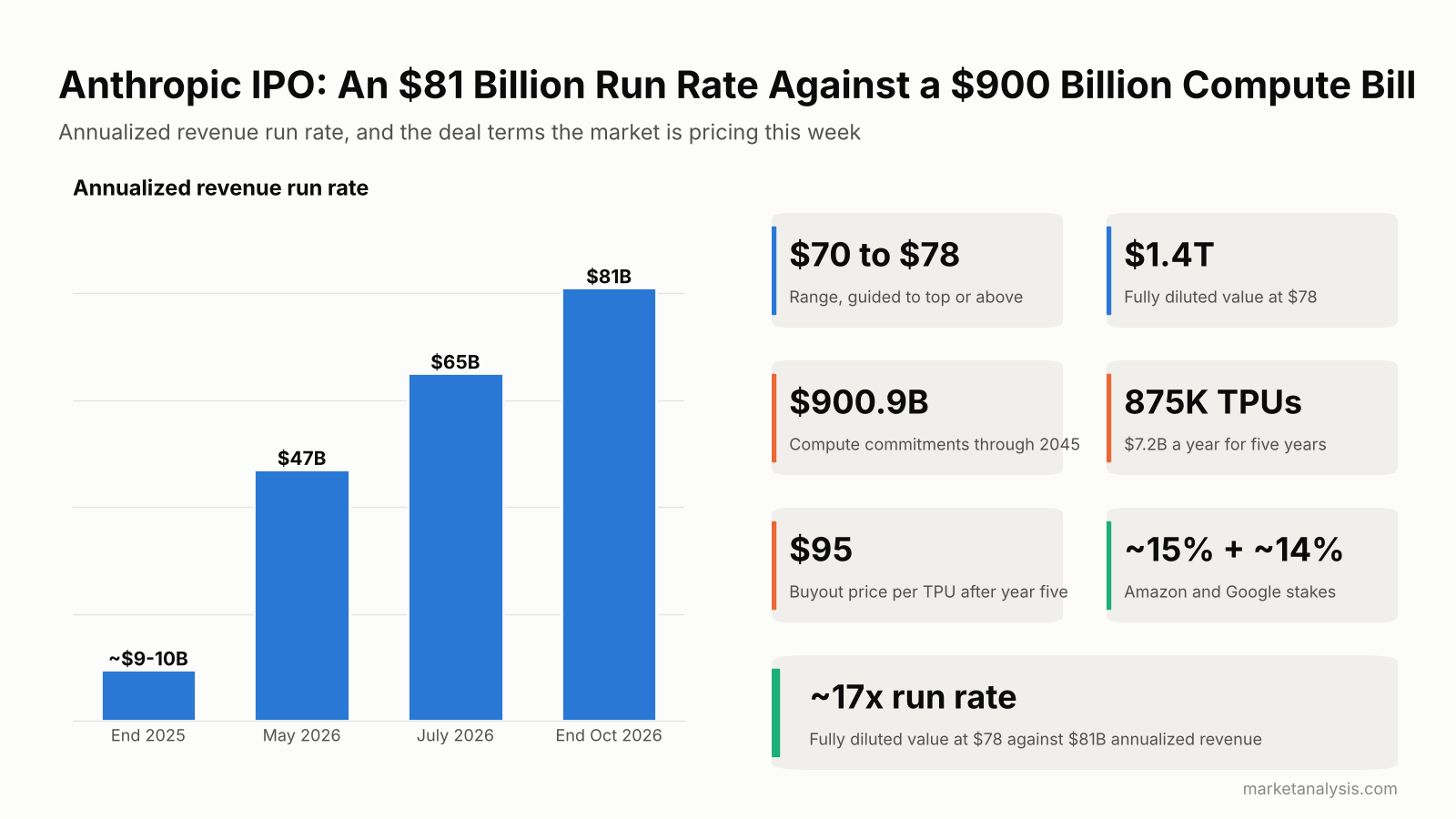
Run the TPU lease through. Five years at $7.2 billion is $36 billion for 875,000 chips, roughly $41,000 per chip, and then $95 to own it. Both sides are pricing the hardware at close to zero after year five. That is a hire-purchase dressed as a lease, and it locks in the same five-year useful life the hyperscalers use in their own depreciation schedules. If the chips stay useful longer, Anthropic gets cheap compute in 2031. If they don’t, Google has already been paid.
On the revenue side, Nvidia’s interim CEO Colette Kress put Anthropic’s annualized revenue at $81 billion at the end of October, on Nvidia’s own earnings call. The run rate was about $9 billion to $10 billion at the end of 2025, $47 billion in May and $65 billion in July. At $1.4 trillion fully diluted the stock would trade at about 17 times that run rate. The commitments, on the other hand, are about eleven years of current revenue. The S-1 notes these commitments can’t simply be summed into one unconditional obligation, and that is fair. But the order of magnitude is the point. Public shareholders are being asked to fund a buildout sized for a company several times larger than today’s.
The cap table is circular in a way the market has not seen at this scale. After the IPO and the placement, Amazon is set to hold almost 15% of Anthropic’s outstanding stock and Google about 14%, mostly in non-voting shares. Google sells Anthropic its TPUs and cloud capacity. Amazon sells it AWS capacity. Nvidia is in the placement and counts frontier labs, Anthropic among them, as about 15% of its data center sales this year (see our post on Nvidia’s quarter). Each of the three is an investor, a supplier and, through Anthropic’s revenue, a beneficiary of the same dollars.
Then there is the wealth effect. One estimate puts the combined equity held by insiders at San Francisco AI startups at $1.2 trillion, and at the IPO midpoint the average Anthropic employee’s stake is worth about $72 million. Venture returns get rearranged too. Smaller early backers such as Spark Capital are set for returns that larger, better-known firms will not match. Most of that paper wealth can’t be sold yet. Lockups on large IPOs typically run about six months, so the first real supply test for ANT arrives in the spring, not this week.
The IPO lands in a nervous market, which we described in our post on the trust crisis. Strong demand for ANT would say investors still trust the AI build when it comes with audited numbers. The figure to watch tonight is simple. A price above $78 means buyers are paying up for the compute program as disclosed. A price inside the range means they are buying the revenue and discounting the commitments.
