Nvidia reported $115.8 billion in revenue for the quarter ended October 25, up 103% from a year ago and 20% from the quarter before. The Street had about $109.1 billion. Nvidia’s own guide was $108 billion. Data center revenue came in at $107.6 billion, up 110%, against estimates near $101.9 billion. Non-GAAP earnings were $2.68 a share. Vera Rubin NVL72 has shipped. The fourth-quarter guide is $130 billion, plus or minus 3%, and the stock rose about 4% after the print.
The line that matters more sits one row lower in the outlook. Gross margin for the January quarter is guided to 71% to 72%, GAAP and non-GAAP alike. Q3 came in at 74.9% non-GAAP, and Nvidia has held close to 75% for four quarters in a row. On $130 billion of revenue, the gap between 74.9% and the guided range is somewhere between $3.8 billion and $5.1 billion of gross profit that the old margin would have produced. That is more than the entire China business Nvidia just walked away from, and it arrives in the same quarter.
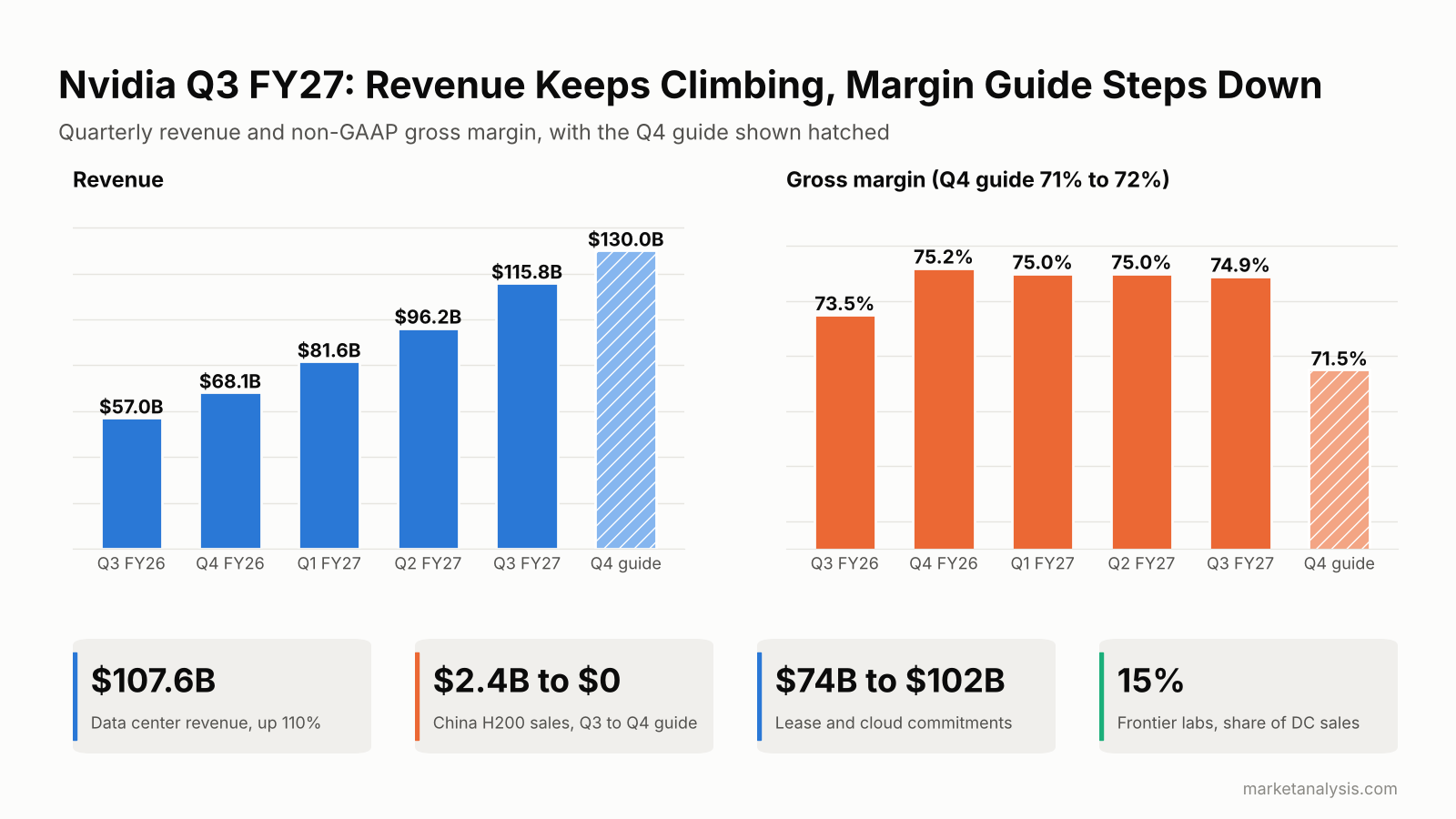
The release does not explain the drop in one sentence. Two causes are likely. A new platform ramp usually runs below the old one in its first quarters, and Rubin is now shipping in volume. Memory also costs far more than it did a year ago, and Nvidia buys a lot of it (our Memory Cycle Gauge still reads Tightening). Either way, the guide says that for the first time in this cycle Nvidia is growing revenue faster than it can protect its margin.
The moat is changing shape, too. Interim CEO Colette Kress said frontier labs such as OpenAI and Anthropic make up about 15% of data center sales this year, and she put Anthropic’s annualized revenue at $81 billion at the end of October. Nvidia’s data center lease commitments and cloud service agreements rose to $102 billion from $74 billion a quarter earlier. Nvidia is renting capacity, helping neoclouds secure land and power, and getting paid upfront for it. That is a balance-sheet moat. It finances its own demand. Kress also said Nvidia will stay “disciplined and selective” in supporting neoclouds. CoreWeave and Nebius still jumped more than 9% in premarket trading, because the market heard continued support with conditions attached, and that was better than it feared.
China is now out of the numbers entirely. Kress said Nvidia is no longer shipping licensed Hopper data center products to China, which ends its part in the H200 arrangement brokered by Huang and President Trump that let Washington collect a 25% tariff. Those sales were $2.4 billion in Q3, about 2.2% of data center revenue, and China had refused much of the delivery anyway. The bigger question is the new remote-access rule. Jefferies estimates it could cut $44 billion to $62 billion from Nvidia’s data center revenue next year. Kress says it will not touch the top line. We cover the rule in a separate post on the export controls.
Then the governance. Board chair Harvey Jones opened the call by saying the board unanimously accepted Huang’s November 12 resignation and does not intend to reinstate him, and he took no questions on it. Hours earlier Huang had said he “would be honored” to come back if the board decided it was in the best interest of shareholders, staff and the country. A faction of directors is reportedly still pushing for his return. A director of developer technology wrote to the board that leaving Huang out could cost Nvidia irreplaceable talent. Reports say Huang’s daughter Madison, a marketing director, helped steer the company’s response to the Megaspeed scrutiny and temporarily sidelined a senior communications executive. Trump said he would not mind a return.
The regulators are moving at the same time. The SEC is reportedly investigating whether Nvidia’s disclosures misled investors. Documents reported this week show Nvidia stopped reporting its Singapore unit’s revenue separately in 2025, when that unit accounted for close to half of global revenue; it grew 72% to $104 billion that year. The Commerce and Justice departments say their joint probe of Singapore-based Megaspeed began in 2024, and that Nvidia put Megaspeed on a “no sell” list in June 2025. Other reports say Nvidia twice introduced Alibaba to Alice Huang in 2022. The board has set up a National Security and Export Control Oversight Committee, and Huang is due before the House Foreign Affairs, Intelligence and China committees on December 1.
The stock carried most of this already. Between the November 6 close and November 12, Nvidia lost about $493 billion in market value while AMD and Broadcom added about $561 billion, as we wrote in our post on the trust crisis. A 4% bounce on a $7 billion beat is a small recovery of that. The order book was never the problem. The board, the China question and the SEC are, and none of them is settled by a quarter.
Kress closed the call with “We’ve got this.” The next number that tests it is the January-quarter gross margin. If it lands near 72% and the April guide moves back toward 75%, the drop was the cost of the Rubin ramp and memory. If the April guide stays near 71%, Nvidia is giving up margin to hold share against AMD, Broadcom and in-house chips, and the market will price that well before it prices the name of a permanent CEO.
