Binary files are hard to read. Open one in a hex editor and you get a wall of numbers. Edit a value by hand and you can break a size field or a checksum somewhere else in the file without noticing. And the format itself usually gets described three times, once in a reader, once in a writer, once in a hex editor template, and the three copies drift apart. EByte describes a … [Read more...] about EByte Describes a Binary File Format Once and Uses It to Read, Edit and Write Files Byte for Byte
startups and funding
BitSpeed Shows Where HTTP Request Time Goes and Resumes Big File Transfers Without Resending Bytes
Two questions eat a lot of developer and operator time. Why is this request slow, and where exactly did the time go? And how do you move a large file over a shaky link without starting from zero every time the connection drops? BitSpeed answers them with two independent Go tools. BitSpeed Inspect records HTTP requests, shows which measured interval took the time, and compares … [Read more...] about BitSpeed Shows Where HTTP Request Time Goes and Resumes Big File Transfers Without Resending Bytes
Aftermarket Repairs and Adapts Shipped Software Without Touching Its Source Code
Software keeps running long after its assumptions stop holding. An upstream API renames a field. A vendor retires an endpoint. A client that can't be rebuilt still expects the old shape of the data. The source is lost, frozen, belongs to someone else, or simply isn't worth reopening. Something has to sit in between and bridge the gap. Aftermarket borrows its idea from cars. A … [Read more...] about Aftermarket Repairs and Adapts Shipped Software Without Touching Its Source Code
XKV Is a Key-Value Store That Remembers Who Changed Every Value and Why
Outages and angry support calls often start with a small value that changed. A credit limit. A price. A timeout. A feature flag. More and more often, a setting an AI agent touched. The store holds the new value and nothing else. The reason lives in a log, a chat thread, a ticket or somebody's memory, and three weeks later nobody can say why it's 50 instead of 100. XKV, short … [Read more...] about XKV Is a Key-Value Store That Remembers Who Changed Every Value and Why
Abbreviatory Shrinks a 5.6 MB Log to a 3 KB Report for Coding Agents Without a Language Model
Test runs, builds and services print far more than anyone reads. Coding agents read it anyway, all of it, and pay for every token. Then they read it again after the next change. The common fix is to have a language model summarise the output, but a summary can drop the one line that mattered, and it won't tell you what it left out. Abbreviatory takes the opposite approach. It … [Read more...] about Abbreviatory Shrinks a 5.6 MB Log to a 3 KB Report for Coding Agents Without a Language Model
Bootstrapping Updates an Application’s Seed Data on Every Release Without Overwriting Admin Edits
Every application ships with rows it needs to run. Roles and permissions. Plan tiers. Workflow states. Country and currency lists. Email templates. They change with each release, and customers' admins edit them too. Then comes the upgrade, and somebody's careful edit gets wiped, or the change the release was supposed to make never lands. Bootstrapping keeps that reference data … [Read more...] about Bootstrapping Updates an Application’s Seed Data on Every Release Without Overwriting Admin Edits
jvq Fails the Pull Request That Makes Your Code Slower and Its Sister Tool Queries JSON Lines 19 to 31 Times Faster Than jq
Code gets slower one pull request at a time. Nobody means it. A small change here, a convenient library there, and each one passes review because nobody measured it. Months later the product is noticeably slower and there's no single change to blame. jvq measures every one. It's a performance budget gate for CI: it runs your benchmarks on the base branch and on the change, … [Read more...] about jvq Fails the Pull Request That Makes Your Code Slower and Its Sister Tool Queries JSON Lines 19 to 31 Times Faster Than jq
LQO Finds the PostgreSQL Queries the Planner Gets Wrong and Proves Which Setting Makes Them Faster
Some PostgreSQL queries are slow without being big. The planner picks plans from estimated row counts, and those estimates can be off by a factor of a thousand, often because two related columns are invisible to the statistics. A query that should take 40 milliseconds takes four seconds. A good DBA knows the fix routine: run EXPLAIN ANALYZE, find the bad join, try … [Read more...] about LQO Finds the PostgreSQL Queries the Planner Gets Wrong and Proves Which Setting Makes Them Faster
FlowChassis Runs Multi-Step Jobs in Go That Resume After a Crash and Undo Themselves on Failure
Plenty of jobs come in steps that have to finish together or not at all. An order reserves stock, charges a card and books a courier. A sign-up creates an account, sets up billing and sends a welcome email. A device update downloads, verifies and installs. The risk is always the same: the process dies halfway, and you're left with a charged card and no courier. There are two … [Read more...] about FlowChassis Runs Multi-Step Jobs in Go That Resume After a Crash and Undo Themselves on Failure
Screening Startup and Product Ideas After a Brainstorm: Four Questions, Money First
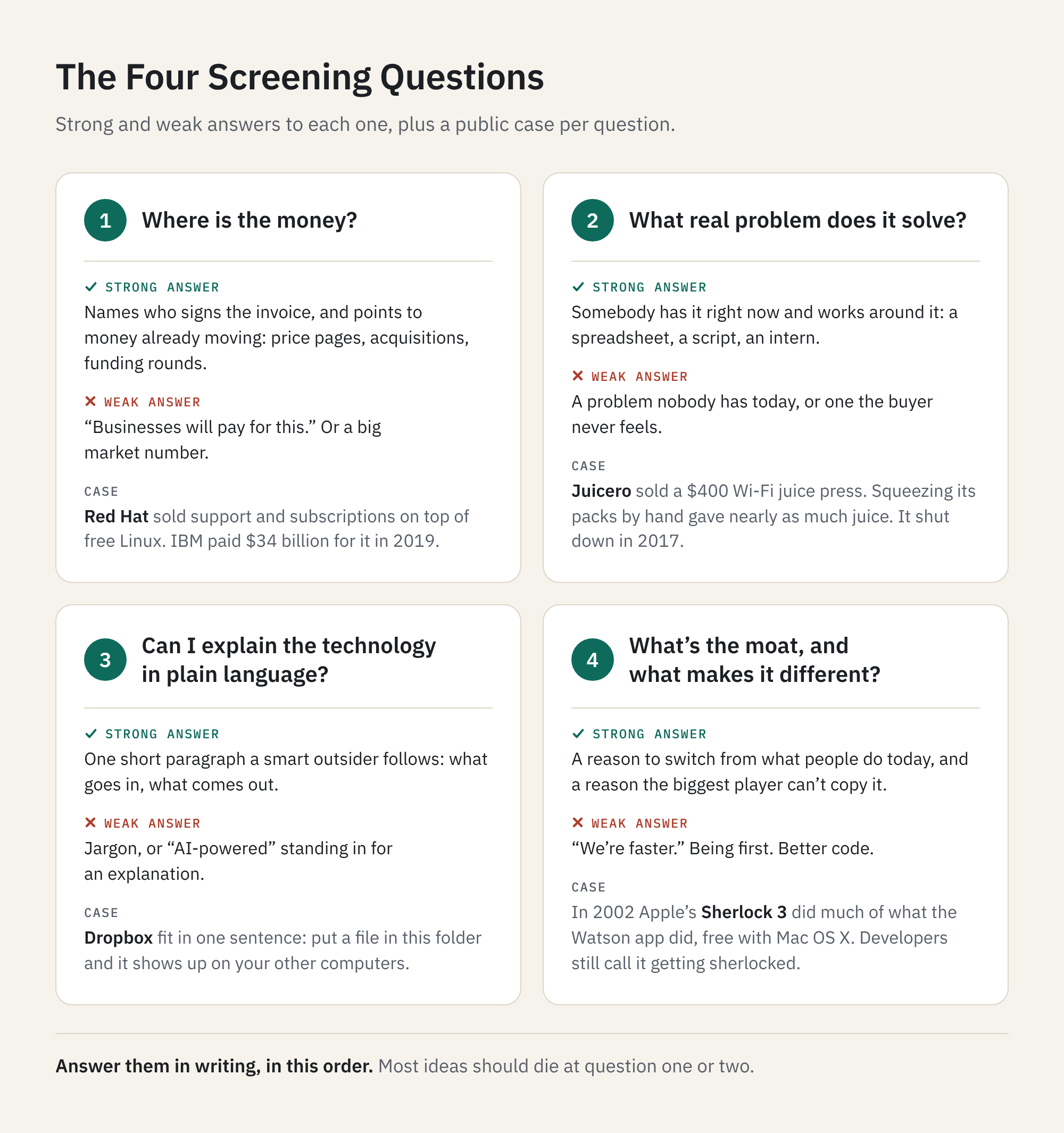
A brainstorm is the cheap part. An hour gives me a page of ideas (products, tools, the odd technology bet, now and then a whole company). On the page they all look good. Building any one of them takes weeks, often months. So nothing gets built until it answers four questions in writing. Where is the money? What real problem does it solve? Can I explain the technology in … [Read more...] about Screening Startup and Product Ideas After a Brainstorm: Four Questions, Money First
