The US Commerce Department is drafting rules to stop Chinese companies from renting advanced Nvidia processors in data centers outside China. According to reporting from The Information and the Wall Street Journal last week, the Bureau of Industry and Security could extend licensing requirements to seven countries: Singapore, Malaysia, Thailand, Indonesia, Brazil, Norway and South Africa. The announcement could come this month. The package is also expected to formally repeal the Biden-era AI diffusion rule.
The timing is not a coincidence. Jensen Huang’s resignation from Nvidia on November 12, and reports linking the scandal to a firm with ties to Singapore and Malaysia, removed the most effective lobbyist against tighter rules. Singapore charged a fifth person in an AI server fraud case on Friday, and Malaysia is investigating whether imported AI chips were shipped on. Earlier this year a $2.5 billion Super Micro diversion indictment and BIS guidance of May 31 already required an export license for any customer whose ultimate parent sits in China, regardless of where the data center is.
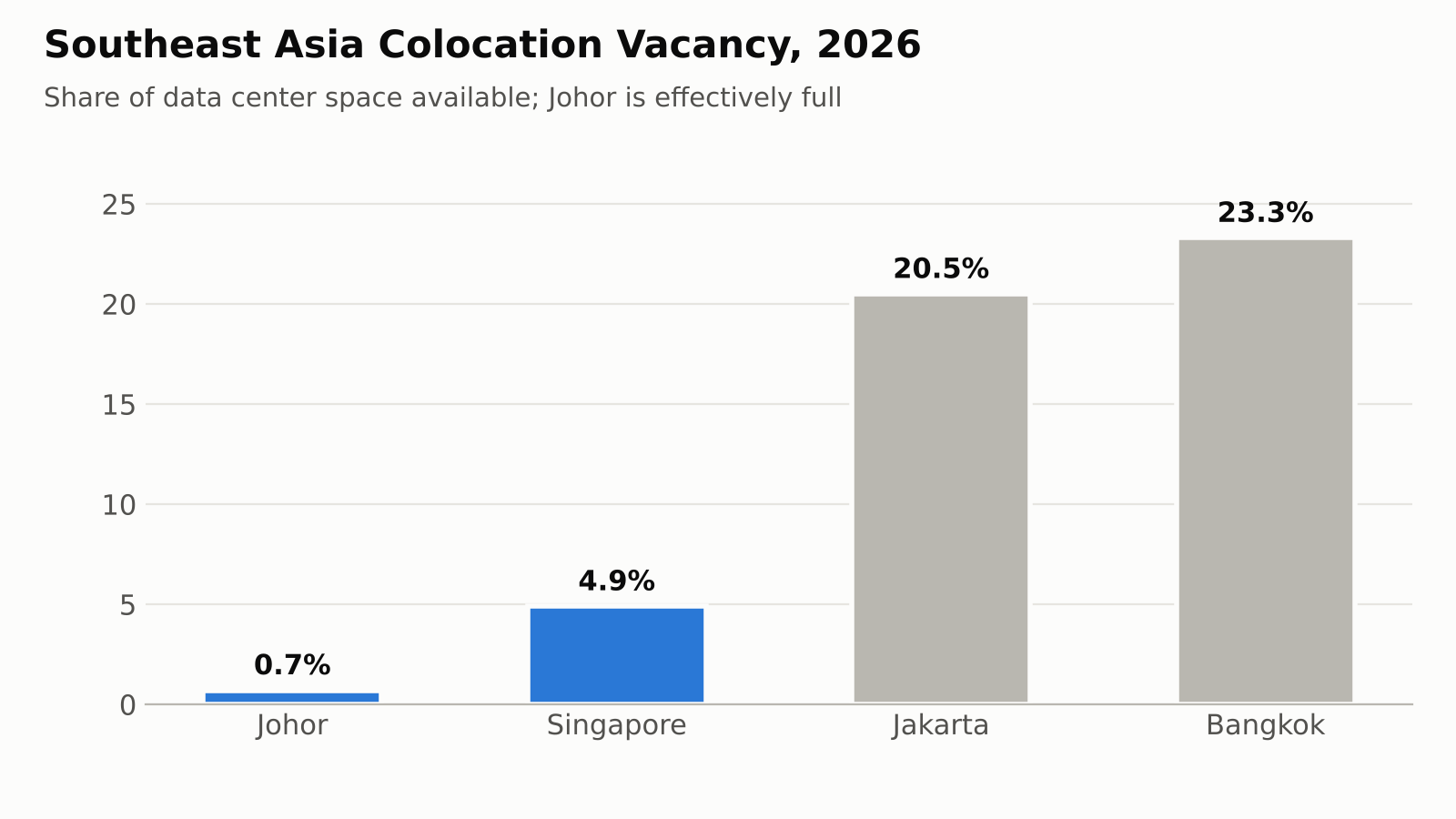
The fear in the region is a demand hole. A former Malaysian deputy trade minister told Bloomberg that Malaysia would take the brunt of any drop in demand, with spillover into Thailand and Indonesia. That is a real risk for operators whose business was renting compute to Chinese model labs. But the region’s numbers say capacity is short, not long. Johor had 1,110 MW of operational IT capacity in the first half of 2026, up from 94 MW in 2023, with 602 MW under construction and 2,486 MW in planning. Its colocation vacancy rate is 0.7%, against 4.9% in Singapore, 20.5% in Jakarta and 23.3% in Bangkok. Malaysia has 1,039 MW under construction, the most in Southeast Asia, and Thailand 859 MW.
A market at 0.7% vacancy does not empty out because one class of tenant is barred. It re-lets. Hyperscalers have been short of powered space all year, and the big five plan roughly $725 billion of capex in 2026. Microsoft is building a cloud region in Johor Bahru. The draft rule reportedly exempts US corporate data centers that block access from arms-embargoed countries and report their customers and compute scale. That is close to a description of how AWS, Microsoft and Google already operate. The rule pushes capacity toward exactly those tenants.
So the most likely outcome is a change in who fills the halls and at what price. Operators who were selling to Chinese labs at a premium will have to re-sign Western cloud or regional enterprise tenants, probably at lower rates and with longer contracts. Some projects that were underwritten on Chinese demand will be delayed or sold. The Johor-Singapore Special Economic Zone may see slower land deals. Those are real costs, but they fall on specific sponsors. The AI compute that would have been deployed does not vanish. It gets deployed by a compliant owner, in the same building or the next one.
For global AI growth, the more important point is that Nvidia already assumes no data center compute revenue from China in its guidance. Its $108 billion October-quarter guide was built without it. Remote access through Southeast Asia was a grey channel at the margin of the business. Closing it moves some demand back into licensed, reportable channels where US suppliers, cloud providers and networking vendors capture it.
The relative winners are clear. Diversified cloud providers with compliance teams and existing tenancy in the region gain pricing power in a tight market. Power and grid suppliers in Malaysia and Thailand keep their order books, because the megawatts still get built. Singapore’s role as a regulated financial and control hub probably strengthens. The relative losers are developers whose model depended on regulatory arbitrage, and Chinese AI labs that will now need domestic chips or licensed access.
Export controls redraw the map of who owns AI capacity. They have not, so far, reduced how much of it the world wants. The industry is becoming more fragmented by geography and ownership, and that fragmentation tends to add duplicate capacity rather than subtract it. Investors should watch the final rule text for the reporting thresholds and the exemption terms, because those decide how quickly the halls in Johor change hands. Related: Nvidia after Jensen Huang.
