Nvidia’s board said on November 12 that Jensen Huang had resigned as president, CEO and director, effective immediately, after 33 years running the company he co-founded. CFO Colette Kress is interim CEO and keeps the finance job. Former Synopsys CEO Harvey C. Jones became the board’s first-ever chair. The search for a permanent CEO will look at internal and external candidates, and the company kept tonight’s Q3 FY27 report on schedule (results around 1:20pm Pacific, call at 2pm).
The stock had already been falling before the announcement. It closed at $186.64 on November 6, against a 52-week high of $239.24 set in October. On the day of the resignation it fell as much as 14% intraday, briefly trading near $150, before recovering part of the loss. Retail buyers put in about $111 million in the first half hour of trading that day, the largest opening bid on record for the stock. Options are pricing a post-earnings move of about 7%, the largest implied swing in the company’s history.
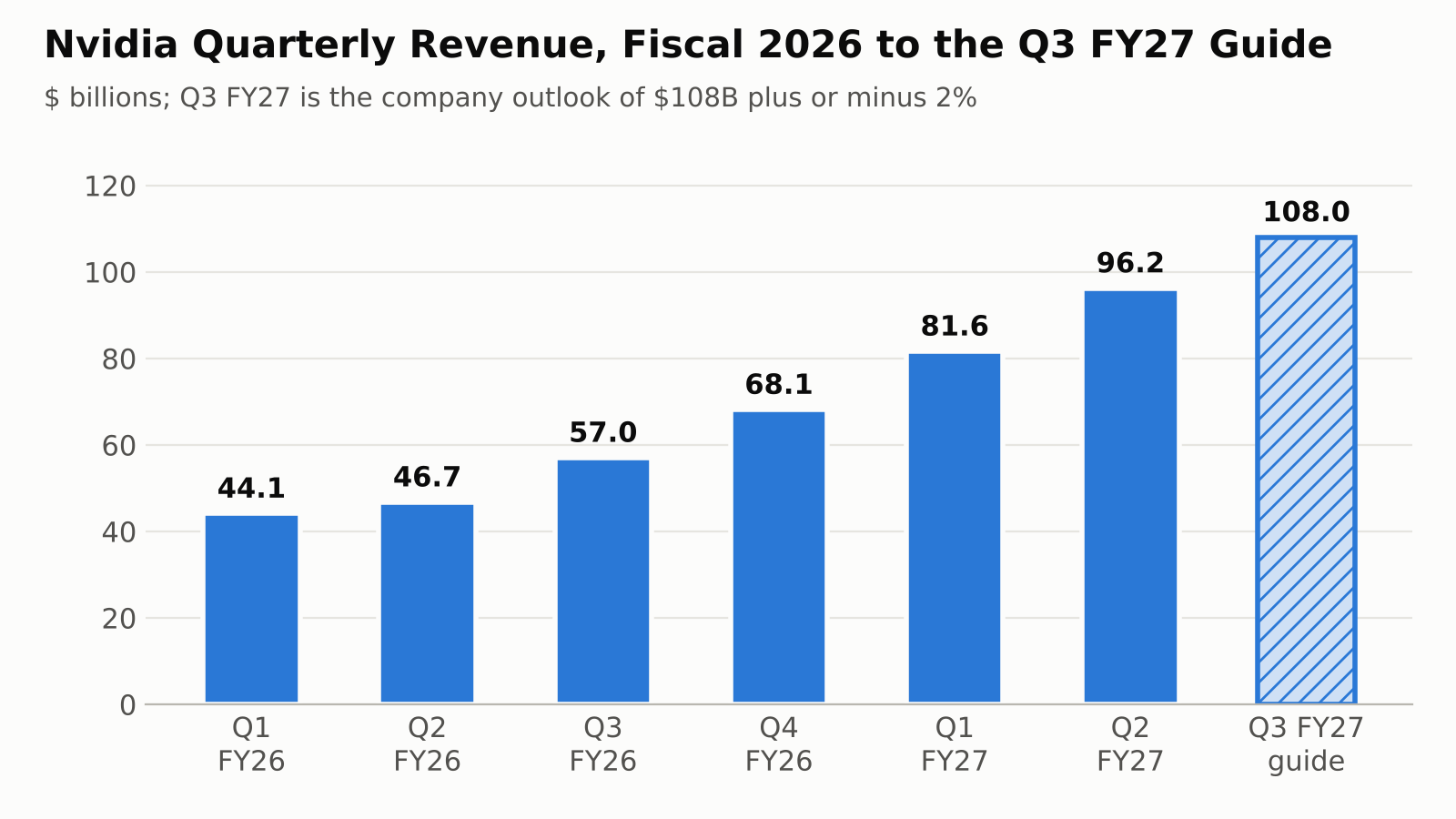
Leadership matters at founder-led companies. Huang was the product strategist, the keynote, and the person customers called. Losing him under a cloud (an admitted affair, and reports that he was the target of a foreign intelligence effort) is worse than an orderly succession. But look at what the board inherited. Revenue went from $44.1 billion in the first quarter of fiscal 2026 to $96.2 billion in the second quarter of fiscal 2027, and management guided the October quarter to $108 billion, plus or minus 2%. That guide assumes no data center compute revenue from China. Visible Alpha consensus sits a little above it at about $109.3 billion. The guided gross margin is 74%.
The forward book is also on paper. Nvidia’s 10-Q showed supply commitments of $279 billion as of July 26, up from $119 billion a quarter earlier, with $92 billion due in the rest of fiscal 2027. Those are mostly purchases of memory and manufacturing capacity. A company does not commit $279 billion to suppliers unless its customers have committed to it first. Amazon Web Services alone has announced plans to deploy another 2 million Nvidia GPUs between now and mid-fiscal 2029. These orders were placed with a company, not a person, and they come with installation schedules and penalties attached.
The moat sits in the same place it did last week. CUDA, the developer base, NVLink and the networking business, and the installed base of code written for Nvidia hardware are the things a customer would have to abandon to switch. None of that walked out with the CEO. Rubin is ramping on the existing roadmap, and the Blackwell transition is already priced into the guide. The engineering organization that took revenue from $44 billion to $96 billion a quarter in fifteen months is still there.
Kress is also a known quantity to the people who matter most tonight. She has run Nvidia’s finances since September 2013, delivered every earnings call alongside Huang, and owns the guidance process. For tonight’s report specifically, the interim CEO is the person who built the numbers. Investors who worried about a stranger reading the script can relax on that point.
What to watch in the print is narrow. First, whether revenue lands above the $109 billion consensus or only inside the $105.8 to $110.2 billion guide range, since an in-range number can still disappoint a stock that already fell more than 20% in a month. Second, the Q4 guide and any comment on Rubin’s contribution. Third, gross margin against the 74% guide. Fourth, any update on supply commitments, because that line is the best read on what customers have locked in for 2027.
The valuation reset is the opportunity here. The shares fell from $239 to the $150-160 area while the last reported quarter’s revenue doubled year on year. A founder departure under scandal deserves a discount for a quarter or two. It does not erase the world’s largest backlog of accelerated computing demand. If tonight’s numbers clear the bar and Kress gives a steady Q4 guide, the leadership question becomes a governance story rather than a growth story, and growth is what the market pays Nvidia for. More on the chip tape: why the semiconductor selloff and the AI cycle are telling different stories.
