On November 5 the PHLX Semiconductor Index fell 1,257 points, or 12.25%, to close at 9,011.14. It was the second-largest one-day drop in the index’s history and the biggest since the 15.9% fall of March 16, 2020. Roughly $1.5 trillion of chip market value disappeared in one session. The close left the index 38.4% below its June 22 record of 14,634.72, and the first close under 10,000 since late April.
Chip stocks are priced on expectations, which makes them fragile at the top. Micron had rallied more than 300% earlier this year and was the SOX’s best performer before the sell-off began. When everyone owns the same story, a hint that growth might slow from extraordinary to merely strong is enough to empty the room. Concerns about debt-funded AI capacity, a sharp tech selloff in Korea, and then Jensen Huang’s exit from Nvidia gave holders reasons to sell in quick succession.
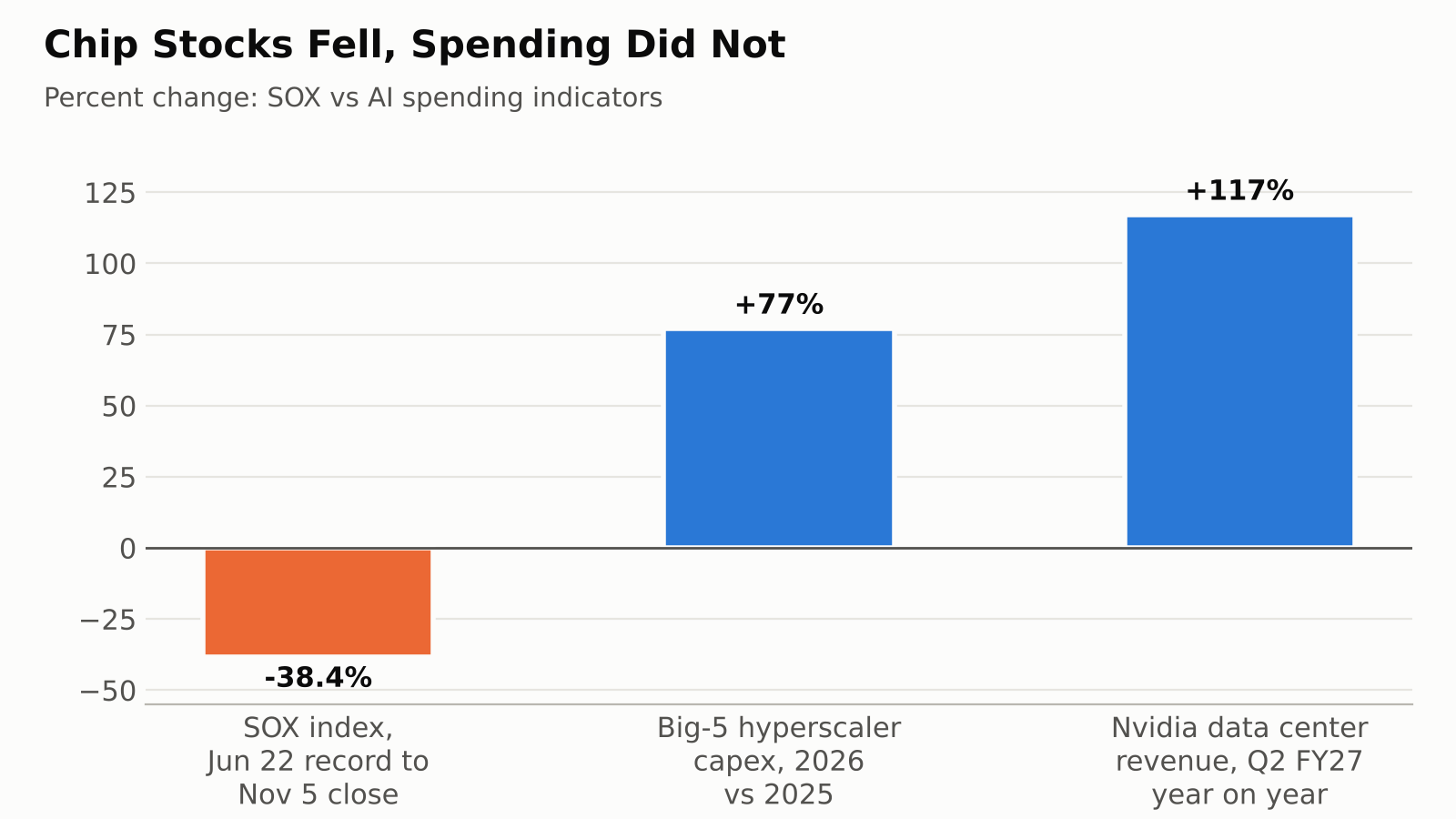
The spending side tells a different story. The five largest hyperscalers (Amazon, Alphabet, Meta, Microsoft and Oracle) are projecting about $725 billion of capital expenditure in 2026, up 77% from last year’s record. Nvidia’s data center revenue rose 117% year on year in its July quarter, to $89 billion. Its 10-Q showed $279 billion of supply commitments, mostly memory and manufacturing capacity, with $92 billion due before the end of January. Those are orders with delivery dates. A stock-market cycle can turn in a week. A deployment cycle with this much contracted spend behind it turns over quarters, if at all.
The deployment cycle is also widening. Training clusters started it. Inference is a growing share of new demand, and inference spreads compute across far more locations and customers: enterprise software, coding agents, robotics, drug discovery, industrial control. Each of those needs a different mix of accelerators, memory, advanced packaging, networking and storage. A broader workload base makes demand steadier, because it no longer rests on a handful of frontier labs deciding how big their next model run will be.
Falling unit costs are part of that story, and they are often misread. Nvidia says its Vera Rubin platform is designed to cut inference cost by up to ten times. Cheaper inference does not shrink the market. It makes applications that were uneconomic last year profitable this year, which brings in new users and more tokens. Cloud storage and bandwidth followed the same path: price per unit fell for two decades while total spending kept rising.
Within semiconductors the exposures differ. GPU and custom-accelerator designers carry customer concentration and the risk of hyperscaler in-sourcing. Memory makers run their own supply cycle, and DRAM and NAND pricing is set by how fast the top producers add wafers, not only by AI demand. Networking and optical suppliers sell into every cluster regardless of whose chip is inside. Equipment makers live on fab capex timing, which lags the rest. A single index move hides all of that, and the November selling was indiscriminate across the index. That is where selection pays.
The checks for each name are concrete: is the product in the current build, how concentrated are the customers, is inventory building at distributors, and does the company have pricing power or is it taking orders at any price. Companies passing those tests have fallen with the index while their order books have not.
The selloff has repriced the sector to something closer to its earnings. The AI computing cycle that the earnings depend on is still running at the pace hyperscaler budgets and supplier commitments describe. When those two lines diverge this far, the gap tends to close from the price side. Tonight’s Nvidia report is the next data point. See what to watch in Nvidia’s print.
