Diversification has had a rough reputation since 2022. Stocks and bonds have tended to fall together in inflation scares, and Allianz Trade’s analysis this summer put the stock-bond correlation since mid-2022 at around +0.77. IMF researchers date the break to the end of 2019. Morningstar’s data show the correlation dipped back below zero in 2025, but this year’s oil shock and rising long-term yields brought the old worry straight back. With the 10-year Treasury back above 5% and AI stocks selling off at the same time, many investors feel the old cushion has gone.
This month has added to that feeling. Amazon, Nvidia and Tesla have all entered correction territory, Meta dropped into a bear market earlier in November, and Broadcom and AMD have also fallen more than 10% from their highs. The Philadelphia Semiconductor Index closed 38% below its June record after its November 5 rout. When the market’s largest weights fall together, a cap-weighted index offers little shelter.
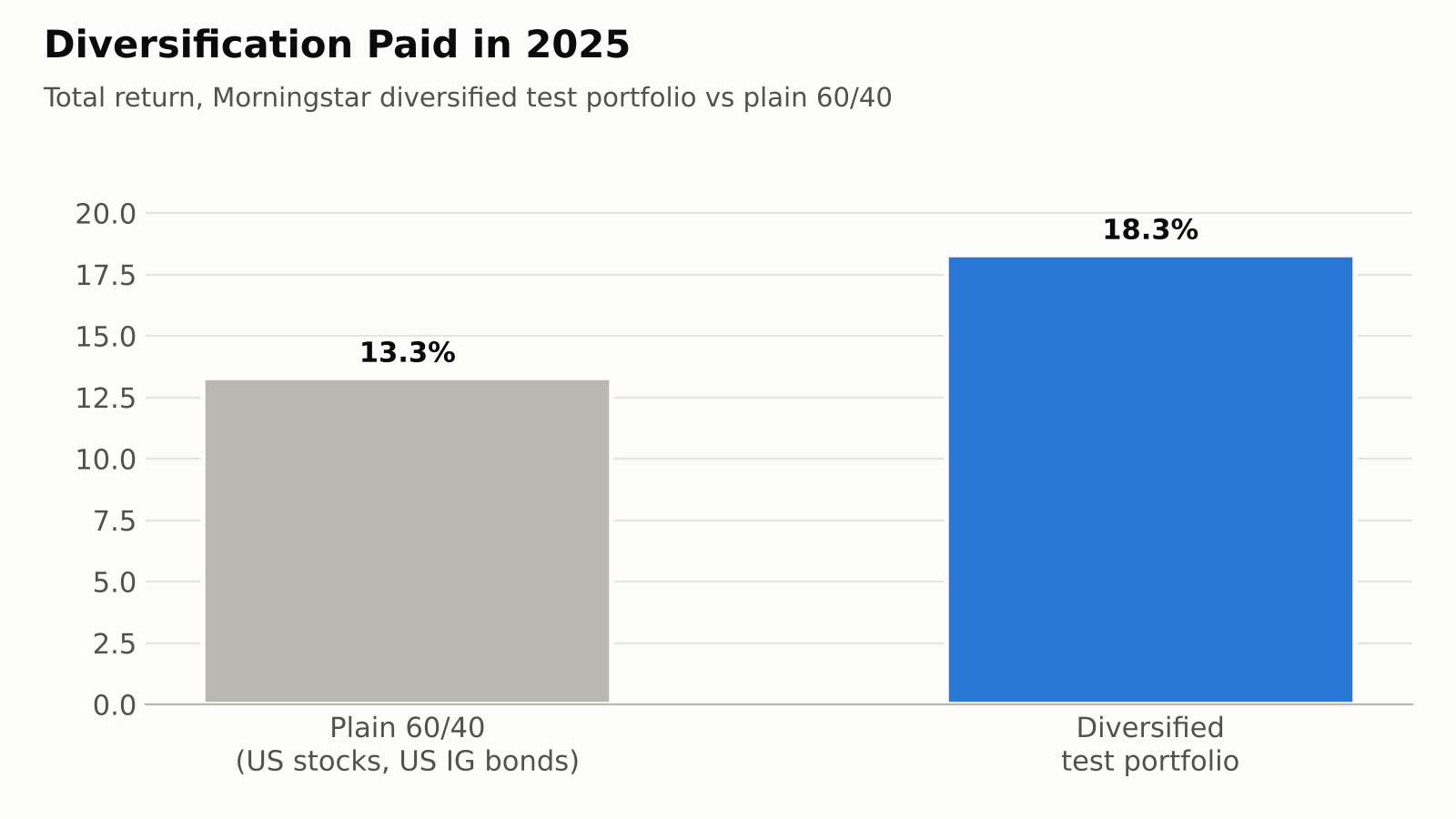
The evidence says diversification still works when it is done across genuinely different return drivers. Morningstar’s 2026 Diversification Landscape found that a broadly diversified test portfolio returned about 18.3% in 2025, against 13.3% for a plain 60/40 mix of US stocks and US investment-grade bonds. That five-point gap was the biggest win for diversification since 2009. Non-US stocks beat US stocks, and gold rose by nearly 70%. The lesson is that bonds alone stopped being enough. Owning several kinds of asset kept working.
AQR made a related point this year: a positive stock-bond correlation is a poor reason to add more equity risk, because a 60/40 portfolio was always driven mostly by its equity sleeve. The fix is to widen the set of things you own rather than abandon the idea.
The AI theme makes this easier than it was a year ago, because the buildout now runs through a much wider slice of the economy than a few chip designers. The big five hyperscalers expect to spend about $725 billion on capex in 2026. That money buys transformers, switchgear and cooling systems, fiber and optical modules, power generation and grid connections, construction services and land. In Southeast Asia alone, Malaysia has more than 1,000 MW of data center capacity under construction and Thailand about 860 MW. These businesses are paid for building and powering capacity, whoever’s chip ends up inside it and whatever happens to GPU prices.
Further out, the users of AI form a separate group again. Insurers, banks, hospital systems, logistics firms and manufacturers that cut costs with AI tools earn the benefit as margin, and their stocks do not trade on Nvidia’s guidance. Their revenue depends on their own markets. That makes them a useful counterweight to the infrastructure names, which share one capex cycle.
A diversified AI portfolio should still be selective. Calling a company “AI-exposed” proves nothing. The useful questions are how much incremental revenue actually comes from AI, whether returns on that investment exceed the cost of capital at today’s 5% rates, and how much of the business depends on a single spending cycle. Geographic diversification counts as well: Japanese, Korean, Taiwanese and European suppliers sit at different points of the chain and trade on different local factors.
AI is spreading through the economy rather than staying concentrated in a handful of megacaps, and the current drawdown in those megacaps is the moment that difference becomes visible. Investors who spread exposure across builders, suppliers and users get more ways to participate in the theme and less dependence on any one stock’s next earnings call. Related: who sold tech this month, and who bought.
