The technology selloff of the last month has a clear seller. Goldman Sachs prime brokerage data showed hedge funds selling roughly $20 billion of tech stocks over two weeks into early November, close to the $23 billion unwind they recorded in July. Long sales outpaced new short sales by about 3.5 to 1, so this was managers cutting exposure, not building bearish bets. Morgan Stanley’s data showed hedge funds cutting overall exposure by about 7.8%, the largest reduction since that series began in 2016.
That kind of selling feeds on itself for a while. Falling prices hit risk limits, risk limits force more sales, and a stock with healthy fundamentals can be sold simply because it was crowded. Long global semiconductors was named the most crowded trade in Bank of America’s October fund manager survey, and that survey had fund managers a net 37% overweight technology, the biggest tilt since August 2020. Crowded trades unwind hard. They also stop unwinding once the leveraged holders are done.
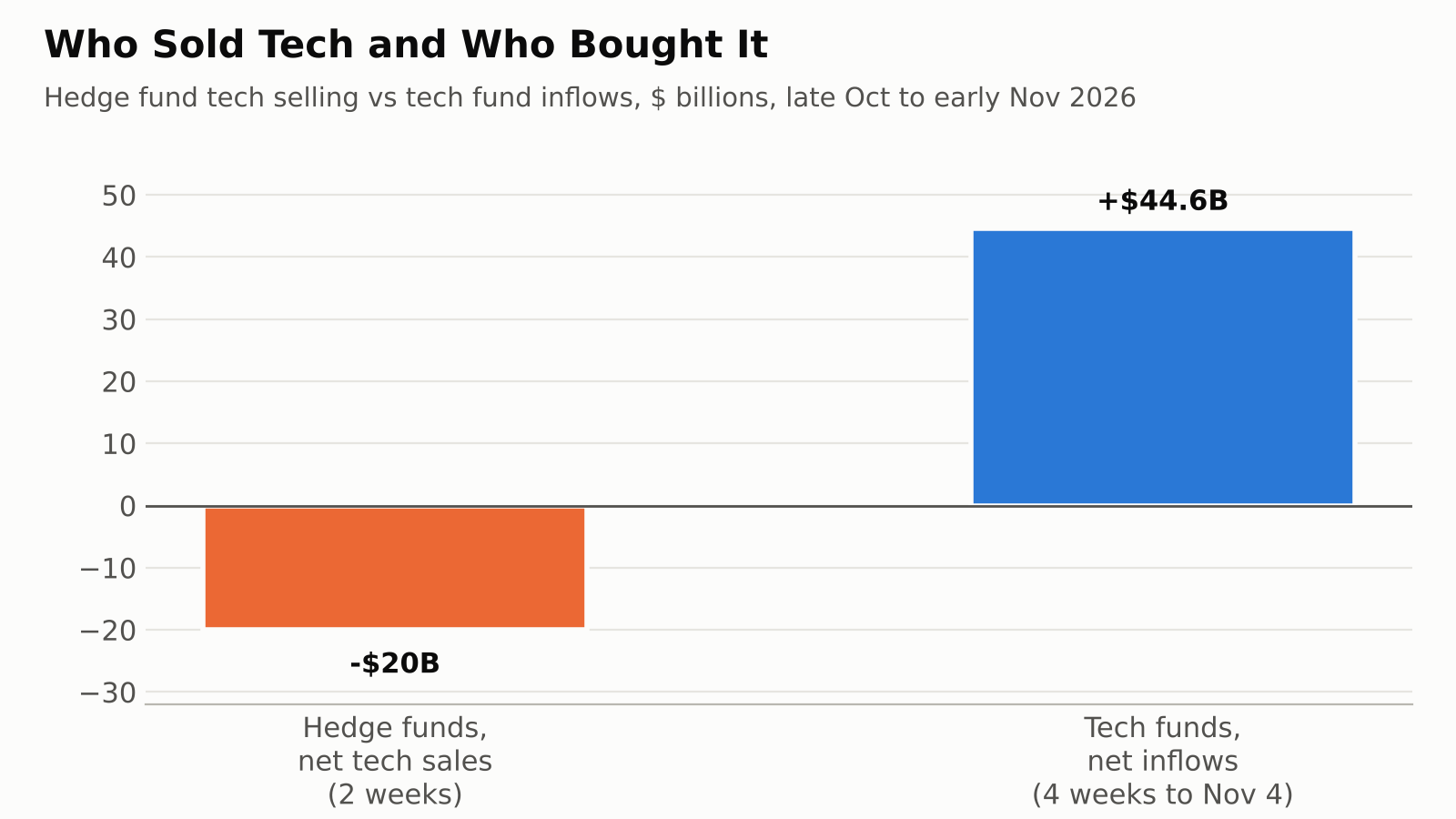
The other side of the trade is the interesting part. Bank of America’s weekly flow data showed technology funds taking in $9.8 billion in the week to November 4 and $44.6 billion over four weeks, the most since July. Global equity funds took in a record $265.6 billion over the same four weeks. On the day Jensen Huang resigned, retail investors bought about $111 million of Nvidia in the first half hour of trading, the biggest opening bid on record for the stock. Fast money sold. Slow money and retail bought.
That pattern matters because of who holds the shares afterward. Hedge fund books are levered and have short horizons, so their ownership amplifies every drawdown. Fund and ETF holders tend to rebalance on schedules and hold through volatility. A transfer of tech ownership from the first group to the second makes the shareholder base sturdier, even if it costs a few weeks of price pain. Hedge funds still hold a lot: tech was 23.5% of Goldman’s global prime book after the selling, in the 90th percentile of the last five years. But the marginal leveraged seller has been working for a month.
Positioning is not a timing tool on its own. A sector can stay out of favor for months, and a lower price is not proof of value. The opportunity shows up when prices fall faster than reasonable estimates of future cash flow. That is the test to apply now. The Philadelphia Semiconductor Index closed 38% below its June record after the November 5 rout, while the big five hyperscalers still plan about $725 billion of capex this year, up 77%. Nvidia’s last reported quarter showed data center revenue up 117% year on year. Prices and fundamentals have separated.
Not every name deserves the same treatment. Investors can sort technology holdings by a few plain measures: recurring AI revenue already in the income statement, free cash flow after capex, balance-sheet strength, and customer retention. Companies that fund their investment from operating cash flow can sit out a tight market. Companies that need to raise equity or junk debt every few quarters are the ones a positioning unwind hurts most, and the ones to avoid until the dust settles.
Michael Hartnett’s team at Bank of America called the US midterms the point of peak AI equity concentration and said it prefers tech bonds to tech stocks. That is a reasonable call on concentration. It also tells you that institutional money wants exposure to the same companies, only further up the capital structure, because it trusts their cash flows. That is hardly a vote against AI.
For patient investors, the practical approach is staggered buying in the names with cash flow, sized so that a further drawdown is an opportunity to add rather than a forced sale. The hedge fund unwind has done much of the work of resetting valuations. A healthier relationship between price and progress is the setup that long-term returns come from. Related: diversification inside the AI trade.
