Anthropic set terms on November 10 for an initial public offering of about $61 billion, with a price range of $70 to $78 a share and a listing on the Nasdaq Global Select Market under the ticker ANT. At the midpoint the company would carry a fully diluted market value of about $1.2 trillion, excluding $111 billion of convertible debt. It would be the second-largest IPO ever, behind SpaceX’s $75 billion in June. Pricing and first trade are expected this week.
The real event is the disclosure. For three years the economics of frontier AI were argued from leaks, fundraising decks and guesses about inference costs. The S-1 filed on October 26 puts filed numbers on the table (audited for the full years, unaudited for the first half of 2026), and from now on they arrive every quarter.
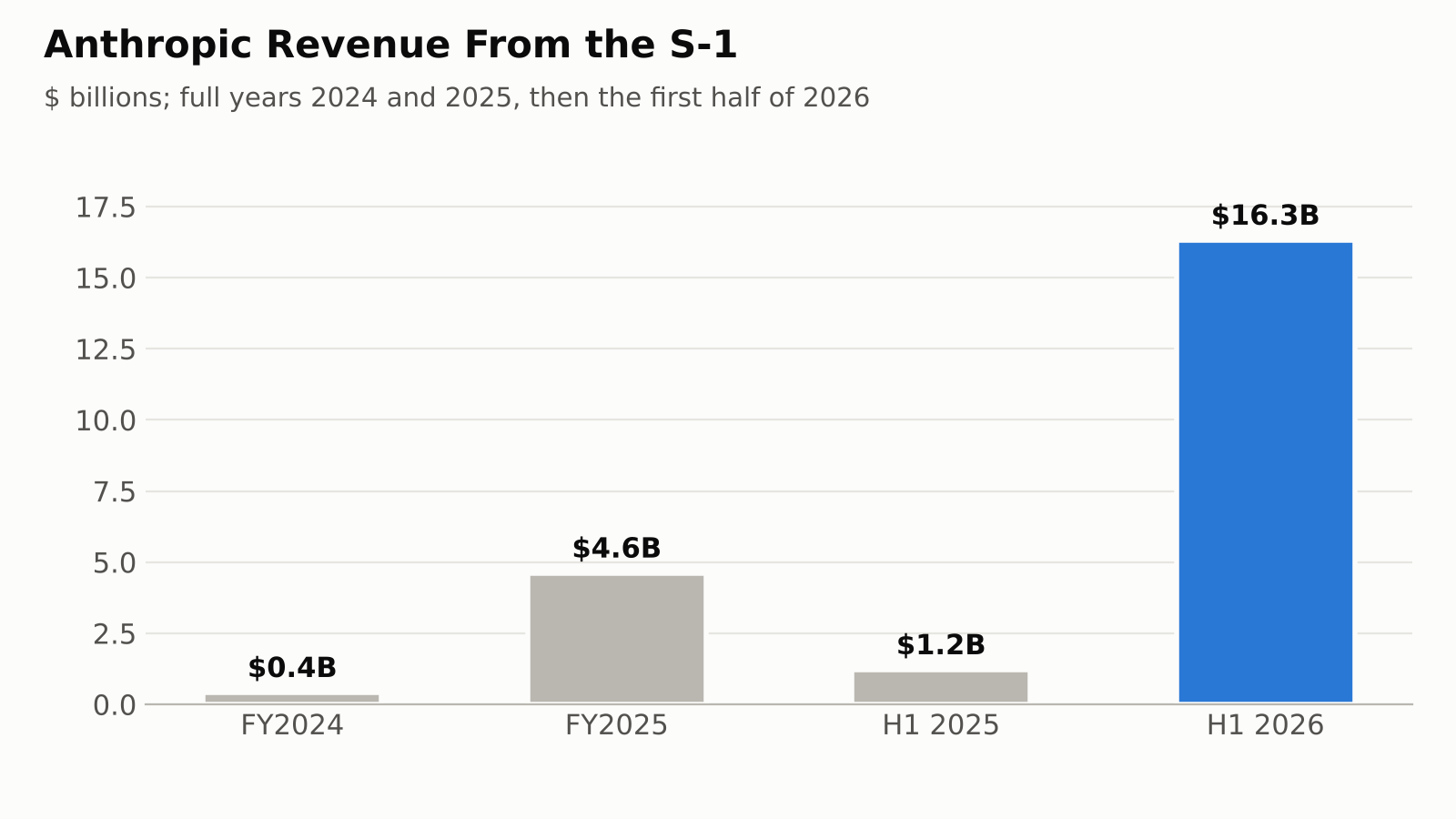
The revenue line is the headline. Anthropic booked about $0.4 billion in 2024 and $4.6 billion in 2025. In the first half of 2026 it booked $16.3 billion, against $1.2 billion a year earlier. Second-quarter revenue alone was $11.6 billion, and the company reported $974 million of operating income for that quarter. Trailing revenue for the twelve months to June 30 was $19.7 billion.
The cost line answers the question bears have asked for two years. Cost of revenue in the first half was $2.4 billion, almost all of it compute and infrastructure. Against $16.3 billion of revenue, that leaves a margin on serving customers of roughly 85%. Model developers were supposed to be stuck with software-like prices and hardware-like costs. At least for this one, serving Claude is a high-margin business, and the losses come from training and from accounting.
The accounting part is large and needs reading carefully. The first-half net loss was $80.7 billion, of which $72.4 billion was a non-cash charge from revaluing convertible notes as the company’s valuation rose. In 2025 the operating loss was about $8 billion, with compute making up more than 91% of it. The swing to an operating profit in Q2 2026 is the number to hold the company to. The other figure to track is commitments: about $265.6 billion of fixed or minimum compute purchases with terms of one to twenty years, owed to cloud and infrastructure partners that include Amazon and Google. That is the bet the company has made on its own growth.
Valuation is easy to compute and hard to anchor. Annualizing the Q2 revenue gives about $46 billion, so $1.2 trillion is roughly 26 times run-rate sales. That is expensive by any software standard and cheap relative to the growth rate, which explains why investors have suggested anything from $1.2 trillion to $2 trillion. The 2026 IPO class has been tough: excluding SpaceX and SK Hynix, more than 100 new listings showed a weighted-average loss of about 4% as of early October. Anthropic will be priced by people who know that.
Public ownership should help the whole sector. Quarterly reporting will allow direct comparison of a model developer with cloud providers and application companies, using the same definitions. Gross margin, enterprise retention, revenue concentration and commitment schedules will be visible instead of rumored. Managers will be judged on customer revenue and operating income rather than benchmark charts and funding rounds. That shift tends to reward the businesses that are actually earning money, and Anthropic’s Q2 says it is one of them.
The first quarters as a public company will be volatile, as they usually are for large tech listings. That volatility is the cost of moving AI from a story priced on expectations to one priced on reported results. Investors get something they have not had before: a frontier lab whose revenue, margins and commitments are reported to the SEC every quarter. For the AI trade as a whole, that is a stronger foundation than another private round. Related: how AI infrastructure is being financed.
