Home Depot reported third-quarter results this morning that beat expectations on the surface. Sales rose 4.9% to $43.4 billion, ahead of consensus near $42.8 billion. Comparable sales grew 2.2%, both overall and in the US, against expectations closer to 1.5%, and adjusted EPS came in at $3.86 versus $3.74 a year ago. The company also named CFO Richard McPhail as its next chief executive.
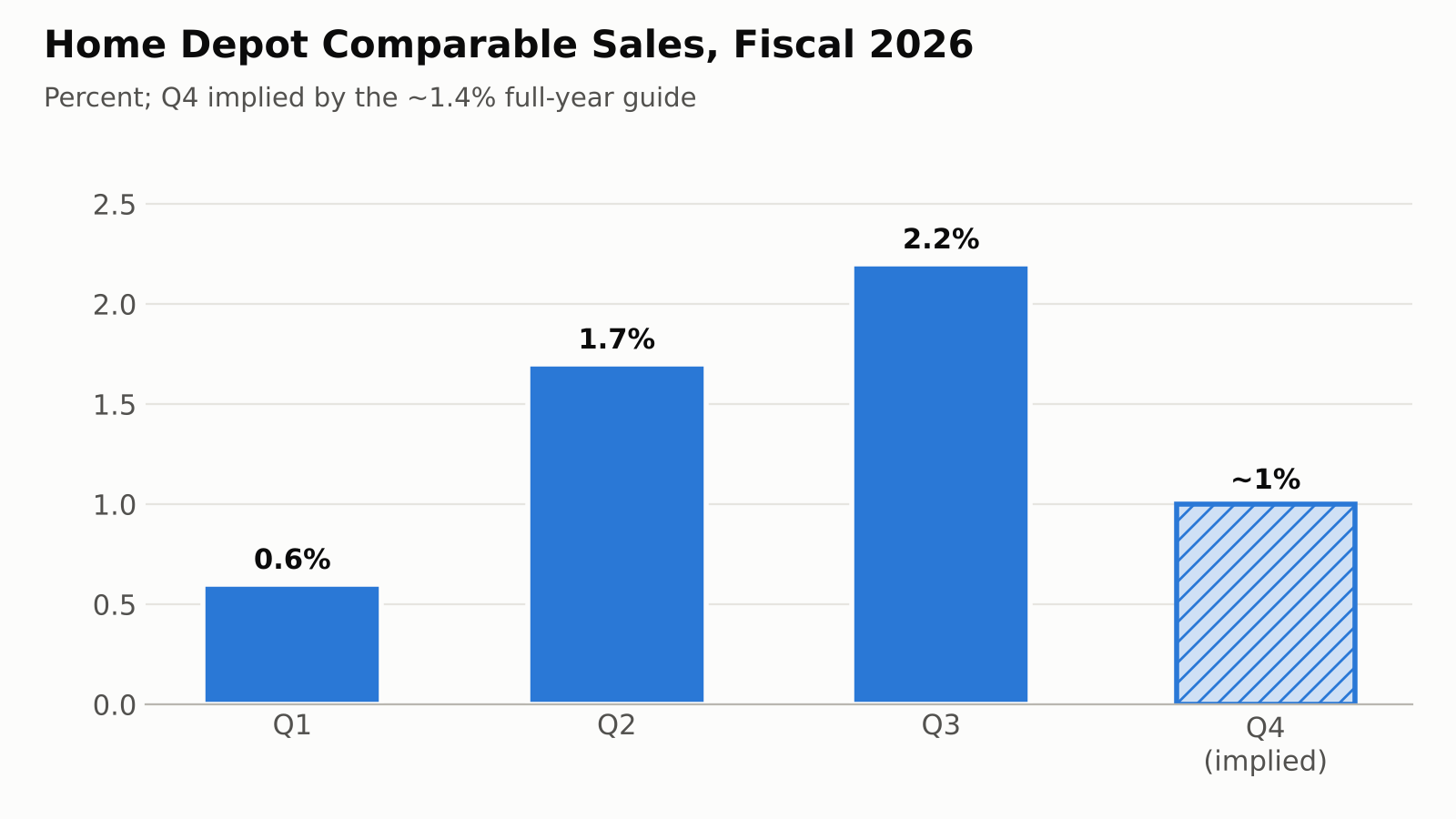
The guidance is where the caution shows. Management set full-year comparable sales growth at about 1.4%, inside its earlier range of flat to 2%. With comps of 0.6% in the first quarter, 1.7% in the second and 2.2% in the third, the full-year figure implies the fourth quarter slows to around 1%. Inside the third quarter, comparable transactions fell 0.5% while the average ticket rose 3%. Customers are paying more per visit and coming in less often. Gross margin narrowed to 32.8% from 33.4% as cost of sales rose 6%, faster than revenue. All this in a quarter when existing home sales ran at only 3.75 million.
One retailer is not the US economy. Home Depot sits right where three pressures meet: 30-year mortgage rates tied to a 10-year Treasury above 5%, a frozen housing turnover market, and services inflation that keeps squeezing household budgets. Still, the pattern in its numbers (higher prices, fewer transactions, margins compressed by costs) is one that many consumer-facing businesses will recognize this holiday season.
When revenue growth is hard to come by, the margin has to come from operations. That is where practical AI tools have a clear job. Inventory forecasting is the obvious one. Home Depot carries tens of billions of dollars of merchandise, and every point of forecasting accuracy releases working capital that now costs 5% a year to fund. Pricing analytics help a retailer pass through cost increases item by item rather than across the board. Logistics planning cuts the cost of moving bulky goods, which matters more with diesel prices still elevated. Customer service tools let stores handle more questions without more labor hours.
The digital channel is already showing the payoff of investment. Home Depot’s online comparable sales grew about 13% in the third quarter, the sixth double-digit quarter in a row, while store transactions fell. Better search, recommendations and fulfilment promises are what turn a website visit into an order, and these are areas where AI-driven tools have measurable effects on conversion.
Consumer-facing AI has limits, and the winners will respect them. Poor recommendations, chatbots that cannot answer a simple question, and intrusive personalization all cost customer trust, and trust is expensive to rebuild in a weak spending environment. The strongest uses are narrow and measurable: fewer stockouts, less markdown, lower cost per order, faster answers to a contractor’s question. Vague promises to reinvent retail will not survive a budget review this year.
The optimistic reading of today’s report is that a slower consumer forces discipline. A retailer facing 1% comps has no room for experiments without a payback, and that is precisely the environment in which useful AI gets adopted and useless AI gets cut. The technologies that protect margins and service quality become more valuable as sales growth gets harder. Related: inflation, diesel and the case for operational AI.
