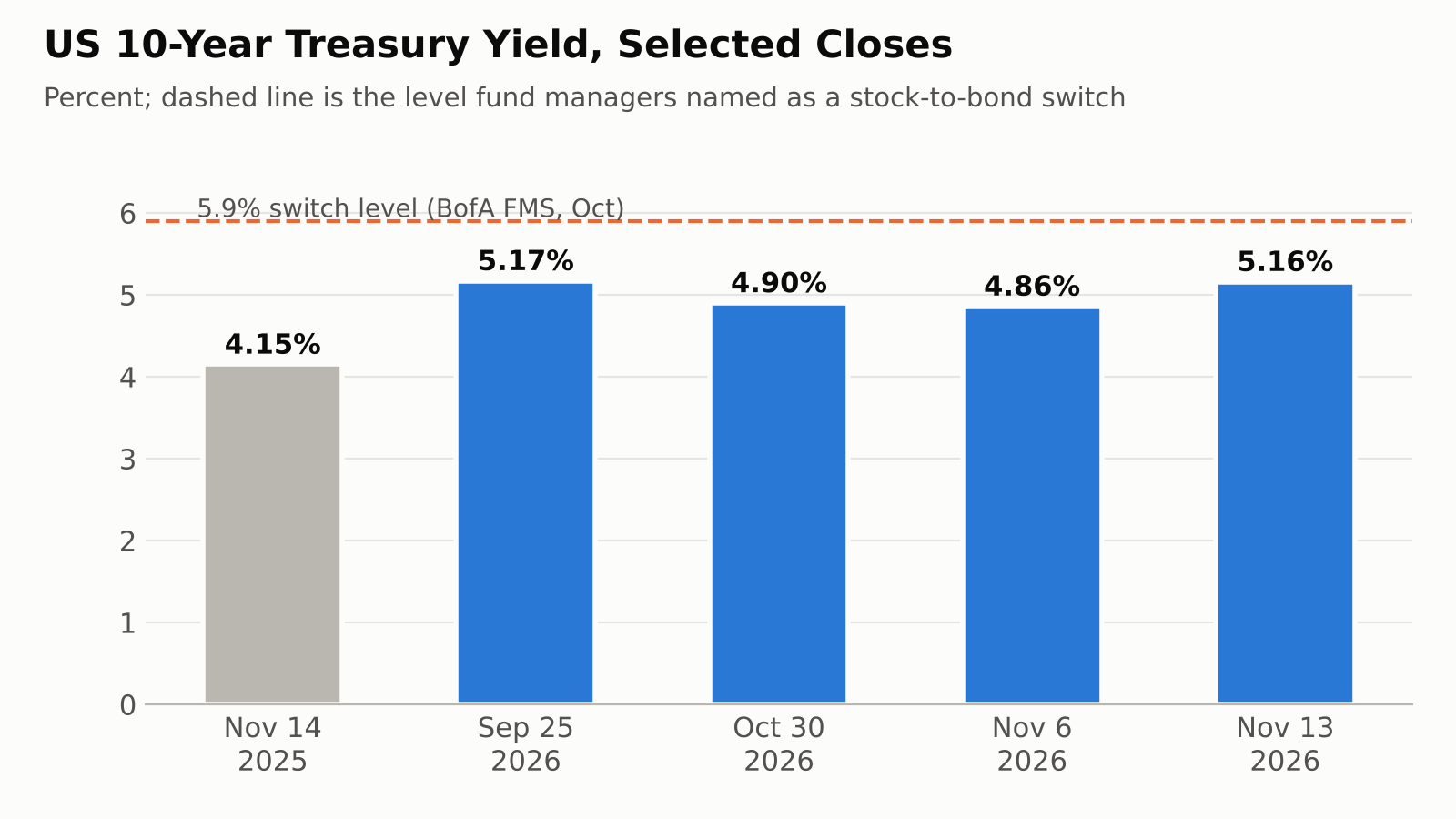
The 10-year Treasury yield rose to 5.16% on November 13, its highest close since October and about 101 basis points above where it stood a year earlier. In late September it pushed past 5.1% for the first time since July 2007 and peaked near 5.20%, and this autumn the 30-year bond briefly traded above 5.6%, a level last seen in 2002. A flight to safety during the late-October AI selloff pulled the 10-year back to about 4.90%, but a hot October CPI report and growing talk of a December rate hike sent it straight back up.
High yields hit long-duration assets in two ways. They raise the cost of borrowing for projects that need years to pay back, and they shrink the present value of profits that sit far in the future. Both apply to AI. Data center developers borrowing in the junk market now pay close to 10%. Growth stocks priced on 2030 earnings lose more value per basis point than utilities do.
The rate shock lands unevenly, though. The companies doing most of the AI spending do not depend on the bond market to keep going. Morgan Stanley’s framework sets about $2.9 trillion of global data center capex through 2028 against roughly $1.4 trillion of hyperscaler operating cash flow. Half the bill is paid from internal cash at a cost of capital that has nothing to do with the 10-year. When the hyperscalers do borrow, they borrow as investment-grade issuers. They have sold more than $370 billion of bonds this year, about a fifth of all US investment-grade issuance, and the market absorbed it at a record pace.
Where the borrowing gets expensive is the bottom of the stack: single-tenant developers, GPU-backed lenders, smaller AI clouds. Higher rates there are a filter, and a useful one. Projects with signed customers and connected power can carry a 10% coupon. Projects built on hope cannot, and they will not get built. That makes the eventual installed base leaner and better utilized.
On the demand side, expensive money increases the value of tools that cut costs. A company facing 5% borrowing costs and slower sales has less room to add headcount and more reason to automate. Software that shortens a sales cycle, a coding assistant that lets a team ship with fewer contractors, a forecasting model that cuts working capital, all of these pay back faster when capital is dear. Working capital tied up in inventory is literally more expensive at 5% than at 2%, so better demand forecasting is worth more in this rate regime than the last one.
For investors the measures that matter in a high-rate market are plain: cash conversion, capital intensity, and payback periods. A company showing AI productivity in its margins today deserves a different multiple from one promising it in 2029. Anthropic’s IPO filing, which shows an operating profit in its June quarter, is the kind of evidence that holds up when discount rates are high. Promises of distant payoffs do not.
There is also a ceiling built into the market. In Bank of America’s October fund manager survey, investors said a 10-year yield of 5.9% would prompt a shift out of stocks and into bonds. At 5.16% the market is still well short of that line. Until it gets there, equity investors are paying for growth even at today’s rates, which suggests they expect AI-driven earnings to outrun the higher discount rate.
Yields near 5% will make AI investment more selective. They will not remove the reason companies adopt it, which is that it lets them do more with fewer resources. That incentive gets stronger, not weaker, when money is expensive. Related reading: what October’s CPI says about inflation and efficiency.
