• Skip to main content
  • Skip to secondary menu
  • Skip to footer

Market Analysis

Connecting the Dots, Quantifying Technology Trends & Measuring Disruption

  • AI Market Analyzer
  • Tech News
    • Project Dashboard
  • Domain Marketplace
  • Sponsored Post
  • About
  • Contact

AI Credit Risks Are Real, but the Infrastructure Boom Has Stronger Foundations Than Bears Admit

November 17, 2026

Goldman Sachs’ credit strategists counted $296 billion of AI hyperscaler debt supply this year as of November 5. Their forecast for all of 2026 was $250 billion. They now expect $440 billion in 2027, and say almost all of the increase will come from private credit, which is mostly unrated. Those numbers are why AI financing became the market’s favorite worry this autumn.

The worry is fair as far as it goes. Long-lived buildings are being financed against GPUs that lose value fast, and a campus leased to one tenant on a short contract carries real renewal risk. But “AI debt” is not one asset. It is at least two very different credits that happen to share a headline, and the market has started to price them differently. That is the healthy part.
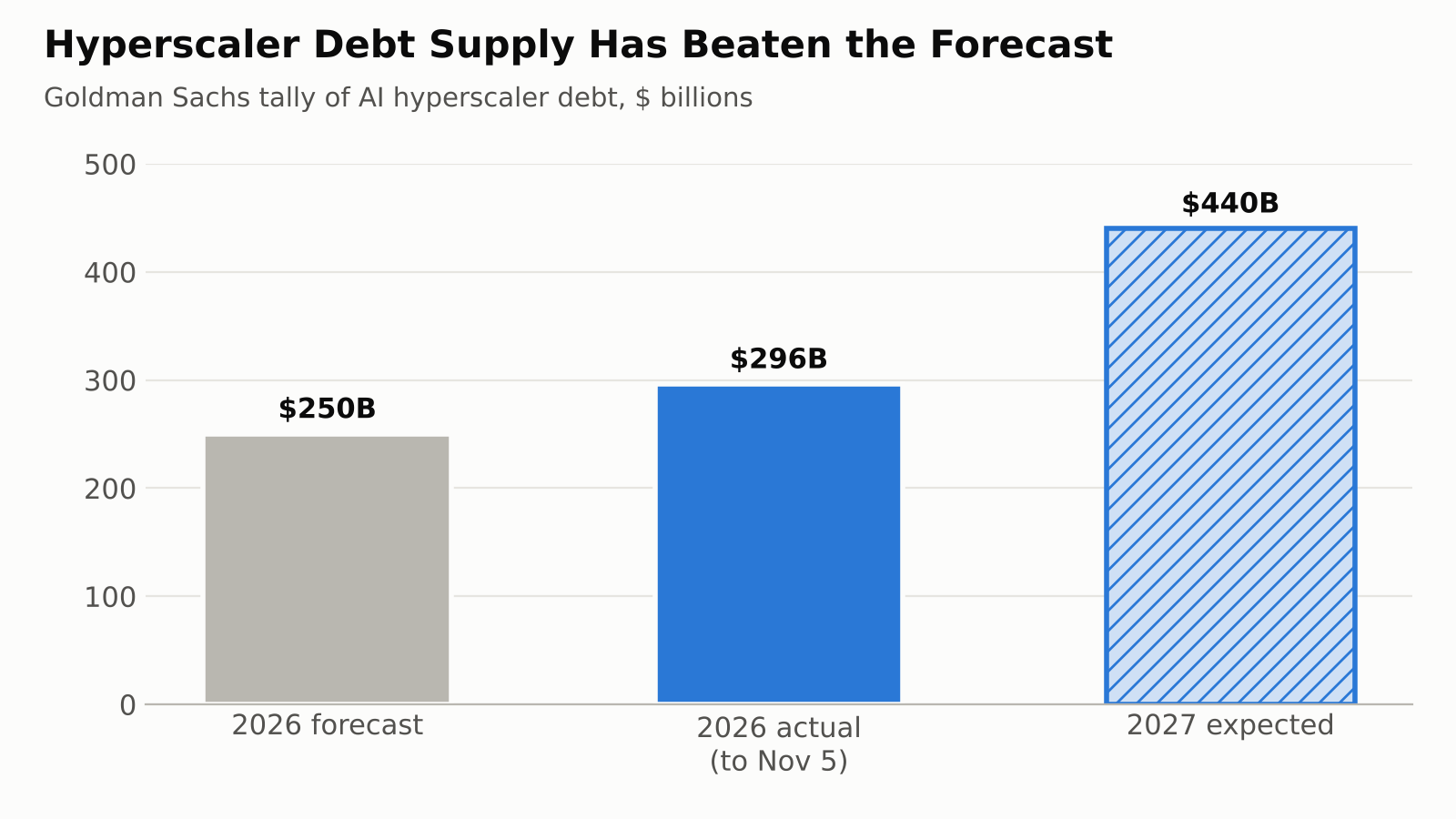
Bar chart: hyperscaler debt supply, $250B 2026 forecast, $296B actual to Nov 5, $440B expected in 2027

Start with the top of the stack. US companies sold $1.88 trillion of investment-grade bonds through November 4, a record that beat the $1.86 trillion of 2020. Hyperscalers accounted for more than $370 billion of it, about a fifth, with Amazon and Alphabet the largest borrowers. These are issuers with enormous operating cash flow. Morgan Stanley’s framework puts global data center capex at roughly $2.9 trillion through 2028 against about $1.4 trillion of hyperscaler operating cash flow. So yes, there is a financing gap, about $1.5 trillion. But more than half the bill is covered from internal cash before a single bond is sold, and the bonds that are sold come from companies whose default probability is close to the sovereign’s.

The bottom of the stack looks different, and it is being treated differently. Junk-rated data center bond issuance reached roughly $37 billion this year against about $8.6 billion in all of 2025. By mid-October average yields on those bonds were close to 10%, and the jump happened in about a week. Yields on the better data center paper rose toward 7% from under 5% earlier in the year. That is not a market that has stopped asking questions. It is a market charging a leveraged developer with one tenant a lot more than it charges Amazon.

That repricing is the mechanism that keeps a buildout from turning into a bubble. In 1999 the telecom credit market lent to everyone at similar spreads until it lent to no one. In 2026 the spread between a hyperscaler’s own bond and an off-balance-sheet campus SPV is already wide, and it widened in weeks. Weak projects will find capital expensive or unavailable. The projects that clear a 10% cost of debt are the ones with signed take-or-pay contracts and power already secured, and those are exactly the ones you want built.

The structures themselves have improved too. Meta’s $27 billion joint venture with Blue Owl for the Hyperion campus in Louisiana put a private-credit balance sheet behind a facility whose sole user is one of the most profitable companies in the world. Lease backstops, residual-value guarantees and step-in rights are now standard asks. A lender to a data center in 2026 usually has a hyperscaler’s credit somewhere in the chain. That was not true of the fiber-to-nowhere loans of the dot-com era.

Demand is the other half of the coverage ratio. Nvidia guided its October quarter to $108 billion of revenue, and its own 10-Q showed supply commitments of $279 billion as of late July, mostly for memory and manufacturing capacity. The big five hyperscalers are projecting about $725 billion of capex in 2026, up 77%. Capacity in the tightest markets is full on arrival: Johor’s colocation vacancy rate is 0.7%. Debt raised against capacity that customers are queuing for is a very different instrument from debt raised against hope.

For investors the useful questions are specific. Who is the tenant, and what is the contract tenor against the debt maturity? Is the power connected or merely applied for? Does the borrower have a parent with cash flow, or only a GPU fleet as collateral? Debt service coverage, customer concentration and utilization will separate the winners from the casualties. Some casualties are coming, especially among single-tenant developers that financed at the top. That would be the credit cycle doing its job.

The constructive case does not require every borrower to survive. It requires the market to keep doing what it did in October: lend cheaply to cash-generating platforms, lend dearly to speculative builders, and refuse the worst deals outright. On the evidence of this autumn’s spreads, it is doing exactly that. AI compute is turning into a utility-like layer of the economy, and capital markets are learning to finance it the way they finance utilities, with a premium for leverage and a discount for contracts. Related reading on this site: how 5% Treasury yields change the AI math.

Filed Under: Reports Tagged With: AI infrastructure, credit markets, data centers, hyperscalers, private credit

Footer

Recent Posts

  • A Cautious American Consumer Makes the Case for Practical AI Even Stronger
  • Diversification Still Works, and AI Creates More Opportunities Than One Technology Trade
  • Oil Volatility and Inflation May Accelerate the Search for AI-Driven Efficiency
  • High Treasury Yields Cannot Cancel the Productivity Potential of Artificial Intelligence
  • Anthropic’s IPO Could Mark the Beginning of a More Accountable AI Investment Era
  • Semiconductor Stocks Are Falling, but the AI Computing Cycle Is Far From Finished
  • Technology Fund Selling Could Create Opportunities for Patient AI Investors
  • AI Chip Export Controls May Redirect Investment Rather Than Stop Global AI Growth
  • Nvidia After Jensen Huang, Why the AI Chip Leader Still Has a Powerful Future
  • AI Credit Risks Are Real, but the Infrastructure Boom Has Stronger Foundations Than Bears Admit

RSS feed: Market Research Media Market Research Media

  • Four Vendor Surveys on Missed AI Returns Each Find the Problem Their Sponsor Sells a Fix For
  • Wasabi Study Puts Unplanned Infrastructure Spending at $63.4 Billion, With Germany Overspending by 7.1 Billion Euros
  • CSC Survey Finds 88% of Private Capital GPs Spend Up to Half Their Finance Time Checking Administrator Work
  • Lenovo Survey Finds 80% of IT Leaders Tie AI Success to the Digital Workplace and Only 10% Have Redesigned It
  • Claude and ChatGPT Integrations Killed the Headless CMS Market
  • Survey Margin of Error Explained, What Plus or Minus 3 Points Covers and What It Leaves Out
  • Morgan Stanley Pulse Survey Finds Bearish Investor Sentiment Rising to 42 Percent as Inflation Fears Grow
  • A Stronger Week Across the Network, October 4–10, 2026
  • The Tariff Map Is Becoming an Industrial Policy Map—and the U.S. Economy Is Paying the Price
  • PC Shipments Fall 22.4% as Higher Component Costs Price Buyers Out

Media Partners

  • Analysis
  • Technology Conferences
  • OSINT
  • Defense Market
  • Cybersecurity Market
  • Event Calendar
  • Calendarial
  • Opinion
  • 3V
  • Media Presser
  • Exclusive Domains

Copyright © 2026 MarketAnalysis.com | Terms of Service | Privacy Policy | Supplier Disclaimer | The Website Coded and Designed by SoftDev Studio

Media Partners: Technologies | Photography | Referently

We use cookies on our website to give you the most relevant experience by remembering your preferences and repeat visits. By clicking “Accept”, you consent to the use of ALL the cookies.
Do not sell my personal information.
Cookie SettingsAccept
Manage consent

Privacy Overview

This website uses cookies to improve your experience while you navigate through the website. Out of these, the cookies that are categorized as necessary are stored on your browser as they are essential for the working of basic functionalities of the website. We also use third-party cookies that help us analyze and understand how you use this website. These cookies will be stored in your browser only with your consent. You also have the option to opt-out of these cookies. But opting out of some of these cookies may affect your browsing experience.
Necessary
Always Enabled
Necessary cookies are absolutely essential for the website to function properly. These cookies ensure basic functionalities and security features of the website, anonymously.
CookieDurationDescription
cookielawinfo-checkbox-analytics11 monthsThis cookie is set by GDPR Cookie Consent plugin. The cookie is used to store the user consent for the cookies in the category "Analytics".
cookielawinfo-checkbox-functional11 monthsThe cookie is set by GDPR cookie consent to record the user consent for the cookies in the category "Functional".
cookielawinfo-checkbox-necessary11 monthsThis cookie is set by GDPR Cookie Consent plugin. The cookies is used to store the user consent for the cookies in the category "Necessary".
cookielawinfo-checkbox-others11 monthsThis cookie is set by GDPR Cookie Consent plugin. The cookie is used to store the user consent for the cookies in the category "Other.
cookielawinfo-checkbox-performance11 monthsThis cookie is set by GDPR Cookie Consent plugin. The cookie is used to store the user consent for the cookies in the category "Performance".
viewed_cookie_policy11 monthsThe cookie is set by the GDPR Cookie Consent plugin and is used to store whether or not user has consented to the use of cookies. It does not store any personal data.
Functional
Functional cookies help to perform certain functionalities like sharing the content of the website on social media platforms, collect feedbacks, and other third-party features.
Performance
Performance cookies are used to understand and analyze the key performance indexes of the website which helps in delivering a better user experience for the visitors.
Analytics
Analytical cookies are used to understand how visitors interact with the website. These cookies help provide information on metrics the number of visitors, bounce rate, traffic source, etc.
Advertisement
Advertisement cookies are used to provide visitors with relevant ads and marketing campaigns. These cookies track visitors across websites and collect information to provide customized ads.
Others
Other uncategorized cookies are those that are being analyzed and have not been classified into a category as yet.
SAVE & ACCEPT